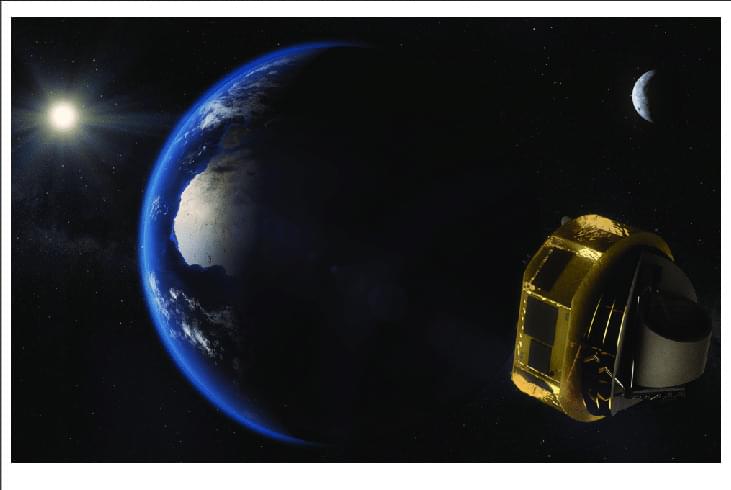
Astronomers want to collect as much data as possible using as many systems as possible. Sometimes that requires coordination between instruments. The teams that run the James Webb Space Telescope (JWST) and the upcoming Atmospheric Remote-sensing Infrared Exoplanet Large-survey (Ariel) missions will have plenty of opportunity for that once both telescopes are online in the early 2030s. A new paper, available in pre-print on arXiv, from the Ariel-JWST Synergy Working Group details just how exactly the two systems can work together to better analyze exoplanets.
JWST has already been at the center of media attention since even before its launch in late 2021. It is currently the most capable of our space-based observatories, but it is a multi-purpose tool that has a long line of scientists waiting to get time on it.
Capable of observing everything from far-away black holes to interstellar comets passing through our own solar system, JWST has absurdly high resolution but lacks the sheer amount of time it takes to observe some exoplanets fully. In addition, in some cases it’s too sensitive, as exceptionally bright stars, which are great for observing exoplanet atmospheres, are powerful enough to saturate the detectors on JWST, making it useless to track exoplanets orbiting those types of stars.
Space is huge, immense beyond our wildest dreams. In order to explore and settle it, we’ll need to learn to dream a lot bigger and bolder than ever before.
Have you ever felt like the world around you isn’t exactly… “real”? Modern physics is starting to suggest something incredible: The universe isn’t made of atoms, energy, or particles. It is made of Information. In this video, we explore the radical “It from Bit” theory and the Holographic Principle. From the mysterious paradoxes of Black Holes and Hawking Radiation to the way quantum entanglement might actually create the fabric of space and time, we dive deep into the mind-bending reality of quantum mechanics. In this video, we cover: Why Stephen Hawking conceded the Black Hole Information Paradox. The Ryu-Takayanagi formula: How entanglement builds geometry. Why 3D space might just be a 2D holographic projection. The “It from Bit” philosophy by John Wheeler. How consciousness relates to Integrated Information Theory (IIT). If reality is just a pattern of qubits in a vast Hilbert space, what does that make us? Join us as we deconstruct the material world and look at the “source code” of the universe. #QuantumPhysics #HolographicUniverse #ItFromBit #TheoreticalPhysics #ScienceDocumentary #SpaceTime #quantuminformation
Last year, our most detailed map of the universe yet suggested our understanding of dark energy has been wrong for decades. The shock result is reigniting the search for a better cosmic story
A viral post claimed that a mysterious force passed through the Milky Way without light or warning. But what are astronomers actually observing? In this video, we break down the real science behind high-velocity gas clouds, dark matter halos, and how our galaxy continues to evolve.
#jameswebbspacetelescope #jwst. Finally Released! The James Webb Telescope Has Found The Object That Holds Our Universe Together.
Containing nearly 800,000 galaxies, this image from NASA’s James Webb Space Telescope is overlaid with a map of dark matter, represented in blue. Researchers used Webb data to find the invisible substance via its gravitational influence on regular matter.
You see, Scientists using data from NASA’s James Webb Space Telescope have made one of the most detailed, high-resolution maps of dark matter ever produced. It shows how the invisible, ghostly material overlaps and intertwines with “regular” matter, the stuff that makes up stars, galaxies, and everything we can see.
Published Monday, Jan. 26, in Nature Astronomy, the map builds on previous research to provide additional confirmation and new details about how dark matter has shaped the universe on the largest scales — galaxy clusters millions of light-years across — that ultimately give rise to galaxies, stars, and planets like Earth.
💼 Business Inquiries and Contact. • For business inquiries, copyright matters or other inquiries please contact us at: [email protected].
Workshop on quantum aspects of black holes and spacetime.
Topic: Comments on the Hartle-Hawking state and observers. Speaker: Ying Zhao. Affiliation: Massachusetts Institute of Technology. Date: December 3, 2025 Wolfensohn Hall.
It was argued that any fixed holographic theory contains only one closed universe state and hence fails to give semi-classical physics. It was proposed that this problem can be resolved by including a classical observer living inside the universe. Earlier works focused on closed universes connected with asymptotic Euclidean boundaries. In this talk we examine the case of Hartle-Hawking state where the dominant Euclidean topology is a sphere. We show that different features emerge. We comment on the potential implications for the understanding of de Sitter space. Based on work with Daniel Harlow.