Anthropic’s Claude Opus 4.6 AI found 22 Firefox vulnerabilities, including 14 high severity, helping Mozilla patch flaws in Firefox 148.


Cybersecurity researchers have discovered a malicious npm package that masquerades as an OpenClaw installer to deploy a remote access trojan (RAT) and steal sensitive data from compromised hosts.
The package, named “@openclaw-ai/openclawai,” was uploaded to the registry by a user named “openclaw-ai” on March 3, 2026. It has been downloaded 178 times to date. The library is still available for download as of writing.
JFrog, which discovered the package, said it’s designed to steal system credentials, browser data, crypto wallets, SSH keys, Apple Keychain databases, and iMessage history, as well as install a persistent RAT with remote access capabilities, SOCKS5 proxy, and live browser session cloning.

Interestingly, the original extension developer has published several other extensions under their name on the Chrome Web Store, and all of them have received a Featured badge. The developer also has an account on ExtensionHub, although no extensions are currently listed for sale. What’s more, the individual has attempted to sell domains like “AIInfraStack[.]com” for $2,500, stating the “strong keyword domain” is “relevant for [sic] rapidly growing AI ecosystem.”
“This is the extension supply chain problem in a nutshell,” Annex Security said. “A ‘Featured,’ reviewed, functional extension changes hands, and the new owner pushes a weaponized update to every existing user.”
The disclosure comes as Microsoft warned of the malicious Chromium‑based browser extensions that masquerade as legitimate AI assistant tools to harvest LLM chat histories and browsing data.
Microsoft says threat actors are increasingly using artificial intelligence in their operations to accelerate attacks, scale malicious activity, and lower technical barriers across all aspects of a cyberattack.
According to a new Microsoft Threat Intelligence report, attackers are using generative AI tools for a wide range of tasks, including reconnaissance, phishing, infrastructure development, malware creation, and post-compromise activity.
In many cases, AI is used to draft phishing emails, translate content, summarize stolen data, debug malware, and assist with scripting or infrastructure configuration.
Want to support our production? Feel free to join our membership at https://www.youtube.com/BeeyondIdeas/join.
Special thanks to our beloved YouTube members this month: Powlin Manuel, Saïd Kadi, Chenxi, Lord, Sudhir Paranjape, Nate Lachae, Alison Rewell, Thomas Lapins, Ahmad Salahudin, Antonio Ferriol Colombram, Anton Nicolas Burger 🚀🚀🚀
Experts featured in this video include Demis Hassabis, Tristan Harris, Aza Raskin, Elon Musk, David Deutsch, Michio Kaku, Brian Greene and Nick Bostrom.
Chapter:
0:00 A dangerous truth?
1:29 AI advancement.
3:46 AI pretending not to know.
7:29 Interactive tutoring.
9:37 That’s it from our sponsor!
10:21 The merging of QC and AI
12:03 IBM 100,000 qubits.
14:34 AI wipes out humanity?
16:05 Google Willow.
17:06 The misuse of AI and QC
18:22 Singularity and Turing test.
22:51 Reverse Turing test.
29:39 Quantum-AI consequences.
32:25 The double slit experiment.
36:15 Quantum multiverse.
41:05 Computing history.
46:49 AGI timeline.
51:45 Philosophical consequence.
#AI #quantumcomputing #singularity
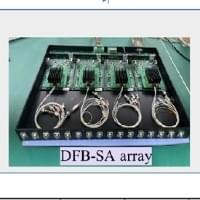
Photonic computing chips have made significant progress in accelerating linear computations, but nonlinear computations are usually implemented in the digital domain, which introduces additional system latency and power consumption, and hinders the implementation of fully functional photonic neural network chips. Here, we propose and fabricate a 16-channel programmable incoherent photonic neuromorphic computing chip by co-designing a simplified Mach–Zehnder interferometer (MZI) mesh and distributed feedback lasers with saturable absorber (DFBs-SA) array using different materials, enabling implementation of both linear and nonlinear spike computations in the optical domain through two separate chips. Furthermore, previous studies mainly focused on supervised learning and simple image classification tasks. Here, we propose a photonic spiking reinforcement learning (RL) architecture for the first, to our knowledge, time, and develop a software–hardware collaborative training-inference framework (in situ photonic training and hardware-aware fine-tuning) to address the challenge of training spiking RL models. We achieve large-scale, energy-efficient (photonic linear computation: 1.39 TOPS/W, photonic nonlinear computation: 987.65 GOPS/W), and low-latency (on-chip 320 ps) deployment of an entire layer of photonic spiking RL. Two RL benchmarks including the discrete CartPole task and the continuous Pendulum task are demonstrated experimentally based on the spiking proximal policy optimization (PPO) algorithm. The hardware–software collaborative computing reward value converges to 200 (−250) for the CartPole (Pendulum) tasks, respectively, comparable to that of a traditional PPO algorithm. This experimental demonstration addresses the challenge of the absence of large-scale on-chip photonic nonlinear spike computation and spiking RL training difficulty, and presents a high-speed and low-latency photonic spiking RL solution with promising application prospects in fields such as robot control, autonomous driving, and embodied intelligence.

The APOE4 allele is the strongest genetic risk factor for sporadic Alzheimer’s disease (sAD), yet its cell-autonomous effects remain poorly understood. While young, asymptomatic APOE4 carriers exhibit abnormal brain metabolism, the mechanistic link between mitochondrial dysfunction and lysosomal-autophagic failure remains unclear. In this study, we conducted a comprehensive analysis of primary human fibroblasts from APOE3 controls, APOE4, and sAD donors to assess mitochondrial bioenergetics, oxidative stress, autophagy, and lysosomal function. APOE4 fibroblasts displayed increased mitochondrial content-associated markers (PGC1α, mtDNA) accompanied by reduced respiratory capacity, elevated proton leak, and excessive mitochondrial ROS. In parallel, APOE4 fibroblasts showed impaired autophagic flux and reduced LC3-TOMM20 colocalization, indicating defective mitophagy. Lysosomal proteolytic activity, assessed using DQ-BSA, was significantly reduced and remained unresponsive under to starvation, in contrast to the partial recovery observed in sAD cells. Pharmacological targeting of mitochondrial ROS with site-specific inhibitors revealed that complex III-derived ROS is the predominant driver of redox stress in APOE4 fibroblasts, while complex I contributes primarily in sAD. Notably, selective inhibition of complex III-derived ROS with S3QEL restored lysosomal degradation, autophagic flux, and mitochondrial respiration in APOE4 cells. Together, these findings demonstrate that mitochondrial oxidative stress disrupts the mitochondria-lysosome axis in an APOE4-specific manner, revealing early and mechanistically distinct vulnerabilities that may precede neurodegeneration. Our results challenge the notion that APOE4 merely amplifies AD pathology and instead identity site-specific redox signaling as a promising target for allele-informed interventions.
Keywords: APOE4; Autophagy; Human fibroblasts; Lysosome; Mitochondria; Mitochondrial complex III; S3QEL.
Copyright © 2024. Published by Elsevier B.V.
Let’s unravel what happens when AI merges with quantum, and starts knowing EVERYTHING ♾️ Go to https://piavpn.com/beeyondideas to get 83% off from our sponsor Private Internet Access with 4 months free!
Want to support our production? Feel free to join our membership at https://youtu.be/_Z4W6sWDo_4?si=Q8eRZoNFUv7sAd9y Special thanks to our beloved YouTube members this month: Powlin Manuel, Saïd Kadi, Chenxi, Lord, Sudhir Paranjape, Nate Lachae, Alison Rewell, Thomas Lapins, Ahmad Salahudin, Antonio Ferriol Colombram, Anton Nicolas Burger 🚀🚀🚀 Experts featured in this video include Demis Hassabis, Tristan Harris, Aza Raskin, Elon Musk, David Deutsch, Michio Kaku, Brian Greene and Nick Bostrom. Chapter: 0:00 A dangerous truth? 1:29 AI advancement 3:46 AI pretending not to know 7:29 Interactive tutoring 9:37 That’s it from our sponsor! 10:21 The merging of QC and AI 12:03 IBM 100,000 qubits 14:34 AI wipes out humanity? 16:05 Google Willow 17:06 The misuse of AI and QC 18:22 Singularity and Turing test 22:51 Reverse Turing test 29:39 Quantum-AI consequences 32:25 The double slit experiment 36:15 Quantum multiverse 41:05 Computing history 46:49 AGI timeline 51:45 Philosophical consequence #AI #quantumcomputing #singularity.
Special thanks to our beloved YouTube members this month: Powlin Manuel, Saïd Kadi, Chenxi, Lord, Sudhir Paranjape, Nate Lachae, Alison Rewell, Thomas Lapins, Ahmad Salahudin, Antonio Ferriol Colombram, Anton Nicolas Burger 🚀🚀🚀
Experts featured in this video include Demis Hassabis, Tristan Harris, Aza Raskin, Elon Musk, David Deutsch, Michio Kaku, Brian Greene and Nick Bostrom.
Chapter:
0:00 A dangerous truth?
1:29 AI advancement.
3:46 AI pretending not to know.
7:29 Interactive tutoring.
9:37 That’s it from our sponsor!
10:21 The merging of QC and AI
12:03 IBM 100,000 qubits.
14:34 AI wipes out humanity?
16:05 Google Willow.
17:06 The misuse of AI and QC
18:22 Singularity and Turing test.
22:51 Reverse Turing test.
29:39 Quantum-AI consequences.
32:25 The double slit experiment.
36:15 Quantum multiverse.
41:05 Computing history.
46:49 AGI timeline.
51:45 Philosophical consequence.
#AI #quantumcomputing #singularity
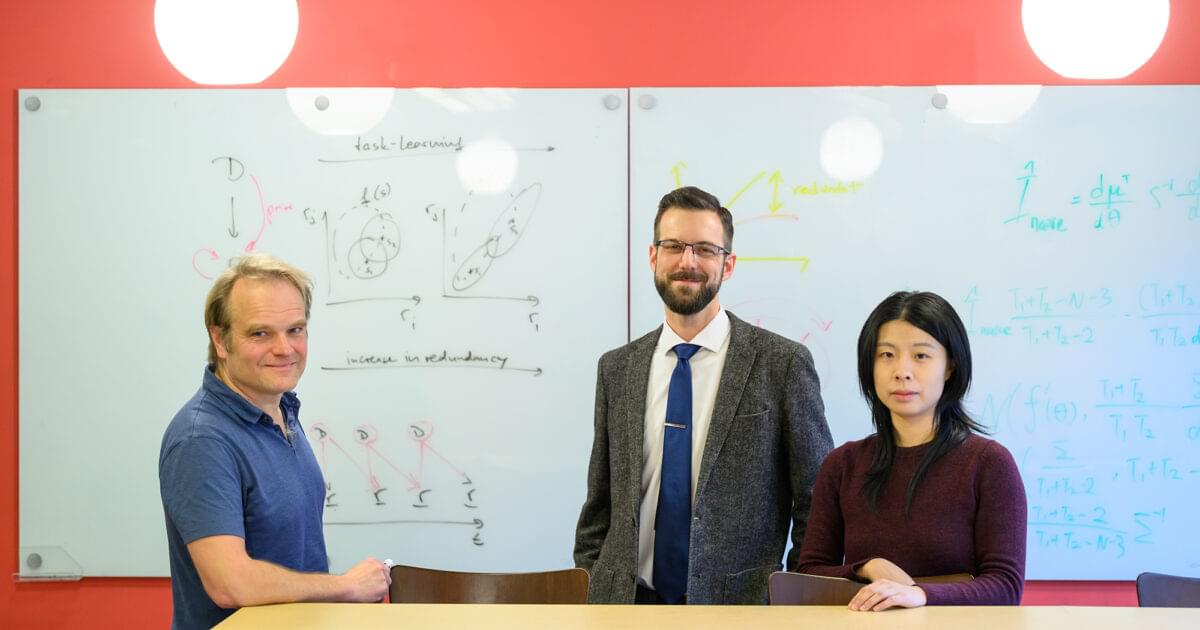
When you get better at a skill—recognizing a familiar face in a crowd, spotting a typo at a glance, or anticipating the next move in a game—sensory neurons in your brain become more coordinated, sharing information rather than acting more independently. That’s the conclusion of a new study by researchers at the University of Rochester and its Del Monte Institute for Neuroscience, published in Science, which challenges a long-held assumption in neuroscience that learning improves efficiency by minimizing repetition across neural signals.
Led by Shizhao Liu, a graduate student in the labs of Ralf Haefner and Adam Snyder, both faculty members in the Department of Brain and Cognitive Sciences, the study shows that learning instead increases shared activity among neurons. The findings could provide insights into learning disorders and inspire more flexible, human-like artificial intelligence tools.
“The dominant view in neuroscience has been that learning makes the brain more efficient by pushing neurons to act more independently, so information can be read out more cleanly,” Liu says. “Our results support a different idea, that sensory areas of the brain aren’t just passively encoding the world. They’re actively performing inference by combining what’s coming in with what the brain has learned to expect.”
A new University of Rochester study could reshape how scientists think about perception, learning disorders, and artificial intelligence.