Physicists are scrambling to understand why dark energy is weakening. In a surprising twist, we must now reconsider the possibility that our reality contains extra dimensions


When you reach the bottom of a container of milk or honey, you might be tempted to tip the container over to get that last pesky little bit out. After all, you only need another teaspoon for that recipe, and you’re sure it’s in there. From emptying jars to drying dishes, research about thin film flows in the kitchen highlights everyday connections to physics.
In Physics of Fluids, researchers from Brown University present two related studies about thin film fluid flows in the kitchen: one about the relationship between how long it takes to tip the remaining liquid out of a container and its viscosity, and the other about the ideal time to wait before dumping water out of a wok to minimize rusting—it’s more effective to wait a few minutes to let the water accumulate so there’s more to pour out. “The kitchen is sort of the prime laboratory,” said author Jay Tang. “It deals with a lot of chemistry, materials science, and physics.”
Most people have an intuitive sense of what viscosity is, often described as how thick a fluid feels. It is measured scientifically by applying a certain amount of force to a fluid and measuring its flow rate.
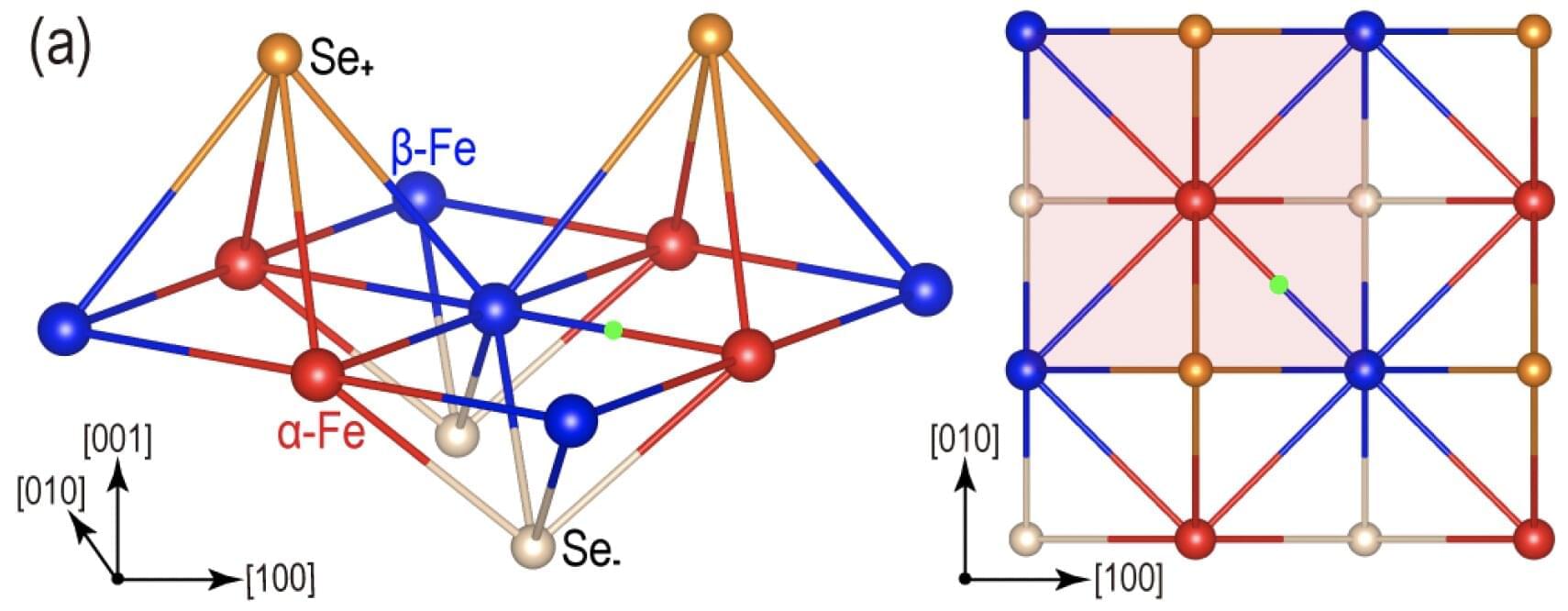
Physicists in China have unveiled new clues to the origins of high-temperature superconductivity in an iron-based material just a single unit-cell thick. Led by Qi-Kun Xue and Lili Wang at Tsinghua University, the team’s experiments show that the effect emerges through a striking dichotomy between two atomic “sublattices” in the material—offering deeper insight into how superconductivity arises. Their results are published in Physical Review Letters.
When cooled below its critical temperature, a superconductor allows electrical currents to flow with virtually zero resistance. While most superconductors discovered so far have critical temperatures close to absolute zero, recent decades have seen the discovery of increasingly advanced materials that host the effect at ever higher temperatures, making them far easier to implement for practical applications.
In 2012, superconductivity was discovered in a single-unit-cell-thick layer of iron selenide (FeSe), consisting of a Se–Fe–Se trilayer only 0.55 nm thick. However, it remained unclear how such a strong superconducting effect could emerge in such an ultrathin system.

An insect-scale robot that jumps using only light has completed 188 continuous leaps without a single electronic component.
The soft machine bends, snaps and resets itself automatically, powered entirely by material physics instead of chips or wires.
The robot is built mainly from liquid crystal elastomers, a rubber-like material that changes shape when exposed to light. When illuminated, the material bends and stores elastic energy in a curved beam structure.

Physicists and chemists at Heidelberg University have realized a photonic microchip that is driven by light just as easily as electronic components via a “plug.” Their development could serve as the basis for fast and cost-effective production of photonic integrated systems that are of great importance for implementing innovative computing and communications systems.
Prof. Dr. Wolfram Pernice of the Kirchhoff Institute for Physics headed up the research on this novel coupling concept for light-controlled chips. The results appear in the journal Science Advances.
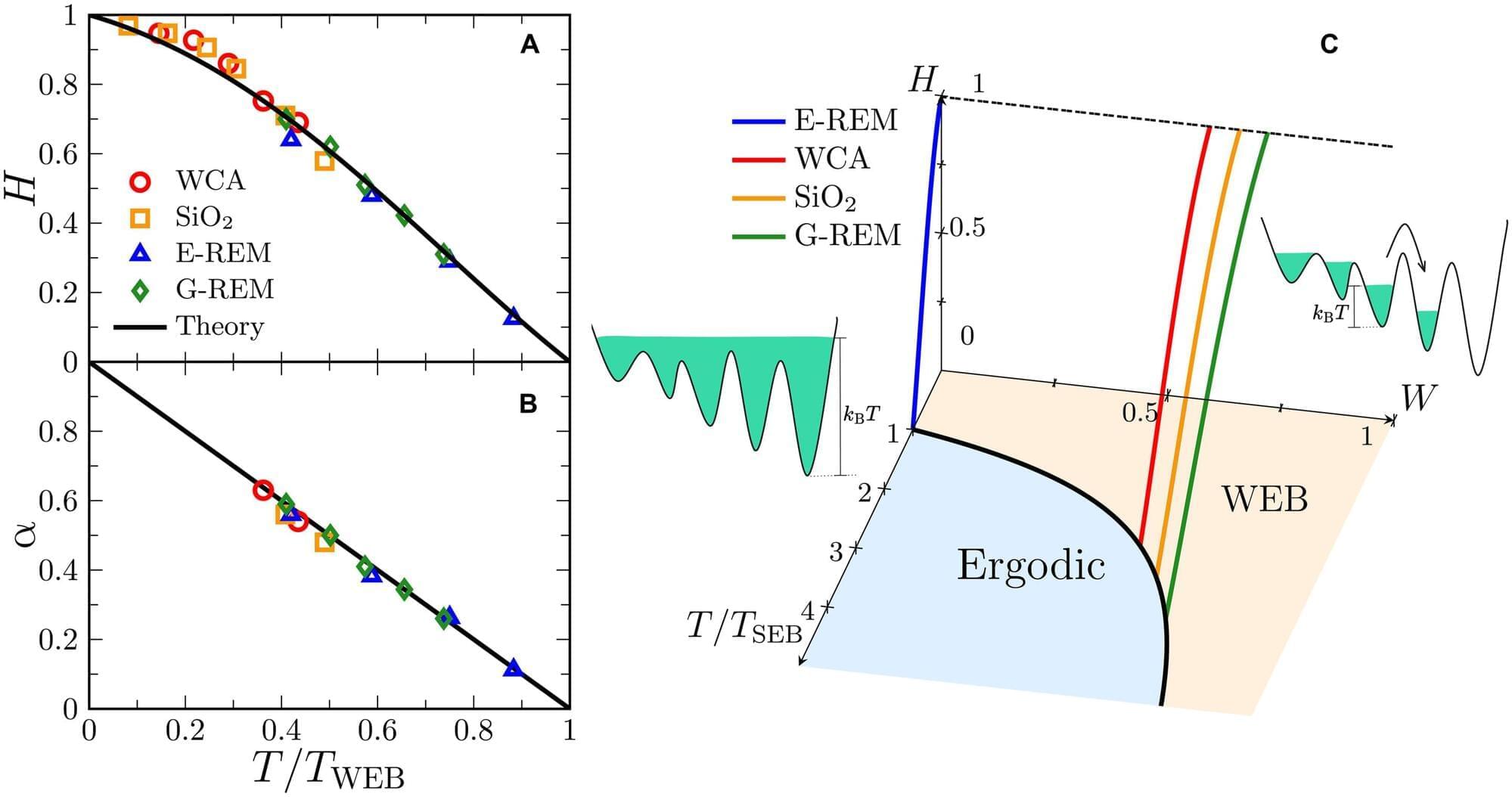
“Glass” has a unique and distinct meaning in physics—one that refers not just to the transparent material we associate with window glass. Instead, it refers to any system that looks solid but is not in true equilibrium and continues to change extremely slowly over time. Examples include window glass, plastics, metallic glasses, spin glasses (i.e., magnetic systems), and even some biological and computational systems.
When a liquid is cooled very quickly—a process called quenching—it doesn’t have time to organize into a crystal but becomes stuck in a disordered state far from equilibrium. Its properties—like stiffness and structure—slowly evolve through a process called “aging.”
Now, a research team from the Institute of Theoretical Physics of the Chinese Academy of Sciences has proposed a new theoretical framework for understanding the universal aging behavior of glassy materials. The study is published in the journal Science Advances.
This script is a mind-bending follow-up to your first one. It moves from Physics into Metaphysics and Platonism, specifically exploring the Mathematical Universe Hypothesis (MUH).
Since this script is more philosophical and \.

When a human mind can be emulated — memories, habits, and the weather of thought running on engineered hardware — “uploading” stops being an ending and becomes a beginning. Substrate-independent minds can be backed up, restored, paused without time passing, and deployed into new bodies: telepresence robots, swarms, or chassis built for heat and radiation. Distance turns into bandwidth as consciousness moves as data, bound only by light. Under the spectacle is a harder, technical question: what must be captured, at what scale, for an emulation to be someone — and what rights and power follow once persons are portable infrastructure?
Mind uploading has usually been told as a one-way escape hatch: a last-minute transfer from a failing body into a machine, the technological equivalent of outrunning a deadline. That framing makes the idea feel like a hospice fantasy — dramatic, personal, terminal. But it leaves out the second verb that changes everything. If a mind can be reproduced as a running process, it isn’t just uploaded once; it can be instantiated again, moved, paused, restored, and redeployed. Uploading is capture. Downloading is what makes a mind into something mobile.
The phrase “substrate-independent mind” tries to name that mobility without the melodrama. A substrate is the medium a mind runs on: biological tissue, silicon, specialized hardware, something not yet invented. Independence doesn’t mean the mind floats free of physics; it means the same meaningful mental functions might be implementable on different platforms, like a program that can run on different computers. The promise is not that neurons are irrelevant, but that the mind might be the pattern of information processing the neurons carry out — the thing they do, not the stuff they’re made of.
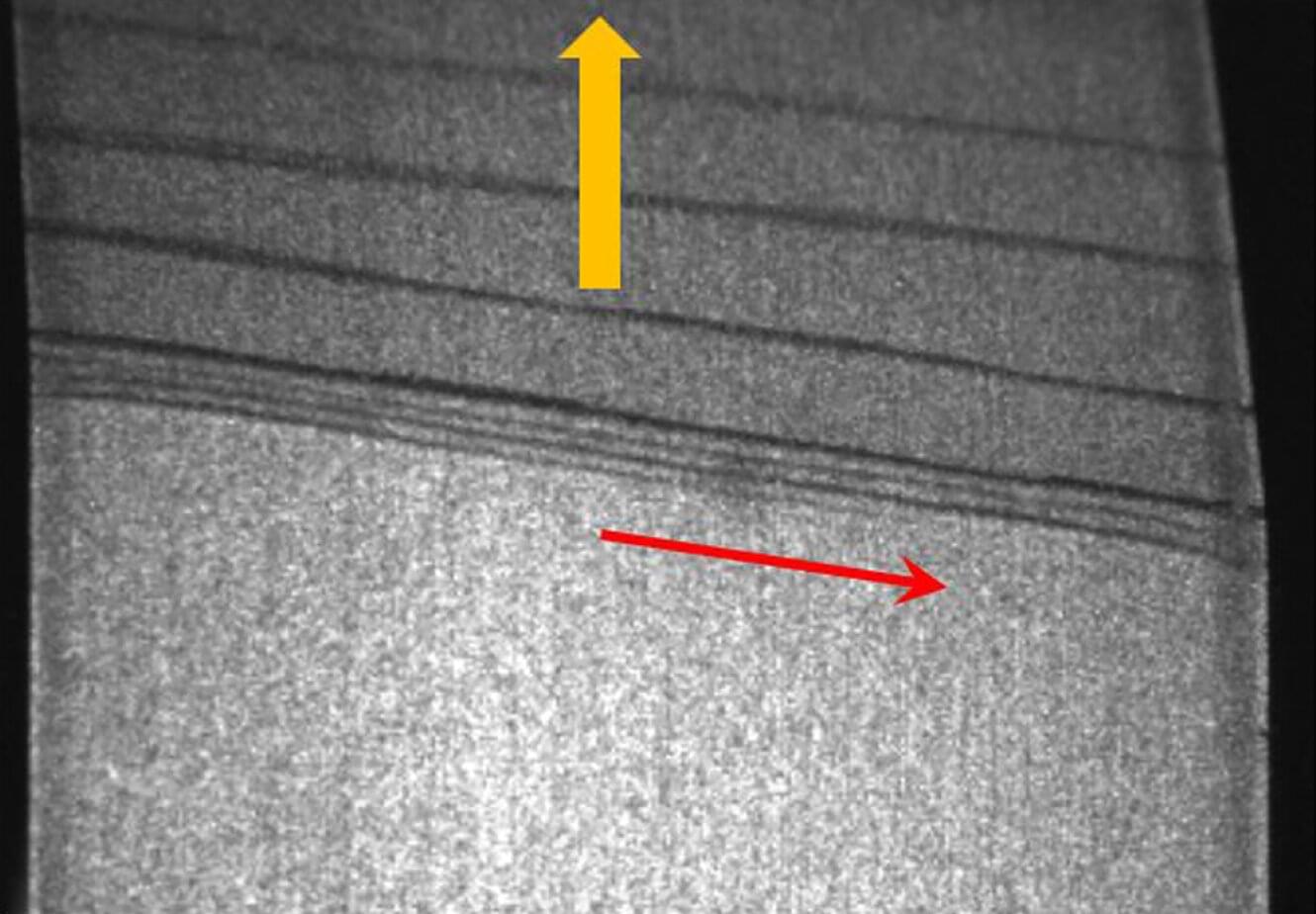
A new experiment has uncovered the mechanism responsible for the screeching sound made by peeling sticky tape. Using a combination of ultrafast imaging and synchronized acoustic recordings, Sigurdur Thoroddsen and colleagues at King Abdullah University of Science and Technology have shown that the noise is produced by a rapid train of tiny shockwaves, released through a specialized form of stick–slip motion. The research is published in Physical Review E.
If you’ve ever used sticky tape, you’ll probably be all too familiar with the harsh sound it makes as it peels away from a surface. Yet despite decades of experimental scrutiny, physicists have yet to fully explain the origins of this intriguing acoustic effect.
Previous studies established that peeling proceeds via a “stick–slip” mechanism—a jerky motion characterized by brief, rapid accelerations interrupted by sudden stops. Similar dynamics underpin phenomena ranging from earthquakes to the squeak of basketball shoes on a polished wooden court. However, the fine details of how this process unfolds in peeling tape turned out to be more complex than they first appeared.