Identifying the boundary between classical and quantum computation is a central challenge in quantum information. In multi-qubit systems, entanglement and magic are the key resources underlying genuinely quantum behaviour. While entanglement is well understood, magic — essential for universal quantum computation — remains relatively poorly characterised. Here we show that determining membership in the stabilizer polytope, which defines the free states of magic-state resource theory, requires super-exponential time $\exp( n^2)$ in the number of qubits $n$, even approximately. We reduce the problem to solving a $3$-SAT instance on $n^2$ variables and, by invoking the exponential time hypothesis, the result follows. As a consequence, both quantifying and certifying magic are fundamentally intractable: any magic monotone for general states must be super-exponentially hard to compute, and deciding whether an operator is a valid magic witness is equally difficult. As a corollary, we establish the robustness of magic as computationally optimal among monotones. This barrier extends even to classically simulable regimes: deciding whether a state lies in the convex hull of states generated by a logarithmic number of non-Clifford gates is also super-exponentially hard. Together, these results reveal intrinsic computational limits on assessing classical simulability, distilling pathological magic states, and ultimately probing and exploiting magic as a quantum resource.
Category: quantum physics – Page 4

Researchers unlock hidden dimensions inside a single photon
Researchers have discovered new ways to shape quantum light, creating high-dimensional states that can carry much more information per photon. Using advanced tools like on-chip photonics and ultrafast light structuring, they’re pushing quantum communication and imaging into exciting new territory. Although long-distance transmission remains tricky, innovative approaches—such as topological quantum states—could make these fragile signals far more resilient. The momentum suggests quantum optics is entering a bold new phase.
Comments on the Hartle-Hawking state and observers — Ying Zhao
Workshop on quantum aspects of black holes and spacetime.
Topic: Comments on the Hartle-Hawking state and observers.
Speaker: Ying Zhao.
Affiliation: Massachusetts Institute of Technology.
Date: December 3, 2025
Wolfensohn Hall.
It was argued that any fixed holographic theory contains only one closed universe state and hence fails to give semi-classical physics. It was proposed that this problem can be resolved by including a classical observer living inside the universe. Earlier works focused on closed universes connected with asymptotic Euclidean boundaries. In this talk we examine the case of Hartle-Hawking state where the dominant Euclidean topology is a sphere. We show that different features emerge. We comment on the potential implications for the understanding of de Sitter space. Based on work with Daniel Harlow.

Matching vibrations is all it takes to shut down superconductivity in a nearby crystal
The world is never really at rest. Even in a vacuum near ultracold temperatures where all classical motion should come to a halt, you’ll find quantum fluctuations. In thin, two-dimensional materials, these include random vibrations that can alter electromagnetic fields, a feature that theorists have posited could be quite useful for modifying materials.
“It’s a holy grail we’ve been searching for decades,” said Dmitri Basov, Higgins Professor of Physics at Columbia. “We believe we’ve found it.”
In a new paper published in Nature, Basov and 32 collaborators from 17 institutions came together to confirm that quantum fluctuations alone from the vacuum inside atom-thin layers of 2D materials can alter the properties of a larger nearby crystal—a theoretical possibility now experimentally realized for the first time.
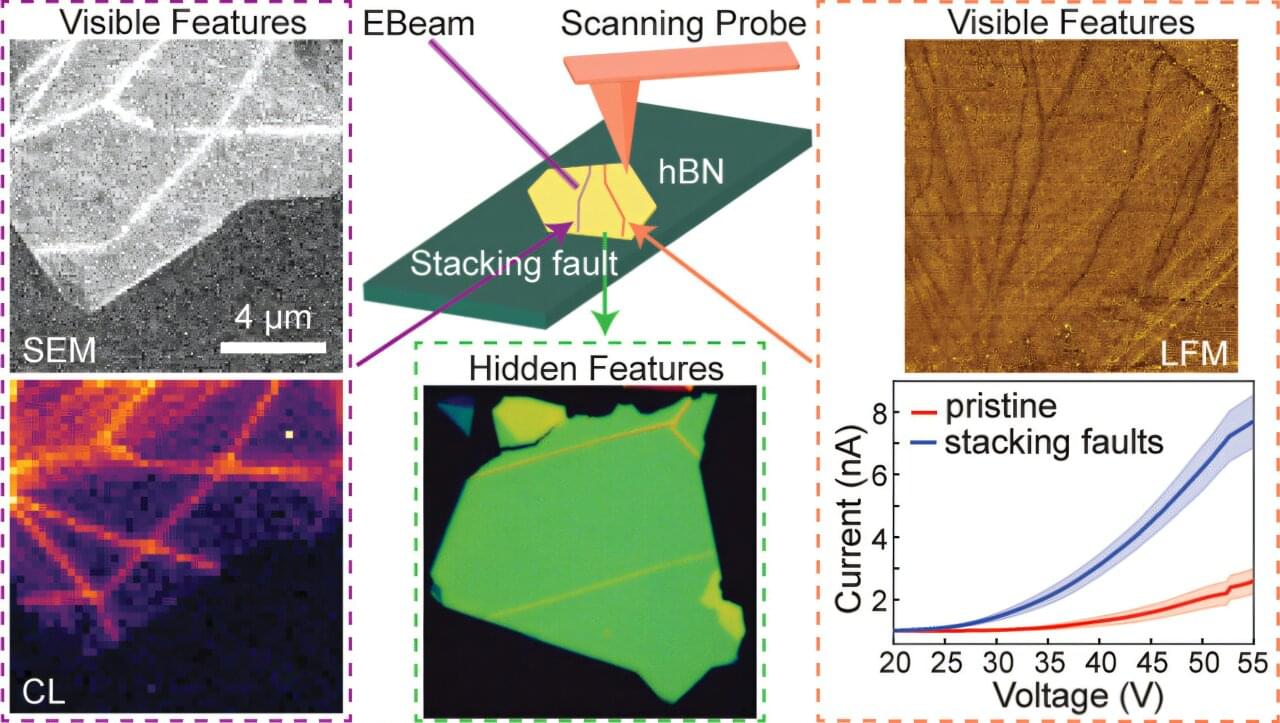
New technique spots hidden defects to boost reliability of ultrathin electronics
Future devices will continue to probe the frontier of the very small, and at scales where functionality depends on mere atoms, even the tiniest flaw matters. Researchers at Rice University have shown that hard-to-spot defects in a widely used two-dimensional insulator can trap electrical charges and locally weaken the material, making it more likely to fail at lower voltages. The findings are published in Nano Letters.
“By showing practical ways to detect when and where these defects form, we help make future devices more reliable and repeatable,” said Hae Yeon Lee, an assistant professor of materials science and nanoengineering at Rice, who is a corresponding author on the study.
Building ultrathin electronics such as advanced transistors, photodetectors and quantum devices involves stacking sheets of different 2D materials on top of each other into “heterostructures.” Hexagonal boron nitride (hBN), prized for being atomically flat and chemically stable, is a common building block.
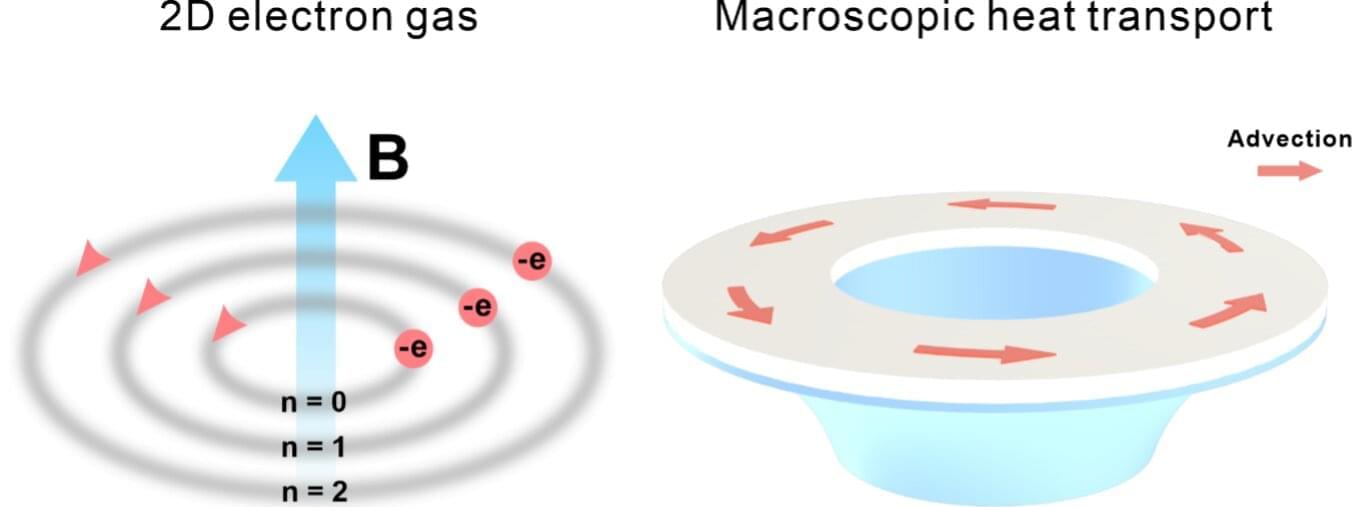
Energy loss triggers quantum thermal Hall-like effect at macroscopic scale
In many quantum materials—materials with unusual electrical and magnetic properties driven by quantum mechanical effects—electrons can organize themselves into Landau levels are essentially quantized energy states that form when charged particles move in a magnetic field.
This process, called Landau quantization, forces electrons into circular (i.e., cyclotron) motion. This motion ultimately produces evenly spaced Landau levels, which are known to underpin various physical phenomena, including the quantum Hall effect.
The quantum Hall effect is a quantum equivalent of the Hall effect that emerges in some two-dimensional (2D) materials at extremely low temperatures and under strong magnetic fields. This effect prompts electrical current to flow along the edges of a material with extremely low loss of energy.


A robust new telecom qubit identified in silicon
Quantum technologies are anticipated to transform computing, communication, and sensing by harnessing the unusual behavior of matter at the atomic scale. Translating quantum’s promise into practical devices will require physical systems that have desirable quantum properties and can be easily manufactured. Silicon, the material behind today’s computer chips, is highly attractive as a platform because it plays to the strengths of the trillion-dollar semiconductor industry that has already been built. Identifying quantum building blocks—qubits—in silicon is, therefore, an important frontier research area.
In a new study, researchers in UC Santa Barbara materials professor Chris Van de Walle’s Computational Materials Group identified a robust new qubit in silicon, called the CN center. The work is published in the journal Physical Review B.
Qubits can be based on atomic-scale defects in a crystal. A prototype example is the NV center, which consists of a nitrogen (N) atom sitting next to a vacancy (V, a missing carbon atom) in a diamond crystal. These defects can interact with both electrons and light, allowing them to emit single photons (quanta of light) that can transmit quantum information or be processed in quantum networks.
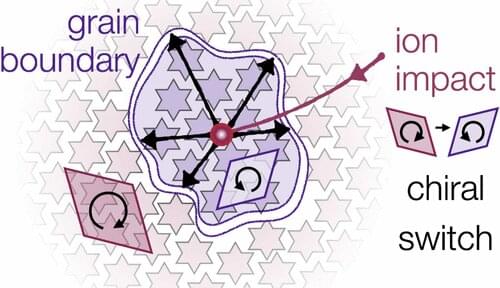
Ion bombardment triggers a reliable quantum switch in tantalum disulfide crystals
When you toss a coin, you put it into a higher-energy state until it falls back down again. It can then end up in one of two possible states: heads or tails. No matter which state the coin was in before, after the toss both outcomes are equally likely. A team at TU Wien has analyzed a quantum system that also has two equivalent ground states. By supplying energy through ion bombardment, this state can be changed.
Remarkably, however, the system behaves very differently from a coin toss: it switches every single time. After ion impact, it reliably ends up in the opposite state. For the experiment, the ion-beam equipment of TU Wien was transported to DESY in Hamburg. The crystals studied were provided by Kiel University (CAU), which also participated in the experiments at DESY. The research is published in the journal Nano Letters.

A protocol to realize near-perfect atom-photon entanglement
Quantum technologies, devices and systems that operate leveraging quantum mechanical effects, could tackle some tasks more reliably and efficiently than any classical technology could. In recent years, some researchers have been trying to realize quantum networks to scale up the size of quantum computers, which essentially consist of several connected smaller quantum processors.
The devices in a quantum network are connected via entanglement, a quantum effect via which distant quantum particles become inextricably linked and share a single correlated state. One way to create entanglement between different atomic quantum computers is to use an atom-cavity interface, a system in which atoms interact with light inside an optical cavity.
Over two decades ago, two physicists at the University of Aarhus introduced a protocol designed to produce high-quality entangled states, reliably connecting devices in a network. Despite its potential, this framework, known as the state-carving (SC) protocol, was found to only succeed in 50% of cases, which has so far prevented its application on a large scale.