A research team from Utrecht University has successfully fabricated working livers using a newly developed ultrafast volumetric 3D bioprinting method.
By means of visible light tomography, the volumetric bioprinting method enabled the successful printing of miniature stem cell units by making the cells “transparent”, which meant they retained their resolution and ability to perform biological processes.
Printed in less than 20 seconds, the liver units were able to perform key toxin elimination processes mimicking those that natural livers perform in our bodies, and could open new opportunities for regenerative medicine and personalized drug testing.
[Billy] has a special interest in passive hydroponics (also known as the Kratky method), which is a way of growing plants in nutrient-rich water that does not circulate. As the plant grows and liquid level drops, only the tips of the roots remain submerged while more and more of the root surface is exposed to oxygen in a harmonious balance. However, “thirsty” plant types (tomatoes, for example) throw off this balance, and the system needs to be modified. To address this, [Billy] designed and printed a passive float valve system that takes care of topping up the reservoir only when needed, without using pumps or any other electrical equipment.
Commercial or industrial float valves are too big to use in his small tanks, which led [Billy] to test dozens of DIY designs. He used everything from plastic water bottles to pipe ends, but nothing quite measured up. With 3D printing, [Billy] was able to create a sealed, lightweight float that exactly matched the housing and tube locations.
The way [Billy]’s float valve works is by using a hollow object as a kind of buoyant plug inside a housing. When the water level is high, the buoyant object rises up and presses a strip of silicone against an outlet, preventing water from flowing. If the water level is low, the buoyant plug drops and water is free to flow. With a reservoir of fresh nutrient-rich water placed above the grow tank, gravity takes care of pushing a fresh supply down a tube, so no active pump is needed. Combined with a passive float valve, the system pretty much runs itself.
Titanium is the lifeblood of metal 3D printing. As the technology was initially driven by the aerospace and weapons sectors, it has become the metal of choice for its high strength-to-weight ratio. Now, Desktop Metal (NYSE: DM) has qualified titanium alloy Ti-6Al-4V (Ti64) for its Studio Systems 2, making it one of the first office-friendly machines capable of 3D printing with titanium. One of Desktop Metal’s first customers in the space appears to be Apple co-founder Steve Wozniak, whose new startup, Privateer Space, aims to clean up space junk.
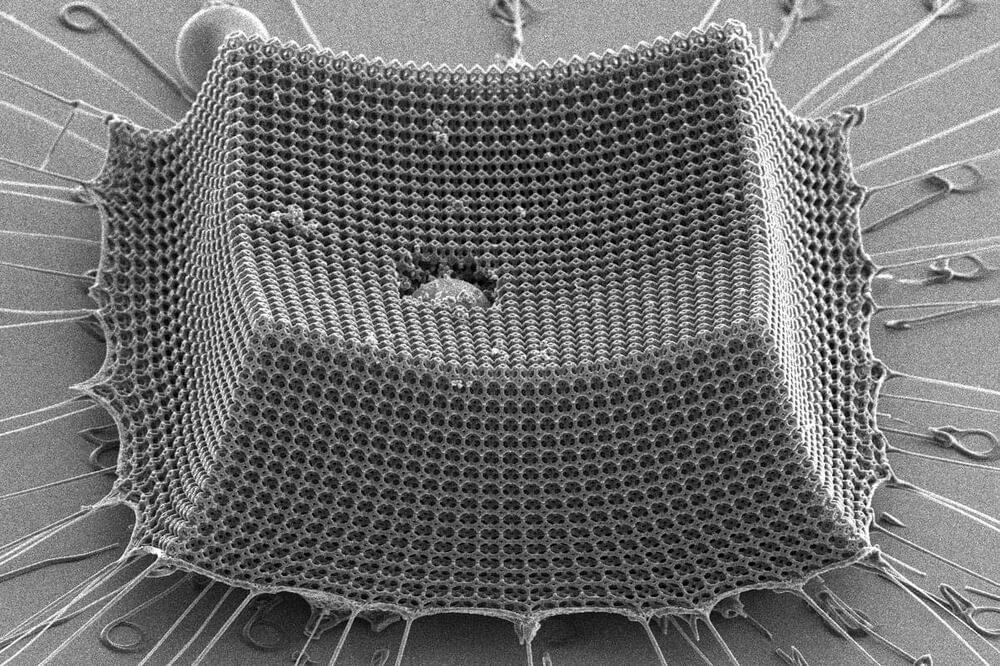
Thinner than a single human hair, the material is made from tiny carbon struts that form interconnected tetrakaidecahedrons – structures with 14 faces – that are fabricated via two-photon lithography.
According to the team, the nano-architected material could potentially replace kevlar for a wide array of bulletproof protective gear used by the armed forces.
Over the last year home prices have skyrocketed (along with prices of almost everything else), leaving millions of people unable to afford to move or to change their housing situation. Mortgage lender Freddie Mac estimated last year that the US has a housing supply shortage of 3.8 million homes. It’s partly Covid-related; construction has slowed due to labor shortages, high raw material costs, and supply chain issues—but the problem predates the pandemic, as demand for homes was already outpacing supply in 2019.
Middle-and low-income families have been hit hardest by the housing shortage. In an effort to assist those in need, Habitat for Humanity launched an initiative last year to incorporate 3D printing into its construction process to cut costs. The first home was completed last month, and a family moved in just before Christmas.
Located in Williamsburg, Virginia, the house has three bedrooms and two bathrooms, and the 3D printed portion of it—that is, the exterior walls—took just 28 hours to build. “Build” in this case meant a 3D printer moved along a track in the shape of the house, putting down one layer after another of a cement mixture.
It looks whimsical, but it could be a blueprint for fixing our woeful infrastructure in the U.S.
After four long years of planning, the world’s first 3D-printed steel bridge debuted in Amsterdam last month. If it stands up to the elements, the bridge could be a blueprint for fixing our own structurally deficient infrastructure in the U.S.—and we sorely need the help.
Dutch Company MX3D built the almost 40-foot-long bridge for pedestrians and cyclists to cross the city’s Oudezijds Achterburgwal canal. It relied on four robots, fit with welding torches, to 3D-print the structure. To do it, the machines laid out 10,000 pounds of steel, heated to 2,732 degrees Fahrenheit, in an intricate layering process. The result? An award-winning design, pushing the boundaries of what steel can do.