Watch the full podcast! https://chinauncensored.tv/programs/p…
There are certain themes that movies in China can’t have, and one of them is time travel. In this clip we discuss China’s ban on time travel, how the CCP got Tesla and Elon Musk to heel, and why the CCP no longer needs Hollywood. Our guest is Chris Fenton, the producer of Bad Counselors, which comes to theaters July 22–27, 2026. https://www.badcounselors.com
Category: time travel
The Physics of FTL Travel
Can humanity ever travel faster than light, or does every shortcut through spacetime break causality itself? We explore warp drives, wormholes, tachyons, and why the universe pushes back.
Get Nebula using my link for 50% off an annual subscription: https://go.nebula.tv/isaacarthur.
Watch my exclusive video Nearby Supernovae: https://nebula.tv/videos/isaacarthur–… SFIA Merchandise: https://isaac-arthur-shop.fourthwall… 🌐 Visit our Website: http://www.isaacarthur.net ❤️ Support us on Patreon: / isaacarthur ⭐ Support us on Subscribestar: https://www.subscribestar.com/isaac-a… 👥 Facebook Group:
/ 1,583,992,725,237,264 📣 Reddit Community:
/ isaacarthur 🐦 Follow on Twitter / X:
/ isaac_a_arthur 💬 SFIA Discord Server:
/ discord Credits: The Physics of FTL Travel Written, Produced & Narrated by: Isaac Arthur Editor: Lukas Konecny Music Courtesy of Stellardrone & Chris Zabriskie Select imagery/video supplied by Getty Images Chapters 0:00 Intro 0:12 Faster Than Light Is the Wrong Question 4:18 Spacetime Engineering: Moving the Map Instead of the Ship 5:24 Warp Drives: Surfing Spacetime 11:46 Wormholes: Shortcuts with a Side of Time Travel 13:20 Hyperspace: Shortcuts Through the Bulk 15:11 Solitons: The Positive Energy Challenge 17:35 The Krasnikov Tube: Building a Star-Road 20:30 Natural Relativistic Loopholes: Cosmic Strings and Tipler Cylinders 25:05 Tachyons: The Simplest Way to Break Time 28:04 Vacuum & Time-Advance Effects: When Causality Bends, Just a Little 32:19 Quantum Red Herrings 35:42 Nebula 36:54 Why the Universe Pushes Back: Chronology Protection and Self-Defeating Physics.
🛒 SFIA Merchandise: https://isaac-arthur-shop.fourthwall…
🌐 Visit our Website: http://www.isaacarthur.net.
❤️ Support us on Patreon: / isaacarthur.
⭐ Support us on Subscribestar: https://www.subscribestar.com/isaac-a…
👥 Facebook Group: / 1583992725237264
📣 Reddit Community: / isaacarthur.
🐦 Follow on Twitter / X: / isaac_a_arthur.
💬 SFIA Discord Server: / discord.
Credits:
The Physics of FTL Travel.
Written, Produced \& Narrated by: Isaac Arthur.
Editor: Lukas Konecny.
Music Courtesy of Stellardrone \& Chris Zabriskie.
Select imagery/video supplied by Getty Images.
Chapters.
0:00 Intro.
0:12 Faster Than Light Is the Wrong Question.
4:18 Spacetime Engineering: Moving the Map Instead of the Ship.
5:24 Warp Drives: Surfing Spacetime.
11:46 Wormholes: Shortcuts with a Side of Time Travel.
13:20 Hyperspace: Shortcuts Through the Bulk.
15:11 Solitons: The Positive Energy Challenge.
17:35 The Krasnikov Tube: Building a Star-Road.
20:30 Natural Relativistic Loopholes: Cosmic Strings and Tipler Cylinders.
25:05 Tachyons: The Simplest Way to Break Time.
28:04 Vacuum \& Time-Advance Effects: When Causality Bends, Just a Little.
32:19 Quantum Red Herrings.
35:42 Nebula.
36:54 Why the Universe Pushes Back: Chronology Protection and Self-Defeating Physics.
These Physicists Claim They Can Send Messages To The Past
Take back your personal data with Incogni! Use code Sabine at the link below and get 60% off annual plans: https://incogni.com/sabine.
When you try to combine quantum physics with Einstein’s theories, you quickly run into some pretty serious problems. The biggest is that causality – the order in which events occur – becomes uncertain as the rest of quantum physics. A group of physicists have leveraged that uncertainty, and are now claiming that they can send messages to the past using quantum mechanics. It’s not as crazy as it sounds. Let’s take a look.
Paper: https://journals.aps.org/prl/accepted… mugs, posters and more: ➜ https://sabines-store.dashery.com/ 💌 Support me on Donorbox ➜ https://donorbox.org/swtg 👉 Transcript with links to references on Patreon ➜ / sabine 📝 Transcripts and written news on Substack ➜ https://sciencewtg.substack.com/ 📩 Free weekly science newsletter ➜ https://sabinehossenfelder.com/newsle… 👂 Audio only podcast ➜ https://open.spotify.com/show/0MkNfXl… 🔗 Join this channel to get access to perks ➜
/ @sabinehossenfelder 📚 Buy my book ➜ https://amzn.to/3HSAWJW #science #sciencenews #physics #quantum In this video, we examine recent headlines suggesting that sending messages into the past has become easier or even possible, drawing from a theoretical physics paper published in a top journal. While these claims might sound like a time machine is within reach, I clarify that this is a theoretical study and not an actual method for backward time travel. It’s crucial for science communication to distinguish between theoretical possibilities in quantum physics and practical applications.
👕T-shirts, mugs, posters and more: ➜ https://sabines-store.dashery.com/
💌 Support me on Donorbox ➜ https://donorbox.org/swtg.
👉 Transcript with links to references on Patreon ➜ / sabine.
📝 Transcripts and written news on Substack ➜ https://sciencewtg.substack.com/
📩 Free weekly science newsletter ➜ https://sabinehossenfelder.com/newsle…
👂 Audio only podcast ➜ https://open.spotify.com/show/0MkNfXl…
🔗 Join this channel to get access to perks ➜
/ @sabinehossenfelder.
📚 Buy my book ➜ https://amzn.to/3HSAWJW
#science #sciencenews #physics #quantum.
In this video, we examine recent headlines suggesting that sending messages into the past has become easier or even possible, drawing from a theoretical physics paper published in a top journal. While these claims might sound like a time machine is within reach, I clarify that this is a theoretical study and not an actual method for backward time travel. It’s crucial for science communication to distinguish between theoretical possibilities in quantum physics and practical applications.
Something Disturbing Happens When You Solve Einstein’s Equations This Way
Check out the Universe in a Black Hole Merch at the Space Time Merch Store
https://www.pbsspacetime.com/shop.
Kurt Gödel discovered a solution to General Relativity that allows time travel without any exotic physics, revealing that the theory doesn’t actually guarantee a consistent chain of cause and effect. His “Gödel universe” shows that under certain conditions, the structure of spacetime itself can loop back on itself—blurring the line between past and future and exposing a deep limitation in our understanding of reality.
Sign Up on Patreon to get access to the Space Time Discord!
/ pbsspacetime.
Sign up for the mailing list to get episode notifications and hear special announcements!
https://mailchi.mp/1a6eb8f2717d/space…
Search the Entire Space Time Library Here: https://search.pbsspacetime.com/
Hosted by matt o’dowd written by matt o’dowd post production by leonardo scholzer directed by andrew kornhaber associate producer: bahar gholipour executive producer: andrew kornhaber executive in charge for PBS: maribel lopez director of programming for PBS: gabrielle ewing assistant director of programming for PBS: mike martin.
A physicist reveals how time travel is possible | Jim Al-Khalili
Become a Big Think member to unlock expert classes, premium print issues, exclusive events and more: https://bigthink.com/membership/?utm_…
Time is the one thing every human being experiences identically, or so we assume.
Physicist Jim Al-Khalili dismantles that assumption, explaining how velocity and gravity don’t just affect clocks but actually alter the rate at which time passes for the person experiencing it.
Preorder Jim Al-Khalili’s forthcoming book, On Time: The Physics That Makes the Universe, here: https://www.amazon.com/Time-Physics-T?tag=lifeboatfound-20…
About Jim Al-Khalili: Jim is a multiple award-winning science communicator renowned for his public engagement around the world through writing and broadcasting and a leading academic making fundamental contributions to theoretical physics, particularly in nuclear reaction theory, quantum effects in biology, open quantum systems and the foundations of quantum mechanics. Jim is a theoretical physicist at the University of Surrey where he holds a Distinguished Chair in physics as well as a university chair in the public engagement in science. He received his PhD in nuclear reaction theory in 1989 and has published widely in the field. His current interest is in open quantum systems and the application of quantum mechanics in biology.
About Jim Al-Khalili:
Scientists revive activity in frozen mouse brains for the first time
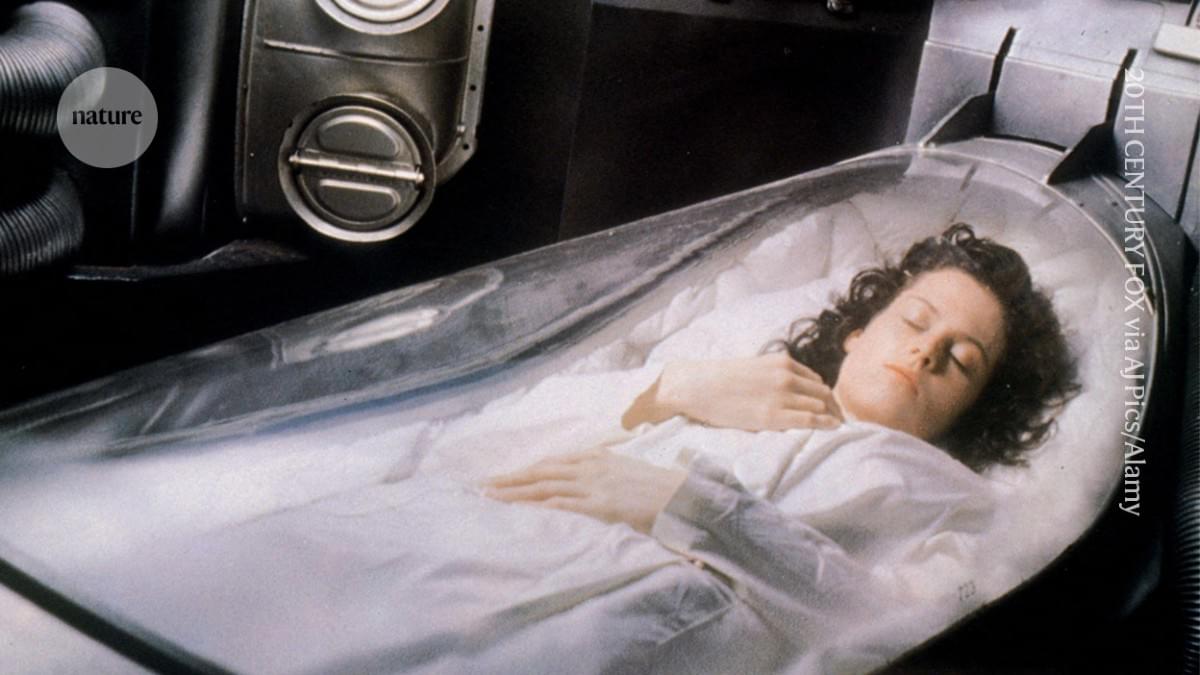
A familiar trope in science fiction is the cryopreserved time traveller, their body deep-frozen in suspended animation, then thawed and reawakened in another decade or century with all of their mental and physical capabilities intact.
Researchers attempting the cryogenic freezing and thawing of brain tissue from humans and other animals — mostly young vertebrates — have already shown that neuronal tissue can survive freezing on a cellular level and, after thawing, a functional one to some extent. But it has not been possible to fully restore the processes necessary for proper brain functioning — neuronal firing, cell metabolism and brain plasticity.
A team in Germany has now demonstrated a method for cryopreserving and thawing mouse brains that leaves some of this functionality intact. The study, published on 3 March in Proceedings of the National Academy of Sciences 3, details the authors’ use of a method called vitrification, which preserves tissue in a glass-like state, along with a thawing process that preserves living tissue.
“If brain function is an emergent property of its physical structure, how can we recover it from complete shutdown?” asks Alexander German, a neurologist at the University of Erlangen–Nuremberg in Germany and lead author of the study. The findings, he says, hint at the potential to one day protect the brain during disease or in the wake of severe injury, set up organ banks and even achieve whole-body cryopreservation of mammals.
Mrityunjay Kothari, who studies mechanical engineering at the University of New Hampshire in Durham, agrees that the study advances the state of the art in cryopreservation of brain tissue. “This kind of progress is what gradually turns science fiction into scientific possibility,” he says. However, he adds that applications such as the long-term banking of large organs or mammals remain far beyond the capabilities of the study.
Article Featured in Nature.
Parallel realities solve this time travel paradox | Jim Al-Khalili
Become a Big Think member to unlock expert classes, premium print issues, exclusive events and more: https://bigthink.com/membership/?utm_…
Time is the one thing every human being experiences identically, or so we assume.
Physicist Jim Al-Khalili dismantles that assumption, explaining how velocity and gravity don’t just affect clocks but actually alter the rate at which time passes for the person experiencing it.
Preorder Jim Al-Khalili’s forthcoming book, On Time: The Physics That Makes the Universe, here: https://www.amazon.com/Time-Physics-T?tag=lifeboatfound-20…
About Jim Al-Khalili: Jim is a multiple award-winning science communicator renowned for his public engagement around the world through writing and broadcasting and a leading academic making fundamental contributions to theoretical physics, particularly in nuclear reaction theory, quantum effects in biology, open quantum systems and the foundations of quantum mechanics. Jim is a theoretical physicist at the University of Surrey where he holds a Distinguished Chair in physics as well as a university chair in the public engagement in science. He received his PhD in nuclear reaction theory in 1989 and has published widely in the field. His current interest is in open quantum systems and the application of quantum mechanics in biology.
About Jim Al-Khalili: