The implant acted like scaffolding to bridge over spinal cord injuries.
Read more


One of the research’s lead investigators, Michael Hill, said in a press release, “We envision this new technique as a low-cost office procedure done under local anesthesia. The whole process would take about five minutes.”
While currently in the process of arranging licensing for their procedure, the researchers are already looking toward using it with other collagen tissue such as tendons, and even corneas for the correction of vision issues. In animal tests, they’ve already had some success with reshaping a cornea using a 3D-printed contact lens painted with electrodes and to which they applied electrical current to soften the cornea. This is especially exciting due to the structure of its collagen fibers. Says Hill during the presentation, “It turns out that in order to remain transparent, the [layers of] collagen fibers are all perfectly aligned.” Molecular surgery allows correction of the cornea without disrupting that required layering.
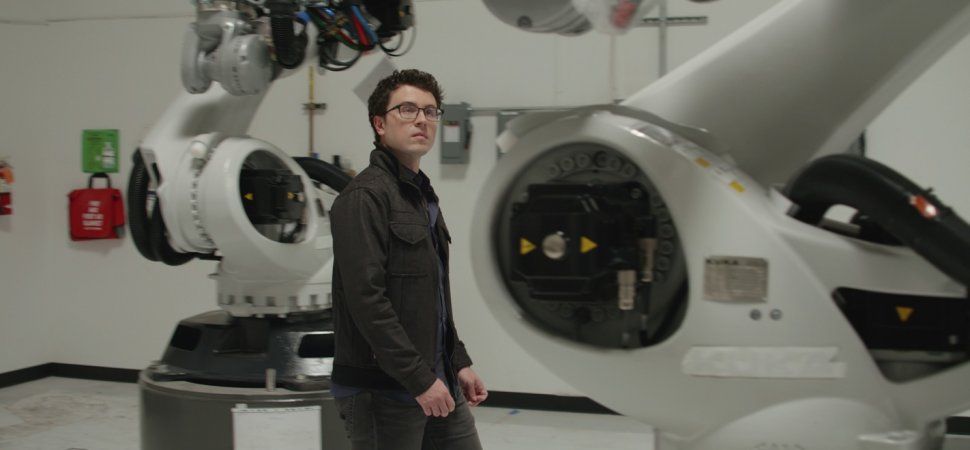
As 3D printing evolves and changes manufacturing, no sector will be left untouched—including rocket-building. Using the world’s largest 3D metal printer and Dell technology, Relativity Space will streamline the rocket-building process and make space exploration faster and more accessible. Watch how this revolutionary startup is partnering with Dell to take a leading spot in the race to space.

Traditional surgery to reshape a nose or ear entails cutting and suturing, sometimes followed by long recovery times and scars. But now, researchers have developed a “molecular surgery” process that uses tiny needles, electric current and 3D-printed molds to quickly reshape living tissue with no incisions, scarring or recovery time. The technique even shows promise as a way to fix immobile joints or as a noninvasive alternative to laser eye surgery.
The researchers will present their results today at the American Chemical Society (ACS) Spring 2019 National Meeting & Exposition.
“We envision this new technique as a low-cost office procedure done under local anesthesia,” says Michael Hill, Ph.D., one of the project’s principal investigators, who will discuss the work at the meeting. “The whole process would take about five minutes.”
To develop a new method of underwater plasma generation, scientists used 3D printing to replicate the shape of a snapping shrimp claw and the complex way it works.
As reported in Science Advances, the discovery could lead to significant improvements in the development of water sterilization, drilling, and more.
When the snapping shrimp—also known as the pistol shrimp—snaps its claw, it shoots out a jet of water fast enough to generate a bubble which, when it collapses, creates a loud noise and emits light. The high pressures and temperatures produced in this process lead to plasma formation.
It’s a fascinating competition that paints an incredibly detailed picture of what the future of Moon or even Mars exploration could look like one day — and we’ve never been closer to that future.
READ MORE: Top Three Teams Share $100,000 Prize in Complete Virtual Construction Level of 3D-Printed Habitat Challenge [NASA]
More on the Challenge: Here Are The Finalists For NASA’s Mars Habitat Design Competition.
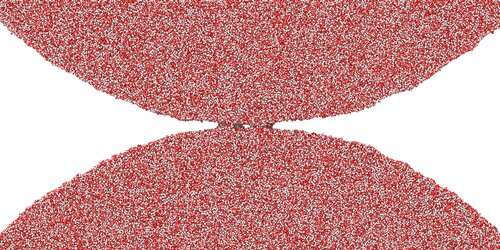
Scientists have revealed the precise molecular mechanisms that cause drops of liquid to combine, in a discovery that could have a range of applications.
Insights into how droplets merge could help make 3D printing technologies more accurate and may help improve the forecasting of thunderstorms and other weather events, the study suggests.
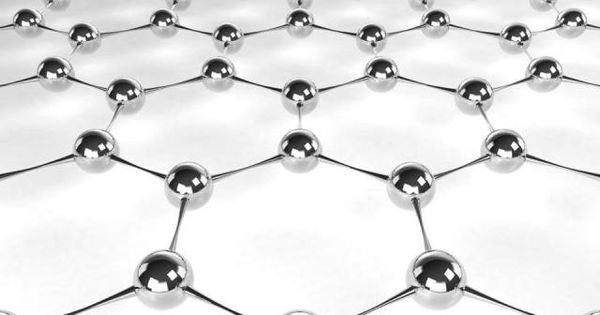
A startup with alumni from MIT and Yale says it’s made a breakthrough in creating a next-generation material that should make it possible to 3D print literally anything out of thin air.
New York-based Mattershift has managed to create large-scale carbon nanotube (CNT) membranes that are able to combine and separate individual molecules.
“This technology gives us a level of control over the material world that we’ve never had before,” said Mattershift Founder and CEO Dr. Rob McGinnis in a release. “For example, right now we’re working to remove CO2 from the air and turn it into fuels. This has already been done using conventional technology, but it’s been too expensive to be practical. Using our tech, I think we’ll be able to produce carbon-zero gasoline, diesel, and jet fuels that are cheaper than fossil fuels.”
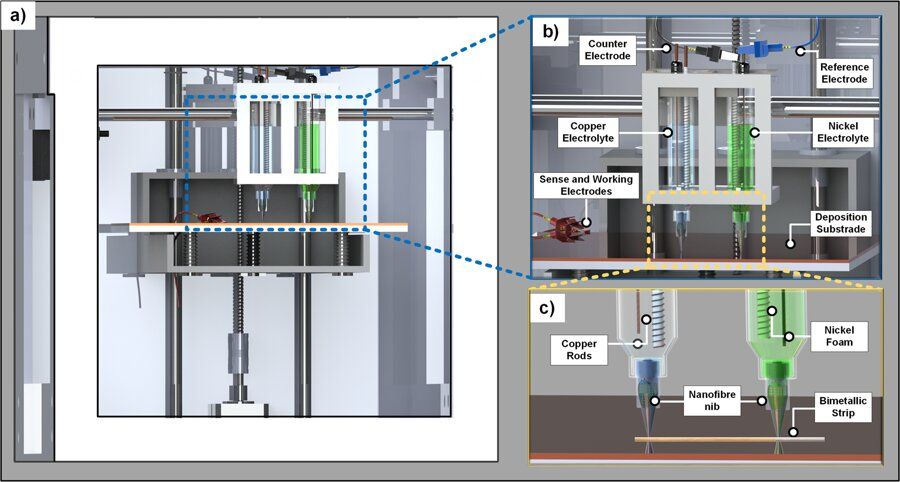
Four-dimensional (4D) printing can create complex 3D geometries that react to environmental stimuli, opening new design opportunities in materials science. A vast majority of 4D printing approaches use polymer materials, which limit the operational temperature during the process of engineering. In a recent study, Xiaolong Chen and co- workers at the Dyson School of Design and Engineering, Department of Earth Science and Engineering and Department of Materials at the Imperial College of London, U.K., developed a new multi-metal electrochemical 3D printer. The device was able to construct bimetallic geometries by selectively depositing different metals with temperature-responsive behavior programmed into the printed structure. In the study, they demonstrated a meniscus confined electrochemical 3D printing approach using a multi-print head design and nickel and copper materials as examples, the ability can be transferred to other deposition solutions. The results are now published in Scientific Reports.