The next—and final?—step for artificial intelligence is on the horizon.

New tools are steadily bridging this gap. And ongoing development of one particular technique, cryo-electron tomography, or cryo-ET, has the potential to deepen how researchers study and understand how cells function in health and disease.
As the former editor-in-chief of Science magazine and as a researcher who has studied hard-to-visualize large protein structures for decades, I have witnessed astounding progress in the development of tools that can determine biological structures in detail. Just as it becomes easier to understand how complicated systems work when you know what they look like, understanding how biological structures fit together in a cell is key to understanding how organisms function.
New study claims an increase in mice median remaining lifespan of 109% via Gene Therapy Mediated Partial Reprogramming.
My full supplement stack: https://drstanfield.com/my-supplements/
Supplements I source from Amazon: http://amzn.to/3o2ULOV
✨10% Discount Code: BRAD ✨
• DoNotAge.org: https://donotage.org/products/
• Renue By Science: https://renuebyscience.com/?rfsn=5206061.b626e7&coupon-code=brad.
• ProHealth: https://www.prohealthlongevity.com/collections/best-sellers.
✨10% Discount Code: BRAD ✨
Donate towards my Rapamycin & Exercise clinical study: https://bit.ly/3QwugRx.
✔️ Look & Feel 5-Years Younger in 90-Days: https://drstanfield.com/5-years-younger/
✔️ Twitter: https://twitter.com/BradStanfieldMD
✔️ Patreon: https://www.patreon.com/bradstanfieldmd.
Here are the links to the research papers referenced in the video:
It’s no secret that social media use can change adult brain anatomy, but a new study suggests that it may impact the developing brains of adolescents in profound ways as well.
Researchers from the University of North Carolina have found, in one of the first studies of its kind, that habitually checking social feeds may change the ways early adolescents process social rewards and punishments — changes concrete enough that they can be seen as distinct and divergent neural pathways in brain scans.
Published in the Journal of the American Medical Association Pediatrics, the paper found significant changes to the amygdala, the bit of grey matter in the brain associated with memory and emotions, in the brains of the 169 tween study participants from a rural North Carolina middle school.

Some health conditions associated with appeared early and consistently long before diagnosis, while others became significant much later, a cohort study suggested.
For people with a subsequent diagnosis of Alzheimer’s disease, the earliest and most consistent associations at all time points over a 15-year span included depression, erectile dysfunction, gait abnormalities, hearing loss, and nervous and musculoskeletal symptoms, reported Lori Beason-Held, PhD, of the National Institute on Aging in Baltimore, and co-authors.
For those eventually diagnosed with vascular, the earliest and most consistent associations across 13 years were an abnormal electrocardiogram (EKG), cardiac dysrhythmias, cerebrovascular disease, non-epithelial skin cancer, depression, and hearing loss, the researchers reported in Annals of Neurology.
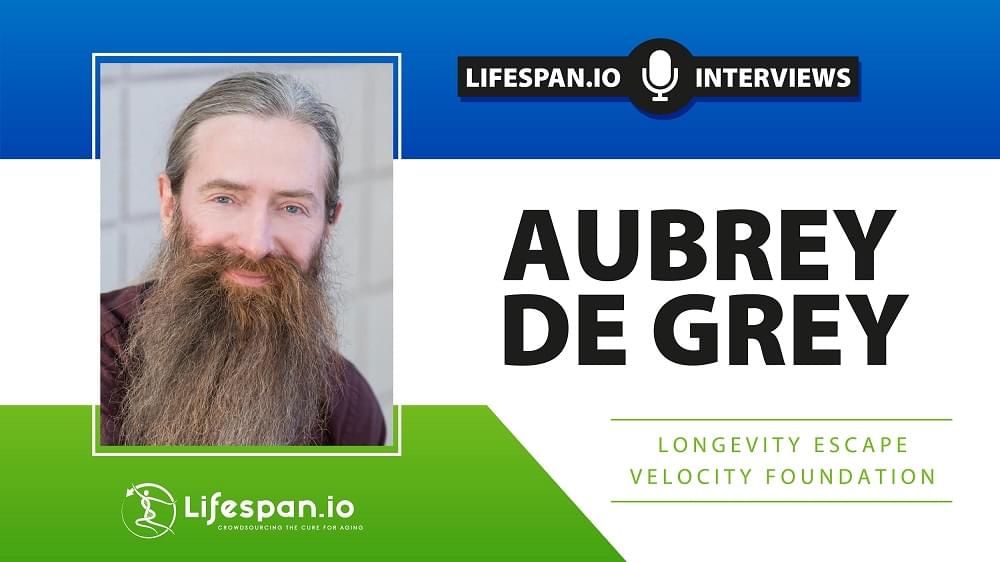
Dr. Aubrey de Grey is a legend in the longevity field who has been steadfastly promoting the idea of life extension since well before it became mainstream. While with SENS Research Foundation, de Grey made significant contributions to geroscience, and at Longevity Summit Dublin last year, he announced the creation of his new brainchild, Longevity Escape Velocity Foundation (LEVF).
Now, the first major and long-awaited LEVF-funded project is being launched: Robust Mouse Rejuvenation (RMR). This is envisioned as a rolling research program aiming to increase both the mean and maximum lifespan of mice by at least 12 months with various combination therapies started late in life. For the first study, four therapies have been chosen: rapamycin, a senolytic, hematopoietic stem cell transplantation (HSCT), and telomerase expression. A groundbreaking experiment by any measure, RMR got us excited, and we reached out to Aubrey to discuss both RMR and LEVF in depth.
The following interview has Arkadi asking questions in bold and Aubrey de Grey answering in normal font.
The finding that these “hidden” memories can be accessed once more, at least in mice, throws up a world of intriguing possibilities.
Neuroscientist Robbert Havekes and his team at the University of Groningen found that learning while sleep-deprived does not result in memory loss; rather, it is more difficult to recall.
“We previously focused on finding ways to support memory processes during a sleep deprivation episode,” says Havekes.
Artisteer/iStock.
Havekes and the team used optogenetic techniques and the human-approved asthma medicine roflumilast to find a means to make this “hidden knowledge” accessible once more days after researching while sleep-deprived.
Naeblys/iStock.
Also known as lecanemab, Leqembi is the second drug of its kind – a medication that has been approved for treating Alzheimer’s disease. This type of medication targets the fundamental pathophysiology of the disease and is considered a significant development in the effort to successfully treat Alzheimer’s disease.
Time to reverse your age and restore youth.
Scientists at a San Diego-based biotech company Rejuvenate Bio claim to have increased the age of mice by reprogramming their genes. They believe their gene therapy actually works like a reverse aging technique that one day might be used for rejuvenating humans.
Their lifespan increased by about seven percent after the introduction of the genes.
National Science Foundation.
The researchers introduced three reprogramming genes into mice that had a remaining lifespan of about nine weeks. Interestingly, the mice survived for 18 weeks after the gene therapy. The tested mice were like 77-year-old humans before the gene therapy.

You have probably heard of ChatGPT and DALLE-E, a new class of AI-powered software tools that can create new images or write text. The algorithm brings to life any idea you may have by putting together fragments of what it has previously seen — such as images annotated with meta-descriptions of what they represent — to generate original content from user-defined input. But now generative AI technology is revolutionizing drug discovery. Absci Corporation (Nasdaq: ABSI) is using machine learning to transform the field of antibody therapeutics: Absci has put out a press release today announcing the ability to create new antibodies with the use of generative AI.
GenerativeAI: You’ve seen it with images like DALL-E, you’ve seen it with text like ChatGPT. Now you can see it with protein design as well.