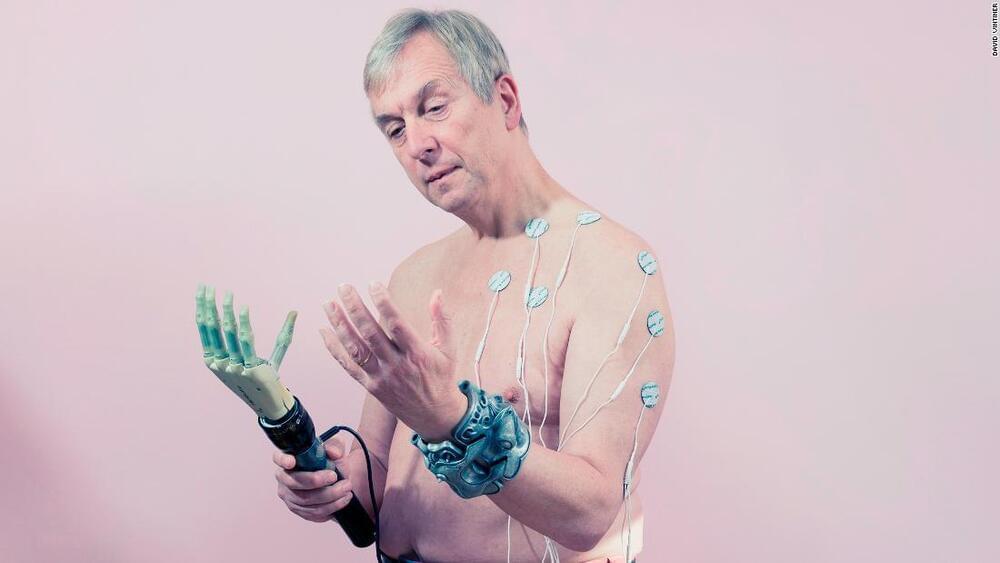
A superficial treatment of Transhumanism by CNN.
Photographer David Vintiner’s portraits feature subjects identifying as “transhuman,” including a man with bionic ears and a woman who can “feel” earthquakes.
Good news.
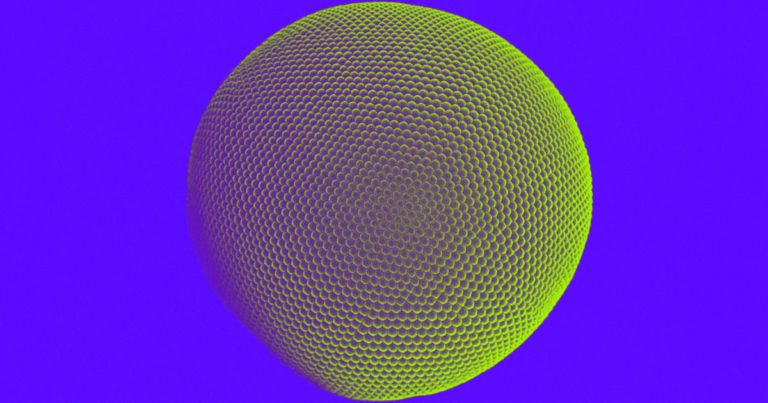
In a paper published last week in Nature, though, researchers from Hong Kong University of Science and Technology devised a way to build photosensors directly into a hemispherical artificial retina. This enabled them to create a device that can mimic the wide field of view, responsiveness, and resolution of the human eye.
“The structural mimicry of Gu and colleagues’ artificial eye is certainly impressive, but what makes it truly stand out from previously reported devices is that many of its sensory capabilities compare favorably with those of its natural counterpart,” writes Hongrui Jiang, an engineer at the University of Wisconsin Madison, in a perspective in Nature.
Key to the breakthrough was an ingenious way of implanting photosensors into a dome-shaped artificial retina. The team created a hemisphere of aluminum oxide peppered with densely-packed nanoscale pores. They then used vapor deposition to grow nanowires inside these pores made from perovskite, a type of photosensitive compound used in solar cells.
You might be interested in my latest interview with Natasha Vita-More, transhumanist writer and executive director of Humanity+, covering human augmentation, the world transhumanist movement and whole-body prosthetics.
Trying to grow my transhumanism related channel so super grateful for any subs: https://www.youtube.com/channel/UCnVLqMgLDwO-aSk5YcYo1dA…
I interview Natasha Vita-More, a transhumanist thinker who wrote the ‘Transhumanist Statement’ and is the Executive Director of Humanity+, formerly the World Transhumanist Association.
We cover artificial intelligence, whole body prosthetics, radical life extension, upgrading the human body and the world transhumanist movement amongst other topics.

A visual cortical prosthesis (VCP) has long been proposed as a strategy for restoring useful vision to the blind, under the assumption that visual percepts of small spots of light produced with electrical stimulation of visual cortex (phosphenes) will combine into coherent percepts of visual forms, like pixels on a video screen. We tested an alternative strategy in which shapes were traced on the surface of visual cortex by stimulating electrodes in dynamic sequence. In both sighted and blind participants, dynamic stimulation enabled accurate recognition of letter shapes predicted by the brain’s spatial map of the visual world. Forms were presented and recognized rapidly by blind participants, up to 86 forms per minute. These findings demonstrate that a brain prosthetic can produce coherent percepts of visual forms.

Other researchers who were not involved in the project pointed out that plenty of work still has to be done to eventually be able to connect it to the human visual system, as Scientific American reports.
But some are hopeful.
“I think in about 10 years, we should see some very tangible practical applications of these bionic eyes,” Hongrui Jiang, an electrical engineer at the University of Wisconsin–Madison who was not involved in the research, told Scientific American.

Roam Robotics is making robotic exoskeletons that are lightweight and affordable so that they can become a new category of consumer electronics. Traditional robotic exoskeletons can weigh between 30 to 60 pounds because they rely on high precision mechanical systems. They are big and bulky and cost as much as a luxury car, which significantly limits their usefulness and availability. Roam’s new robotic exoskeletons are so portable and inexpensive that they could quickly become a commonplace part of modern life.

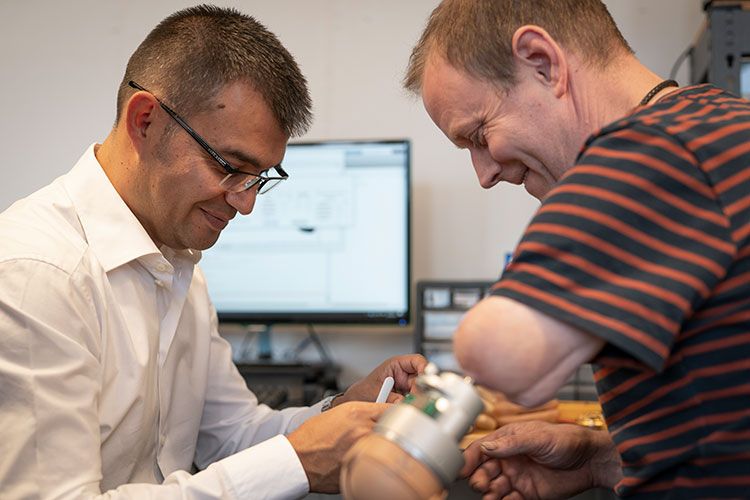
The advance is unique: the patients have used a mind-controlled prosthesis in their everyday life for up to seven years. For the last few years, they have also lived with a new function – sensations of touch in the prosthetic hand. This is a new concept for artificial limbs, which are called neuromusculoskeletal prostheses – as they are connected to the user’s nerves, muscles, and skeleton.
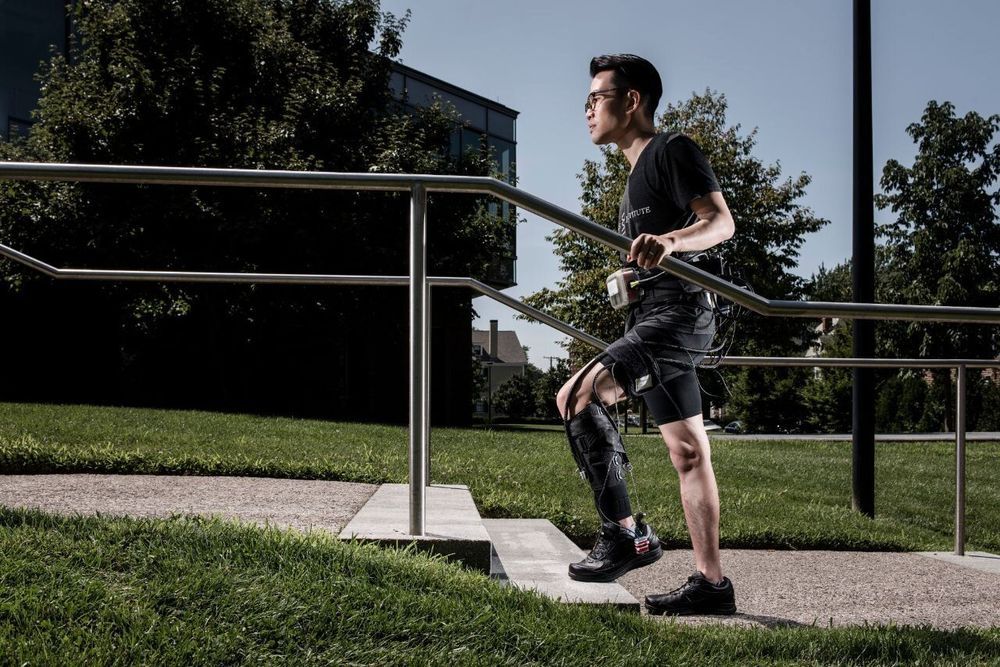
Stroke is the leading cause of serious long-term disability in the US with approximately 17 million individuals experiencing it each year. About 8 out of 10 stroke survivors suffer from “hemiparesis”, a paralysis that typically impacts the limbs and facial muscles on one side of their bodies, and often causes severe difficulties walking, a loss of balance with an increased risk of falling, as well as muscle fatigue that quickly sets in during exertions. Oftentimes, these impairments also make it impossible for them to perform basic everyday activities.
To allow stroke patients to recover, many rehabilitation centers have looked to robotic exoskeletons. But although there are now a range of exciting devices that are enabling people to walk again who initially were utterly unable to do so, there remains significant active research trying to understand how to best apply wearable robotics for rehabilitation after stroke. Despite the promise, recent clinical practice guidelines now even recommend against the use of robotic therapies when the goal is to improve walking speed or distance.
In 2017, a multidisciplinary team of mechanical and electrical engineers, apparel designers, and neurorehabilitation experts at Harvard’s Wyss Institute for Biologically Inspired Engineering and John A. Paulson School of Engineering and Applied Sciences (SEAS), and Boston University’s (BU) College of Health & Rehabilitation Sciences: Sargent College showed that an ankle-assisting soft robotic exosuit, tethered to an external battery and motor, was able to significantly improve biomechanical gait functions in stroke patients when worn while walking on a treadmill. The cross-institutional and cross-disciplinary team effort was led by Wyss faculty members Conor Walsh, Ph.D. and Lou Awad, P.T., D.P.T., Ph.D, together with Terry Ellis, Ph.D., P.T., N.C.S. from BU.