Toggle light / dark theme

Ultrafast camera takes 1 trillion frames per second of transparent objects and phenomena

A little over a year ago, Caltech’s Lihong Wang developed the world’s fastest camera, a device capable of taking 10 trillion pictures per second. It is so fast that it can even capture light traveling in slow motion.

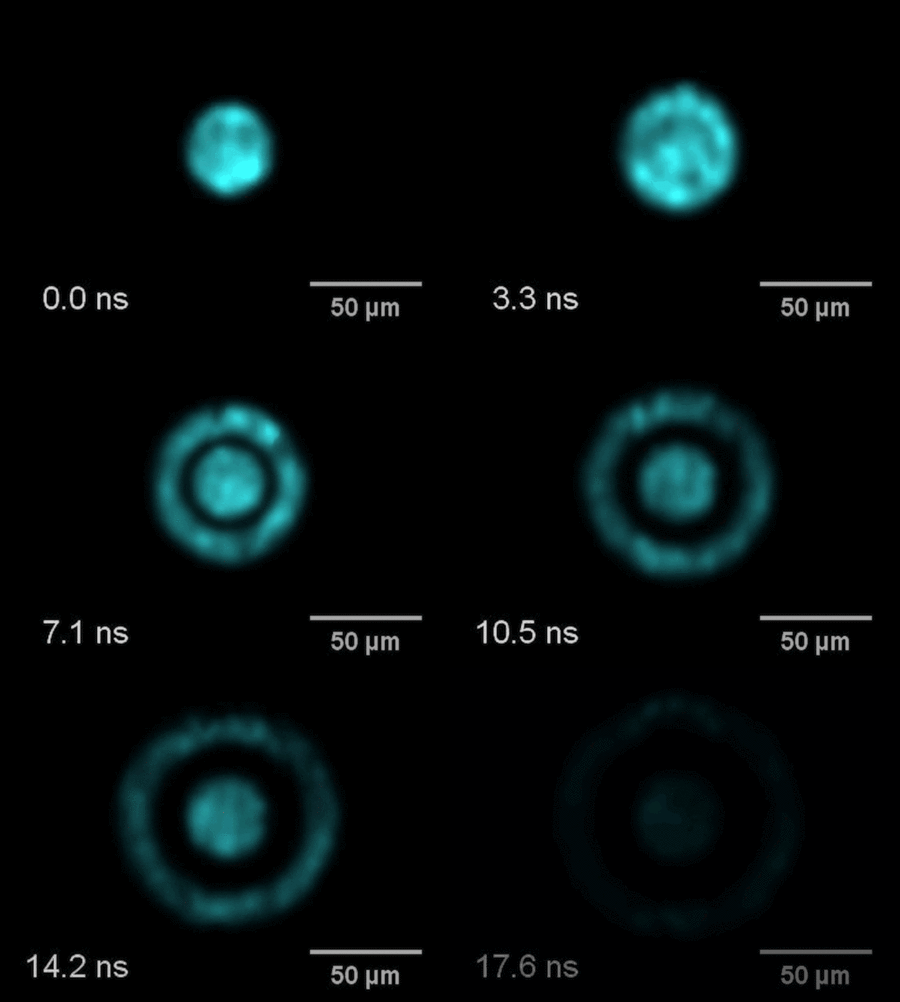
But sometimes just being quick is not enough. Indeed, not even the fastest camera can take pictures of things it cannot see. To that end, Wang, Bren Professor of Medical Engineering and Electrical Engineering, has developed a that can take up to 1 trillion pictures per second of transparent objects. A paper about the camera appears in the January 17 issue of the journal Science Advances.

The technology, which Wang calls phase-sensitive compressed ultrafast photography (pCUP), can take video not just of transparent objects but also of more ephemeral things like shockwaves and possibly even of the signals that travel through neurons.

Watch SpaceX launch a Boeing-built satellite and attempt to recover its spacecraft fairing live

SpaceX is launching yet another rocket this evening — its 13th this year. This Falcon 9 launch is set for liftoff sometime during a window that’ll last for just over an hour, and that opens at 7:10 PM EST (4:10 PM PST) and extends to 8:38 PM EST (5:38 PM PST). The launch will use a first-stage rocket booster that previously flew in May and July of this year, and it’ll include an attempted landing of that booster, as well as a try at recovering both halves of the fairing used to protect the spacecraft’s cargo as it ascends to space.

The cargo itself is a satellite built by Boeing that hosts two payloads for different clients, including Japanese pay TV broadcast service provider SKY Perfect JSAT, and a high-speed broadband connectivity satellite developed by Kratos called Kacific1. The Falcon 9 spacecraft will be looking to deliver these to orbit around half-an-hour after liftoff.

It’s definitely going to be worth watching the secondary mission elements of this one, as SpaceX has so far succeeded only in recovering one half of a fairing used during a mission with a single barge stationed in the ocean. This will see it try to catch both pieces, using two ships named “Ms. Tree” and “Ms. Chief” that have been retrofitted with a large net assembly specifically for the purpose.

Flexible organic electrodes built using water-processed silver nanowires

Organic electronic devices, which are made of small molecules or polymers (i.e., substances composed primarily or completely of similar units bound together) are known to have several advantageous properties. In fact, organic electronics have relatively low production costs, they are easy to integrate with other systems and they enable good device flexibility.

Despite their advantages, most organic optoelectronics devices do not perform as well as devices built on rigid substrates. This is primarily due to the lack of existing flexible electrodes that can simultaneously provide low resistance, high transparency and smooth surfaces.

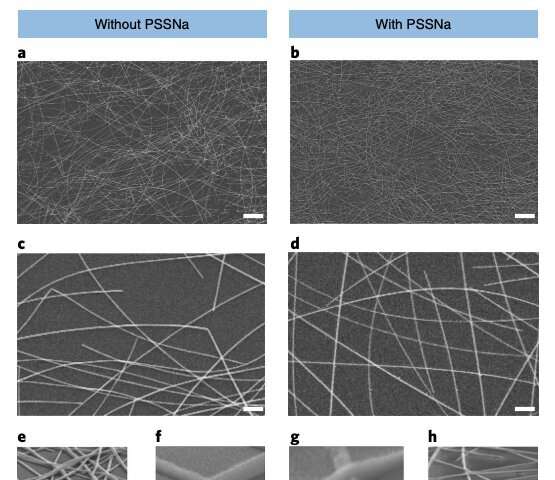
With this in mind, researchers at Nankai University in China have recently set out to create new organic electrodes for flexible photovoltaics, devices that can be used to capture sunlight and convert it into electricity. The electrodes they developed, presented in a paper published in Nature Electronics, were built using water-processed silver nanowires and a polyelectrolyte.

/* */