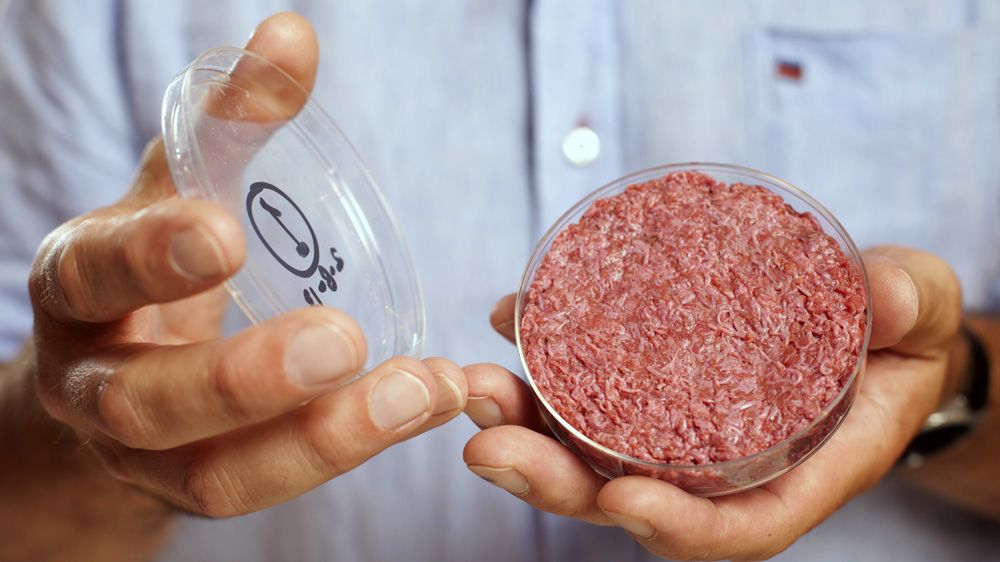
ROME (Thomson Reuters Foundation) — It may sound like science fiction, but in a few short years the family dinner table may be laden with steak from a printer and other proteins produced from air, methane or volcanic microbes.
With the explosive success of vegan beef and burger substitutes developed by Beyond Meat and Impossible Foods, the alternative protein sector just keeps growing.
According to investment bank Barclays, alternative meat sales could reach $140 billion — or 10% of the global meat industry — within a decade, or a 10-fold increase from current levels.
God gives long life to those with a good heart??? Because they work??? Because they eat anything??? That is some of the answers one gets when asking these centurians what got them past 100??? Buster is a character he states he smokes and drinks so he does not know why??? I say mindset and treatment are very key in Japanese culture. In the west sadly families begin to shun and demonize the elderly in their family.
As life expectancy continues to soar, more and more of us are living to well over the age of 100. Award-winning filmmaker Daisy Asquith asks some of the oldest people in the world the question everyone wants answered: what is the secret to long life?
Trillions of plastic fragments are afloat at sea, which cause large “garbage patches” to form in rotating ocean currents called subtropical gyres. As a result, impacts on ocean life are increasing and affecting organisms from large mammals to bacteria at the base of the ocean food web. Despite this immense accumulation of plastics at sea, it only accounts for 1 to 2 percent of plastic debris inputs to the ocean. The fate of this missing plastic and its impact on marine life remains largely unknown.
It appears that sunlight-driven photoreactions could be an important sink of buoyant plastics at sea. Sunlight also may have a role in reducing plastics to sizes below those captured by oceanic studies. This theory could partly explain how more than 98 percent of the plastics entering the oceans go missing every year. However, direct, experimental evidence for the photochemical degradation of marine plastics remains rare.
A team of scientists from Florida Atlantic University’s Harbor Branch Oceanographic Institute, East China Normal University and Northeastern University conducted a unique study to help elucidate the mystery of missing plastic fragments at sea. Their work provides novel insight regarding the removal mechanisms and potential lifetimes of a select few microplastics.
From raindrops rolling off the waxy surface of a waterlily leaf, to the efficiency of desalination membranes, interactions between water molecules and water-repellent “hydrophobic” surfaces are all around us. The interplay becomes even more intriguing when a thin water layer becomes sandwiched between two hydrophobic surfaces, KAUST researchers have shown.
In the early 1980s, researchers first noted an unexpected effect when two hydrophobic surfaces were slowly brought together in water. “At some point, the two surfaces would suddenly jump into contact—like two magnets being brought together,” says Himanshu Mishra from KAUST’s Water Desalination and Reuse Center. Mishra’s lab investigates water at all length scales, from reducing water consumption in agriculture, to the properties of individual water molecules.
When the first smartphones arrived, few people understood how they would change our reality. Today, our internet-connected mobile device maps our travel, manages our finances, delivers our dinner, and connects us to every corner of human knowledge. In less than a generation, it has become almost an extension of our central nervous system — so indispensable that we can’t imagine leaving home without it to guide us.
We are about to embark on another journey even more important to every individual and to human society. We are entering the age of genomics, an amazing future that will dramatically improve the health outcomes of people across the planet. Soon, we won’t be able to imagine a time when we left home without knowledge of our genome to guide us.
But this future isn’t a generation away. As early as 2020, I believe we will be living in a world where software uses knowledge of our personal genome to guide us, like a health GPS, toward choices that are appropriate for us as individuals. From the foods we choose to eat to the medicines we take to prevent or cure disease, from helping us avoid exposure to environmental risks to eradicating thousands of genetic diseases, genomics will reveal such immense possibilities that it will feel as if we can see and hear for the first time.
Diet Plan For Old Age: Reduced food intake must be implemented early and be sustained.
Someone has rightly said, ‘healthy eating begins with you.’ Nourishing your body with the right nutrients and maintaining a healthy weight can help you stay active and independent even as you age. According to a recent study published in the journal Nature Metabolism, reduced intake of food in both humans and animals may improve health in their old age, further leading to longevity. However, in order to improve health in old age and to extend lifespan, the pattern of the diet (diet plan) must be established earlier in life. Scientists from the Max Planck Institute for Biology of Ageing, the Excellence Cluster for Ageing Research at the University of Cologne, the Babraham Institute in Cambridge and UCL observed that mice become healthier when they were fed in moderation from early stage and maintained it before entering old age.
STOMACH bloating is a recurring problem for many people in the UK, with symptoms persisting despite shunning certain culprits known to cause tummy grief. While avoiding certain foods can help to ease symptoms, other foods have been shown to soothe symptoms, including an exotic fruit.
Family grows 7000 pounds of organic food per year on a tenth of an acre, supplying 90 percent of their diet… They spend less than $2 per day per person on other kitchen staples and make over $20,000 a year selling excess produce
Fifteen minutes from downtown Los Angeles, just 100 feet away from a major freeway, a small city lot was transformed into a mini paradise.