Toggle light / dark theme

Will Self-Driving Cars Kill Your Job?

Self-driving cars are pretty cool. Really, who wouldn’t want to spend their daily commute surfing social media, chatting with friends or finishing the Netflix series they were watching at 4 am the night before? It all sounds virtually utopian. But what if there is a dark side to self-driving cars? What if self-driving cars kill the jobs? ALL the jobs?

In this video series, the Galactic Public Archives takes bite-sized looks at a variety of terms, technologies, and ideas that are likely to be prominent in the future. Terms are regularly changing and being redefined with the passing of time. With constant breakthroughs and the development of new technology and other resources, we seek to define what these things are and how they will impact our future.

Follow us on social media:
Twitter / Facebook / Instagram

Follow the money – the future evolution of automotive markets

The automotive industry is undergoing a period of rapid and radical transformation fueled by a range of technological innovations, digital advancements and wave after wave of new entrants and alternative business models; as a result, the entire sector is seeing major disruption.

Read More

A neural approach to relational reasoning

Teaches artificial intelligence superhuman relational reasoning.


A key challenge in developing artificial intelligence systems with the flexibility and efficiency of human cognition is giving them a similar ability — to reason about entities and their relations from unstructured data. Solving this would allow these systems to generalize to new combinations of entities, making infinite use of finite means.

Modern deep learning methods have made tremendous progress solving problems from unstructured data, but they tend to do so without explicitly considering the relations between objects.

In two new papers, we explore the ability for deep neural networks to perform complicated relational reasoning with unstructured data. In the first paper — A simple neural network module for relational reasoning — we describe a Relation Network (RN) and show that it can perform at superhuman levels on a challenging task. While in the second paper — Visual Interaction Networks — we describe a general purpose model that can predict the future state of a physical object based purely on visual observations.

Hankook Tires reveals its vision for the future of transport

A total of 34 works were submitted as part of Hankook Tires’ Design Insight forum, with five winners chosen.

Mr Seung Hwa Suh, Vice Chairman and CEO of Hankook Tire said: ‘The Design Insight Forum to be held at Hankook Technodome is truly meaningful that one can witness fine works of young designers of the future tire innovation at the new and state-of-the art R&D center, Hankook Technodome.

‘Hankook Tire expects to create further synergies with the future leaders in collaboration with Hankook Tire’s technology leadership through the Design Insight Forum.’

Natural Disaster: 5.8 Magnitude Earthquake Hits Montana, Raising Supervolcano Concerns

Yellowstone National Park, which covers parts of Wyoming, Idaho and Montana, lies on top of a supervolcano that could effectively wipe out the United States if it were to explode. The last time it did, 640,000 years ago, it expelled 240 cubic miles (think about that) of rocky debris into the sky.

Early Thursday morning, residents of southern Montana feared the worst when a 5.8 magnitude earthquake shook the region. Though its epicenter was only 230 miles from Yellowstone, the United States Geological Survey (USGS) says the seismic activity was not irregular, and the supervolcano is not expected to erupt anytime soon.

Related: Yellowstone supervolcano hit by hundreds of earthquakes.

3D printers start to build factories of the future

As this example shows, 3D printing has come a long way, quickly. In February 2011, when The Economist ran a story called “Print me a Stradivarius”, the idea of printing objects still seemed extraordinary. Now, it is well established. Additive manufacturing, as it is known technically, is speeding up prototyping designs and is also being used to make customised and complex items for actual sale.


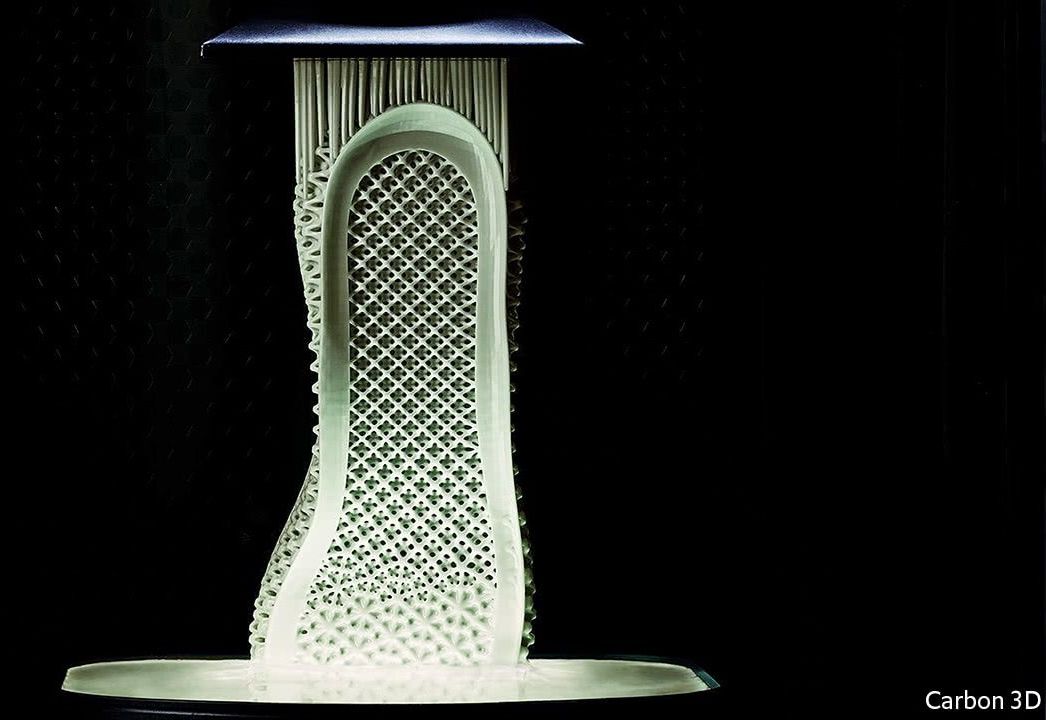
SLOWLY but surely the sole of a shoe emerges from a bowl of liquid resin, as Excalibur rose from the enchanted lake. And, just as Excalibur was no ordinary sword, this is no ordinary sole. It is light and flexible, with an intricate internal structure, the better to help it support the wearer’s foot. Paired with its solemate it will underpin a set of trainers from a new range planned by Adidas, a German sportswear firm.

Adidas intends to use the 3D-printed soles to make trainers at two new, highly automated factories in Germany and America, instead of producing them in the low-cost Asian countries to which most trainer production has been outsourced in recent years. The firm will thus be able to bring its shoes to market faster and keep up with fashion trends. At the moment, getting a design to the shops can take months. The new factories, each of which is intended to turn out up to 500,000 pairs of trainers a year, should cut that to a week or less.

NASA’s Quiet Supersonic Plane Could Soon Take Flight

It has been more than a decade since the Concorde was retired from service, and since then no passenger aircraft has exceeded the speed of sound. That might change in the not-too-distant future, thanks to a project from NASA and industry partner Lockheed Martin Corporation. The agency is close to testing its design for Quiet Supersonic Transport, or QueSST, which could lead to passenger jets that can again reach supersonic speeds.

The Concorde was never seen as a major commercial success — more of a vanity project for the few European airlines that operated the planes. The nature of supersonic flight meant the sonic boom at ground level could shatter windows. Thus, the plane could only fly at high speeds over the ocean. The trip between Europe and New York was fast, but other routes were not feasible. When the travel industry took a downturn in 2003, the Concorde was mothballed.

QueSST technology has the potential to make supersonic air travel workable even over land, and NASA has announced that its preliminary design review is done. The aim is to build a plane that can fly at supersonic speeds without the disruptive sonic boom. NASA, with the help of Lockheed Martin, has designed and tested a scale model version of the so-called Low Boom Flight Demonstration (LBFD) experimental aircraft, known as an X-plane. This model was placed in a 6-by-8-foot supersonic wind tunnel at NASA’s Glenn Research Center. This led engineers to confirm the fuselage, wing, and engine design could allow for quieter supersonic flight.

/* */