Sixteen people in six states have been infected with the listeria strain, resulting in one death and 13 hospitalizations, the agency said.


My AI Girlfriend won’t talk to me unless I renew my annual Netflix subscription.
— You in five years
Everyone has written about the dangers of AI and the uncertain future of humanity, and many of these worries focus on large scale issues like disinformation, democracy, wartime decision making by computers, etc. However, it is the small and personal changes to human life that tend to create the biggest effects down the line. If we assume that a sizeable portion of the population will have, at some point, some form of AI assistant, friend, companion, etc. and that these AI assistants are designed by for-profit companies to perfectly press our psychological buttons, then we are in serious danger of handing ourselves over to the whims of those companies, or governments.
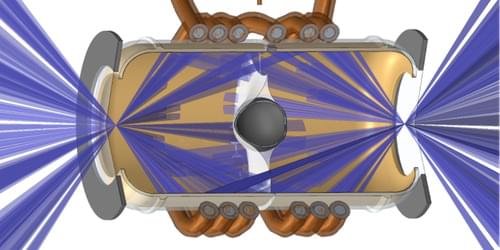
A magnetic field can significantly boost the performance of a large-scale fusion experiment that may lead to a future source of clean power.
Nuclear fusion could provide a clean power source, but one of the technological challenges is maintaining the fuel at a high enough temperature for a long enough time. In a technique called inertial confinement fusion (ICF)—where lasers initiate the nuclear reaction—a magnetic field has been shown to improve heating. Now researchers have shown that a magnetic field can also help in a large-scale experiment with a more complicated design that produces far more energy [1]. The applied field increased the fuel’s temperature by 40% and tripled the fusion reaction’s efficiency. The work provides a step toward increasing the robustness and energy output of the fusion reaction and provides the first proof of concept of magnetization-assisted fusion in a large-scale experiment.
In the simplest version of ICF, synchronized laser pulses hit a capsule filled with cold hydrogen fuel, causing it to implode. The implosion heats the fuel and creates a spot of burning plasma (see Viewpoint: Fusion Turns Up the Heat). The “hot spot” serves as a spark that initiates burning throughout the fuel, driving a self-sustaining fusion reaction that releases energy. However, these implosions can fail to generate significant fusion energy if the fuel pellet has small imperfections on its surface or if the lasers are not perfectly timed. But if the fuel could be heated to temperatures higher than was possible in recent experiments, there would be more margin for error, which could alleviate the sensitivity to such details.
Share your videos with friends, family, and the world.

Elon Musk doesn’t follow the same standards that most entrepreneurs do. He’s different, he likes to be different!
And when you’re different, and you’re not afraid to be, it’s okay to test a cigar (or should I say ‘joint’?) of tobacco mixed with marijuana, on Joe Rogan’s famous podcast. But if you look closely, Elon was just nice (polite) and followed Rogan’s elaborate script. Before trying it, Musk even asked him if it was legal.
Then all those facial expressions of Musk, which photojournalists love to catch, go viral as if he’s there promoting some soft drug or passing abroad that his office at Tesla (or SpaceX) is enveloped in a large cloud of smoke.
Quite the opposite. The expressions themselves spoke for themselves, as if to say, “This is nothing special, Joe. Why do you waste my time with these scenes”? Musk even claimed that weed is not good for productivity at all, but it has nothing against (as I do, by the way).

Erik Verlinde has been compared to Einstein for completely rethinking the nature of gravity.
Read more about Present And Future Exist Simultaneously, According To This New Theory.

The UK @Ministry of Defence #Defence Science and #Technology Laboratory (Dstl) has hosted the UK’s first high-powered, long-range #Laser Directed Energy Weapon (LDEW) trial on its ranges at Porton Down.
The trials involve firing the UK #DragonFire demonstrator at a number of targets over a number of ranges, demanding pinpoint accuracy from the beam director.
The trial improves the UK’s understanding of how high-energy lasers and their associated technologies can operate over distance and defeat representative targets. The ability to deliver high levels of laser power with sufficient accuracy are two of the major areas that need to be demonstrated in order to provide confidence in the performance and viability of LDEW systems.
The programme has developed a UK Sovereign ‘Centre of Excellence’ staffed with experts from multiple fields. LDEW have the potential to provide lower cost lethality, reduced logistical burden and increased effectiveness when compared to other weapon systems – the technology could have a huge effect on the future of Defence operations.
The programme’s specialist industry partners are:
• @MBDA with overall responsibility for the system and have developed the advanced command and control (C2) and image processing capabilities;