Scientists are starting to run for office to bring evidence-based reasoning back to government.

It’s getting too easy to create dangerous viruses. The upcoming national biodefense strategy should ensure that scientific journals don’t help terrorists learn how.
The news that researchers have recreated an extinct cousin to the smallpox virus using only commercially available technology and items purchased over the Internet renews concerns that bioterrorists could do the same if detailed information about the methods were published. Here’s the problem: scientific journals are geared toward publication, often without sufficient understanding of the public-security risks. We need a better system to ensure that information that could help bad actors stays unpublished.
It took David Evans’ team of scientists at the University of Alberta in Edmonton, Canada, about six months and $100,000 to recreate the horsepox virus, a close relative of the smallpox virus that killed perhaps 300 million people in the 20th century before it was eradicated in 1980. In a summary of the research, the World Health Advisory Committee on Variola Virus Research wrote that “recreation of such viral genomes did not require exceptional biochemical knowledge or skills, significant funds, or significant time.”

How the tech billionaires are planning to send you into space.
John Thornhill investigates whether big government or big business will fund the future of space exploration.
Watch the full interview with ex-NASA Admin Charles Bolden:
Watch the full interview with sci-fi author Kim Stanley Robinson:
► Subscribe to FT.com here: http://bit.ly/2r8RJzM
► Subscribe to the Financial Times on YouTube: http://bit.ly/FTimeSubs

Gold climbed to the highest since mid-June, pushing up mining-company shares amid military tensions between the U.S. and North Korea.
Equities slid and the Swiss franc and some developed-market government bonds advanced as President Donald Trump threatened North Korea with “fire and fury” following a series of missile tests by the communist regime, boosting demand for haven assets. Gold also climbed after Indian imports of the metal were said to have doubled.
The U.S. North-Korea tensions add to investor angst that has helped push up gold more than 10 percent this year, even with equities hitting records and the Federal Reserve keen to shrink its balance sheet. Should geopolitical tensions intensify, gold is likely to be in demand as a safe-haven, according to analysts at Commerzbank AG.

John Bucknell presented at the Starship Congress 2017 his Nuclear Thermal Turbo Rocket and applied for a single stage to orbit mission of placing a space habitat. John Bucknell worked on the SpaceX Raptor rocket as a senior engineer so he is very qualified to understand current rocket technology and rockets in general.
Nextbigfuture has noted that NASA has funded $18.8 million on advancing nuclear thermal rocket propulsion by studying low enriched uranium for the fuel. Nuclear-powered rocket concepts are not new. The United States conducted studies and significant ground tests from 1955 to 1972 to determine the viability of such systems, but ceased testing when plans for a crewed Mars mission were deferred.
The NERVA NRX (Nuclear Rocket Experimental) program started testing in September 1964. The final engine in this series was the XE, designed with flight design hardware and fired in a downward position into a low-pressure chamber to simulate a vacuum. SNPO fired NERVA NRX/XE twenty-eight times in March 1968. The series all generated 1100 MW, and many of the tests concluded only when the test-stand ran out of hydrogen propellant. NERVA NRX/XE produced the baseline 75,000 lbf (334 kN) thrust that Marshall required in Mars mission plans.

A proposal in Congress would create the first new uniformed service in 70 years, but it faces opposition from the Pentagon.
The U.S. military hasn’t added a new uniformed service in 70 years, when the Air Force was created in the aftermath of World War II.
If Congress gets its way, that will soon change.
It’s a tricky problem, so solutions have to be carefully thought out.
Federal agencies face a thorny path as they try to step up the government’s fight against armies of infected computers and connected devices known as botnets, responses to a government information request reveal.
Industry, academic and think tank commenters all agreed more should be done to combat the zombie computer armies that digital ne’er-do-wells frequently hire to force adversaries offline.

Are U.S. killer drones headed to the Philippines? There are already U.S. special operators fighting ISIS there. There could soon be American drones carrying out airstrikes there, too, according to a plan under consideration inside the Pentagon, NBC News reported Monday. “The authority to strike ISIS targets as part of collective self-defense could be granted as part of an official military operation that may be named as early as Tuesday, said the officials. The strikes would likely be conducted by armed drones.”
SecState Rex Tillerson gave the pitch some momentum Monday in Manila when he said the U.S. was providing the Philippine government “some recent transfers of a couple of Cessnas and a couple of UAVs (drones) to allow to them to have better information with which to conduct the fight down there.”
And in a bid to cut off concerns over working even more closely with alleged human rights abuser Philippine President Rodrigo Duterte, Tillerson said that’s pretty much just not an issue right now: “I see no conflict at all in our helping them with that situation and our views of other human rights concerns we have with respect to how they carry out their counternarcotics activities.” More from NBC News, here.
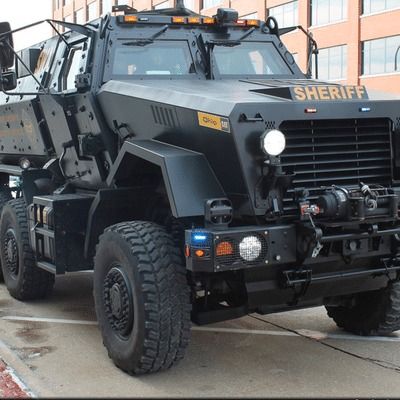
A sting operation run by the Government Accountability Office revealed a number of loopholes that bad actors could use to buy excess military arms and equipment through the 1033 program.
When you realize you’ve somehow sold $1.2 million worth of controlled military equipment to a law enforcement agency that doesn’t exist, you’re likely to jumpstart efforts to reform that program.
That’s what happened when the Defense Logistics Agency learned that a sting operation run by the Government Accountability Office had exploited vulnerabilities in the Pentagon’s 1033 program, which sells local, state, and federal law enforcement agencies excess military equipment.