Toggle light / dark theme

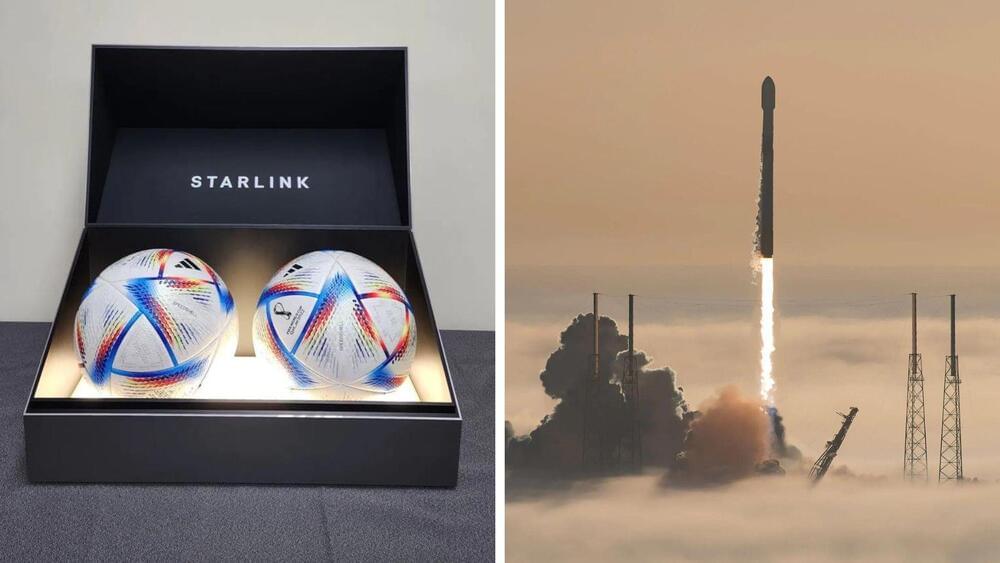
FIFA World Cup’s high-tech balls kicked 76 miles into space aboard SpaceX rocket

Al Rihla in Arabic means “a journey,” and perhaps this was one of the epic journeys of the technologically loaded football.

The FIFA World Cup official match ball, Al Rihla, has been launched into space and back in a football frenzy to garner attraction to the ongoing World Cup in Qatar.

From space to the football pitch. We brought the official football for FIFA World Cup Qatar, becoming part of this historical out-of-the-world journey together with.


Starlink.

Qatar Airways teamed up with SpaceX to send two FIFA World Cup official match balls all the way to space, according to a Twitter post by the state-owned flag carrier airline on Sunday.
China will regulate AI-generated content with a new set of regulations

The rules will go into effect starting in 2023.

China has issued rules and guidelines that regulate the use of artificial intelligence within the country. The regulations are cautious when it comes to AI. This includes the trending AI chatbots, such as ChatGPT, AI-generated art, the many methods of utilizing AI in the health care sector and all forms of artificial intelligence, in general.

The Cyberspace Administration of China (CAC), has issued a set of rules to follow when incorporating AI. The CAC is the internet regulator and censor in China. The agency released guidelines on “deep synthesis”. The regulatory measures will take effect starting on Jan. 10, 2023.


Igor Kutyaev/iStock.

The conditions regarding AI, or “deep synthesis”.

4 Mind-Boggling Technology Advances In Store For 2023

Kindly see my latest FORBES article:

In the piece I explore some of the emerging tech that will impact our coming year. Thank you for reading and sharing!


2022 was a transformative year for technological innovation and digital transformation. The trend will continue as the pace of innovation and development of potentially disruptive emerging technologies exponentially increases every year. The question arises, what lies ahead for tech for us to learn and experience in 2023?

While there are many impactful tech topics such as the Internet of Things, 5G, Space, Genomics, Synthetic Biology, Automation, Augmented Reality, and others, there are four tech areas to keep a keen watch on this coming year as they have promising and near-term capabilities to transform lives. They include: 1) artificial intelligence, 2) computing technologies, 3) robotics, and 4) materials science.

Video streaming as polluting as driving? See the new calculations

Could video streaming be as bad for the climate as driving a car? Calculating Internet’s hidden carbon footprint.

We are used to thinking that going digital means going green. While that is true for some activities — for example, making a video call to the other side of the ocean is better than flying there — the situation is subtler in many other cases. For example, driving a small car to the movie theatre with a friend may have lower carbon emissions than streaming the same movie alone at home.

How do we reach this conclusion? Surprisingly, making these estimates is fairly complicated.


ATHVisions/iStock.

This is remarkable given that we have been able to estimate quite accurately phenomena that are much more complex. In this case, we would only need quantitative information – the electrical energy and the amount of data used – that can be determined with great accuracy. The current situation is not acceptable and should be addressed soon by policymakers.

Thanks to AI, it’s probably time to take your photos off the Internet

If you’re one of the billions of people who have posted pictures of themselves on social media over the past decade, it may be time to rethink that behavior. New AI image-generation technology allows anyone to save a handful of photos (or video frames) of you, then train AI to create realistic fake photos that show you doing embarrassing or illegal things. Not everyone may be at risk, but everyone should know about it.

Photographs have always been subject to falsifications—first in darkrooms with scissors and paste and then via Adobe Photoshop through pixels. But it took a great deal of skill to pull off convincingly. Today, creating convincing photorealistic fakes has become almost trivial.

Once an AI model learns how to render someone, their image becomes a software plaything. The AI can create images of them in infinite quantities. And the AI model can be shared, allowing other people to create images of that person as well.

ChatGPT Is A Huge Fan Of Elon Musk, Donald Trump And AI, But Not Google, Amazon And Apple

Silicon Valley has been obsessed with ChatGPT since it launched on Nov. 30. The clever chatbot, created by Elon Musk-founded startup OpenAI, has racked up more than a million users in its first five days and is likely to report strong engagement as people dive deeper into the charms of its impressive AI.

You can chat with it for free at chat.openai.com and ask it anything it deems appropriate. It doesn’t have access to the internet and can only respond based on the data set it was trained on, but its answers can be quite imaginative.


The Tesla and SpaceX founder is always the hero in this chatbot sensation’s stories.

CIA Venture Capital Arm Partners With Ex-Googler’s Startup to “Safeguard the Internet”

The quiet October 29 announcement of the partnership is light on details, stating that Trust Lab and In-Q-Tel — which invests in and collaborates with firms it believes will advance the mission of the CIA — will work on “a long-term project that will help identify harmful content and actors in order to safeguard the internet.” Key terms like “harmful” and “safeguard” are unexplained, but the press release goes on to say that the company will work toward “pinpointing many types of online harmful content, including toxicity and misinformation.”

Though Trust Lab’s stated mission is sympathetic and grounded in reality — online content moderation is genuinely broken — it’s difficult to imagine how aligning the startup with the CIA is compatible with Siegel’s goal of bringing greater transparency and integrity to internet governance. What would it mean, for instance, to incubate counter-misinformation technology for an agency with a vast history of perpetuating misinformation? Placing the company within the CIA’s tech pipeline also raises questions about Trust Lab’s view of who or what might be a “harmful” online, a nebulous concept that will no doubt mean something very different to the U.S. intelligence community than it means elsewhere in the internet-using world.

/* */