A research team affiliated with UNIST has unveiled a quantum device, capable of ultra-fast operation, a key step toward realizing technologies like 6G communications. This innovation overcomes a major hurdle that has long limited the durability of such devices under high electrical fields.
Professor Hyeong-Ryeol Park from the Department of Physics at UNIST, in collaboration with Professor Sang Woon Lee at Ajou University, has developed a terahertz quantum device that can operate reliably without suffering damage from intense electric fields—something that has been a challenge for existing technologies.
SpaceX’s potential Initial Public Offering (IPO) could not only reward long-term Tesla shareholders but also has significant implications for Elon Musk’s companies, with a possible valuation of $1.2–1.5 trillion, driven by ventures like Starlink and Starship # ## Questions to inspire discussion.
IPO Timing and Valuation Strategy.
🚀 Q: When could SpaceX realistically go public and at what valuation? A: SpaceX IPO timing targets mid-2026 with potential valuation of $1.2–1.5 trillion, dependent on Starship production readiness, successful orbital launches with Starlink payloads by mid-2024, and prevailing volatile public market conditions at listing time.
💰 Q: How much capital would SpaceX raise in the IPO? A: SpaceX would likely issue new shares to raise approximately $80 billion at the $1.2–1.5 trillion valuation target, rather than conducting a buyback of existing shares, with potential share prices ranging $50–150 per share.
📈 Q: What drives SpaceX’s trillion-dollar valuation thesis? A: Valuation hinges on Starlink satellite network (10M subscribers, 10K satellites), rapid and complete reusability of Starship launch vehicles, planned Moon and Mars bases by 2030–2040, and the Musk premium factor where investors pay extra for his involvement.
SpaceX’s valuation has the potential to reach $1.5 trillion due to its innovative technologies, including reusable rockets, Starship, and Starlink, which could revolutionize the space industry and unlock massive growth opportunities in areas such as satellite connectivity, data centers, and computing ## Questions to inspire discussion.
Starship Production & Economics.
🚀 Q: What is SpaceX’s Starship production target and cost reduction goal? A: SpaceX plans to manufacture 1,000 Starships per year by 2030 (with aspirational goals of 10,000 per year), reducing launch costs to $10/kg through fully reusable vehicles achieving 99% reliability and 30 flights per booster.
🎯 Q: When will Starship begin commercial payload launches? A: Starship is currently in testing phase with proven relighting, PEZ dispenser deployment, and large payload capacity, expected to achieve commercial readiness as reliability approaches 99% through iterative flight testing.
Starlink V3 Revenue Model.
💰 Q: What revenue will Starlink V3 generate for SpaceX? A: Starlink V3 constellation will generate $250B revenue with 50% profit margins, representing 90–95% of SpaceX’s revenue over the next 5 years according to Mach33 and ARK Invest modeling.
A new chip-based quantum memory uses 3D-printed “light cages” to store light in atomic vapor with high precision. Quantum information storage plays a central role in the development of the quantum internet and future quantum computers. Today’s quantum communication systems are limited by signal l
Griefbots fundamentally change the process of mourning.
Xingye, the platform on which Roro created her late mother’s chatbot, is one of the key prompts for proposed new regulations from China’s Cyberspace Administration, the national internet content regulator and censor, which seek to reduce the potential emotional harm of “human-like interactive AI services”
What does digital resurrection do to grief?
Deathbots fundamentally change the process of mourning because, unlike seeing old letters or photos of the deceased, interacting with generative AI can introduce new and unexpected elements into the grieving process. For Roro, creating and interacting with an AI version of her mother felt surprisingly therapeutic, allowing her to articulate feelings she never voiced and achieve a sense of closure.
🤖 Q: How quickly will AI and robotics replace human jobs? A: AI and robotics will do half or more of all jobs within the next 3–7 years, with white-collar work being replaced first, followed by blue-collar labor through humanoid robots.
🏢 Q: What competitive advantage will AI-native companies have? A: Companies that are entirely AI-powered will demolish competitors, similar to how a single manually calculated cell in a spreadsheet makes it unable to compete with entirely computer-based spreadsheets.
💼 Q: What forces companies to adopt more AI? A: Companies using more AI must outcompete those using less, creating a forcing function for increased AI adoption, as inertia currently keeps humans doing AI-capable tasks.
📊 Q: How much of enterprise software development can AI handle autonomously? A: Blitzy, an AI platform using thousands of specialized agents, autonomously handles 80%+ of enterprise software development, increasing engineering velocity 5x when paired with human developers.
This change will revolutionize leadership, governance, and workforce development. Successful firms will invest in technology and human capital by reskilling personnel, redefining roles, and fostering a culture of human-machine collaboration.
The Imperative of Strategy Artificial intelligence is not preordained; it is a tool shaped by human choices. How we execute, regulate, and protect AI will determine its impact on industries, economies, and society. I emphasized in Inside Cyber that technology convergence—particularly the amalgamation of AI with 5G, IoT, distributed architectures, and ultimately quantum computing—will augment both potential and hazards.
The issue at hand is not if AI will transform industries—it has already done so. The essential question is whether we can guide this change to enhance security, resilience, and human well-being. Individuals who interact with AI strategically, ethically, and with a long-term perspective will gain a competitive advantage and foster the advancement of a more innovative and secure future.
Thanks to Einstein’s relativity, time flows differently on Mars than on Earth. NIST scientists have now nailed down the difference, showing that Mars clocks tick slightly faster—and fluctuate over the Martian year. These microsecond shifts could play a big role in future Mars navigation, communications, and even a solar-system-wide internet. It’s a small time gap with big consequences for space exploration.
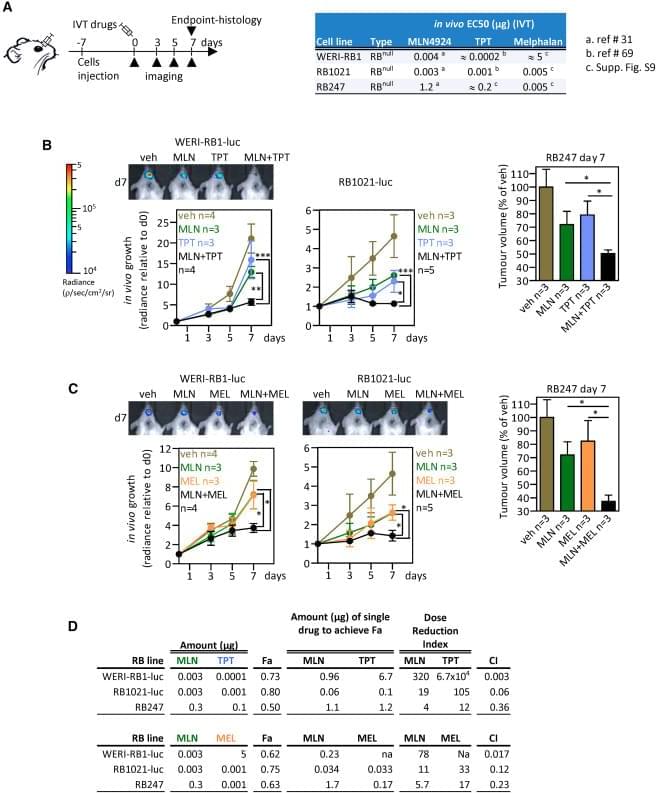
The authors were made aware of an image duplication in their published paper. The representative photo in Figure 5B is the same as the image in Fig. 4g of Aubry et al., 2020, Oncogene 39, p. 5338–5357. The assays involved treating xenografts of the RB1021-luc retinoblastoma line, using either MLN4924 (MLN) and topotecan (TPT; Cell Reports) or the RAD51 inhibitor B02 and TPT (Oncogene). These assays were run and analyzed concurrently in 2018. For the Xenogen measurements of tumor growth, we first quantified the signal and recorded the values in tables. After all the mice were assessed, appropriate mice were placed together for representative images. Thus, the quantification, which was performed correctly, and acquisition/storage of the representative image, which was not, were performed separately. Our review of image files revealed that the representative image of the B02 + TPT series of mice was accidentally duplicated using the file name for the MLN + TPT series of mice.
You deserve an explanation, so please don’t skip this 1-minute read. It’s Sunday, December 28. Our fundraiser will soon be over, but fewer people are seeing our message this December and we’re short of our goal. If you’ve lost count of how many times you’ve visited Wikipedia this year, we hope that means it’s given you at least $2.75 of knowledge. If everyone who finds Wikipedia useful gave $2.75, we’d hit our goal in a few hours.
It’s been 25 years and Wikipedia is still free. It’s still created by people, not machines, and we don’t run ads or put up paywalls because we’re not here to make a profit off your attention. In other words, it’s still the internet we were promised.
Less than 2% of our readers donate, so if you’ve never given and Wikipedia has provided you with at least $2.75 worth of knowledge, donate today. If you are undecided, remember any contribution helps.