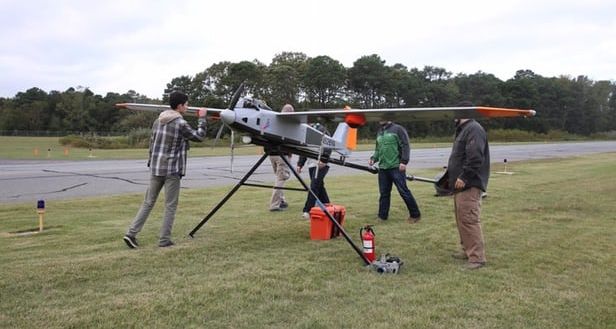
Facebook plans to use solar-powered drones to extend internet access to remote parts of the planet.
Read the latest on these ambitious plans: http://bbc.in/29WgEvF
Facebook plans to use solar-powered drones to extend internet access to remote parts of the planet.
Read the latest on these ambitious plans: http://bbc.in/29WgEvF
So far the system can be used to receive signals carrying data at rates of up to 2.1 gigabits per second, though the team claims it could go faster if it were built to absorb infrared, rather than blue, light.
It’s worth pointing out that this isn’t the first piece of hardware to emerge from the Connectivity Lab. Famously, it’s been working on a solar-powered drone to deliver Internet access. That particular project is progressing slowly, though, so despite the fact that the team behind the new laser device plans to test it in a real-world setting, there’s likely still much development ahead before it’s used widely.
The social network is, however, busy pursuing plenty of other projects to take data to the sticks. Most notably, its Telecom Infra Project will use open-source cellular networks to achieve similar results. That way, you see, anyone will be able to sign up on Facebook.
Have you wondered how Facebook might offer high-speed internet access using lasers? The company’s Connectivity Lab is happy to show you. It just published a research paper explaining laser beam technology can deliver up to 2Gbps to remote places. The trick, it says, is to use fluorescent optical fibers to collect the light instead of relying on traditional optics. Since the fibers don’t emit the same color that they’re absorbing, you can shine a brighter light at them (similar to a solar concentrator) and manage an extremely quick turnaround time of under 2 nanoseconds. Combine that with multi-stream data encoding and you get the ample bandwidth that’s normally reserved for WiFi and wired networks.
Facebook says it’s “investigating the feasibility” of shipping laser internet hardware based on this technology, but that may be more realistic than you think. The social network managed this feat using readily available materials that weren’t even meant for the purpose. It’s hoping that other organizations will craft optimized materials that are better-suited, and notes that an infrared-based system might hit speeds of up to 10Gbps. As important as Facebook’s findings might be, they’re only just the beginning.
The team is now embarking on its most ambitious project yet, a wide-reaching virtual reality network called Project Sansar that is, in many ways, aiming to become a new layer of reality that gives individuals and businesses a space to experiment with VR environments for their first time.
I had the chance to sit down for a demo of Sansar with Linden Lab CEO Ebbe Altberg this past week and take an early look into some of the platform’s first environments.
Traversing the worlds of Sansar and chatting with my guide, Linden Lab VP of Product Bjorn Laurin, was a mostly seamless experience but still an oddly unsettling one. It’s not that anything was particularly creepy about the place I was viewing through an Oculus Rift headset. Sansar is visually placid and often beautiful, but it’s also startlingly scalable and boundless. Scale is something that’s often taken for granted in an age of video game epics like Skyrim and GTAV, but when every horizon you see through your own point-of-view is conquerable, you’re left to either feel very bold or very lost.
NASA’s Space Technology Mission Directorate (STMD) worked with two private firms to develop advanced structures for high power solar arrays that are stronger, lighter, and package more compactly for launch. This technology investment furthers the agency’s deep space exploration goals and aids the commercial communications satellite industry, the provider of direct-to-home television, satellite radio, broadband internet and a multitude of other services.
The Roll Out Solar Array (ROSA) is one of the options eyed by NASA that could power an advanced solar electric propulsion spacecraft that makes possible such endeavors as the agency’s Asteroid Redirect Mission—plucking a multi-ton boulder from an asteroid’s surface, and then maneuvering that object into a stable orbit around the moon for human inspection and sampling.
Tapping into ROSA technology allows the conversion of sunlight into electrical power that drives the ion thrusters of a solar electric propulsion spacecraft. ROSA is expected to enable a number of space initiatives and is a cost-saving plus to transport cargo over long distances beyond the Earth.
Horizon Robotics, led by Yu Kai, Baidu’s former deep learning head, is developing AI chips and software to mimic how the human brain solves abstract tasks, such as voice and image recognition. The company believes that this will provide more consistent and reliable services than cloud based systems.
The goal is to enable fast and intelligent responses to user commands, with out an internet connection, to control appliances, cars, and other objects. Health applications are a logical next step, although not yet discussed.
Wearable Tech + Digital Health San Francisco – April 5, 2016 @ the Mission Bay Conference Center.
Dark Net v. Law Enforcement — who is winning and who is struggling.
The Dark web is a privileged place for cyber criminals that, under specific conditions, could operate in anonymity.
The United Nation’s Office on Drugs and Crime (UNODC) has published its annual report that contains a specific mention to the illicit trade of goods and drugs in this hidden part of the web.
The crooks seem to be one step ahead many countries’ law enforcement agencies that in many cases are not able to target black markets in the dark web.
Their back.
The internet has always been the most preferred platform for carrying out illicit activities. The underground black markets are not a new phenomenon in the virtual world. However, these black markets are now becoming more sophisticated and organized. Darkness is one such underground marketplaces which are rising and becoming uglier. Though law enforcement agencies have brought down the number of such illegal platforms, the Darknet markets are up and running. Darknet markets are growing bigger than ever with over $50 million UDS transactions reportedly flowing through these marketplaces and it is a big challenge in front of security agencies and governments to finish this underground industry from its roots.
Decoding Darknet
As the name suggests, the Darknet market, also known as Cryoto market is a commercial website on the dark web that operates via darkness such as Tor and I2P. These markets primarily indulged in illicit activities such as drug peddling, trade of cyber-arms and weapons, counterfeited currencies, stolen credit card details, forged documents and other illicit goods. Though Darknet started gaining popularity from 2006 onwards, the traces of underground market lie in the early 70s when students at Stanford University and Massachusetts Institute of Technology created, dubbed as the first Darknet marketplace, ‘ARPANET’ to purchase cannabis. Since then, many such dark markets have mushroomed such as Cyber-arms Bazaar, ShadowCrew, the Farmer’s Market, Silk Market 2.0, Agora, AlphaBay etc.
Today’s high-speed wired communication networks use lasers to carry information through optical fibers, but wireless networks are currently based on radio frequencies or microwaves. In an advance that could one day make light-based wireless communications ubiquitous, researchers from Facebook Inc.’s Connectivity Lab have demonstrated a conceptually new approach for detecting optical communication signals traveling through the air.
The team described the new technology, which could pave the way for fast optical wireless networks capable of delivering internet service to far-flung places, in Optica, The Optical Society’s journal for high impact research.
Bridging the Digital Divide
Facebook’s Connectivity Lab develops technologies aimed at providing affordable internet services to the approximately 4 billion people in the world who cannot currently access it. “A large fraction of people don’t connect to the internet because the wireless communications infrastructure is not available were they live, mostly in very rural areas of the world,” said Tobias Tiecke, who leads the research team. “We are developing communication technologies that are optimized for areas where people live far apart from each other.”