Some animals do not age at all and prove that aging is not inevitable. Scientists are working on ways to slow down and even reverse aging.

(http://www.pharma.unizg.hr/en/about-us/staff/gordan–lauc, 450.html) is Professor of Biochemistry and Molecular Biology at the University of Zagreb, Faculty of Pharmacy and Biochemistry, and Founder and CEO of Genos Ltd. (https://genos-glyco.com/), a research-intensive SME located in Zagreb, Croatia with core of expertise in molecular genetics and glycomics (The comprehensive study the entire complement of sugars, whether free or present in more complex molecules of an organism) and they perform contract research, contract analysis and service for numerous universities, hospitals and private individuals in Europe and overseas.
Prof. Dr. Lauc also is CSO of GlycanAge LTD (https://glycanage.com/), a company that has developed a ground-breaking test that analyses your personal glycobiome for insights in improving your health and monitoring your biological age, and Co-Director of the Human Glycome Project (https://human-glycome.org/).
Prof. Dr. Lauc graduated with a degree in molecular biology at the University of Zagreb Faculty of Science in 1992, and obtained Ph.D. in Biochemistry and the University of Zagreb in 1995. He got his postdoctoral training at the Institute for Medical Physics and Biophysics in Münster and Johns Hopkins University in Baltimore. Since 1993 he has been employed at the Faculty of Pharmacy and Biochemistry in Zagreb. Between 1998 and 2010 he was also part-time employed at the University of Osijek School of Medicine where he founded a DNA laboratory for the identification of war victims and also served as Vice-Dean for Science between 2001 and 2005.
Prof. Dr. Lauc is author of over 100 research papers published in international journals and six international patents. He was invited to lecture at numerous international conferences, elected for visiting professor at the Johns Hopkins University and in 2011 also inducted in the prestigious Johns Hopkins Society of Scholars. If 2012 he was appointed Honorary Professor at the University of Edinburgh and Adjunct Professor at the Edith Cowan University in Perth.
Prof. Dr. Lauc chaired a number of conferences, including the “European Science Foundation Exploratory Workshop on Glycoscience” which resulted in the creation of the “European Glycoscience Forum”.
Prof. Dr. Lauc was a chairman of the committee that prepared Croatian National Action plan for the increased investment in research in development (2007), and was a member of the National Science Council between 2009 and 2013 and also and President of the National Council for Natural Sciences. He is a President-elect of the International Glycoscience Organization and member of the Steering Committee of the European Glycoscience Forum.
Ben Goertzel, PhD, is author of many books on artificial intelligence including Ten Years to the Singularity if We Really Really Try; Engineering General Intelligence, Vols. 1 and 2; The Hidden Pattern: A Patternist Philosophy of Mind; and The Path to Posthumanity. He is also editor (with Damien Broderick) of an anthology about parapsychology titled, Evidence for Psi: Thirteen Empirical Research Reports. He is chief scientific officer for Hanson Robotics in Hong Kong.
Here he notes that, while the question of reincarnation in robots seems outlandish, most of our present technology would have seemed nonsensical and incomprehensible to earlier generations of humans. He quotes the 14th Dalai Lama who suggested (half-jokingly) that artificial intelligence programmers of the future might incarnate into robots. He cites Stephen Braude’s book, Immortal Remains, as demonstrating that we must consider some version of consciousness operating outside of the body. He outlines the sort of scientific and metaphysical models that might lead to such a development.
New Thinking Allowed host, Jeffrey Mishlove, PhD, is author of The Roots of Consciousness, Psi Development Systems, and The PK Man. Between 1986 and 2002 he hosted and co-produced the original Thinking Allowed public television series. He is the recipient of the only doctoral diploma in “parapsychology” ever awarded by an accredited university (University of California, Berkeley, 1980). He is also past-president of the non-profit Intuition Network, an organization dedicated to creating a world in which all people are encouraged to cultivate and apply their inner, intuitive abilities.
(Recorded on April 29, 2016)
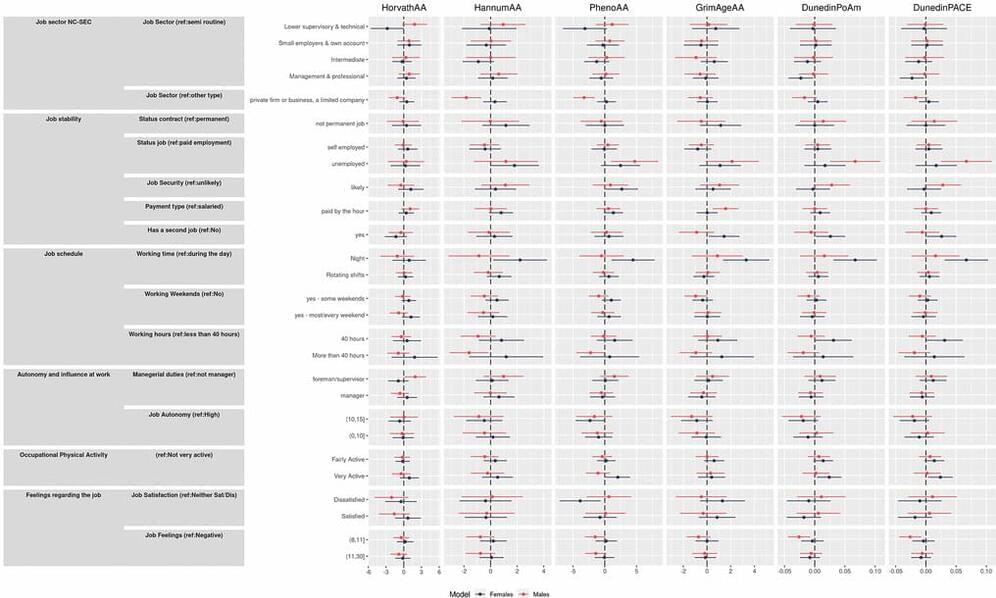
Occupation-related stress and work characteristics are possible determinants of social inequalities in epigenetic aging but have been little investigated. Here, we investigate the association of several work characteristics with epigenetic age acceleration (AA) biomarkers.
The study population included employed and unemployed men and women (n = 631) from the UK Understanding Society study. We evaluated the association of employment and work characteristics related to job type, job stability; job schedule; autonomy and influence at work; occupational physical activity; and feelings regarding the job with four epigenetic age acceleration biomarkers (Hannum, Horvath, PhenoAge, GrimAge) and pace of aging (DunedinPoAm, DunedinPACE).
We fitted linear regression models, unadjusted and adjusted for established risk factors, and found the following associations for unemployment (years of acceleration): HorvathAA (1.51, 95% CI 0.08, 2.95), GrimAgeAA (1.53, 95% CI 0.16, 2.90) and 3.21 years for PhenoAA (95% CI 0.89, 5.33). Job insecurity increased PhenoAA (1.83, 95% CI 0.003, 3.67), while working at night was associated with an increase of 2.12 years in GrimAgeAA (95% CI 0.69, 3.55). We found effects of unemployment to be stronger in men and effects of night shift work to be stronger in women.

Although my plan is to live forever (or at least, a very long time, societal and natural disasters willing) I know many people in the life-extension community are signed up with a cryonics provider, as a plan B, in case they don’t live long enough to welcome the rejuvenation revolution.
A lot has been written to explain how the people are stored, usually accompanied by a picture of the gleaming liquid nitrogen cooled Dewar flasks, along with the ethical questions of the procedure. However, the journey to the semi-final resting place is often overlooked.
To explore how someone who has signed up to a cryonics program makes that transition, I attended one of the regular cryonics demonstration and training sessions put on by Cryonics UK. It turns out there are 4 key stages in the process – standby, initial cool down, perfusion and transportation.