Toggle light / dark theme

How movement affects the way the brain processes sound and sight

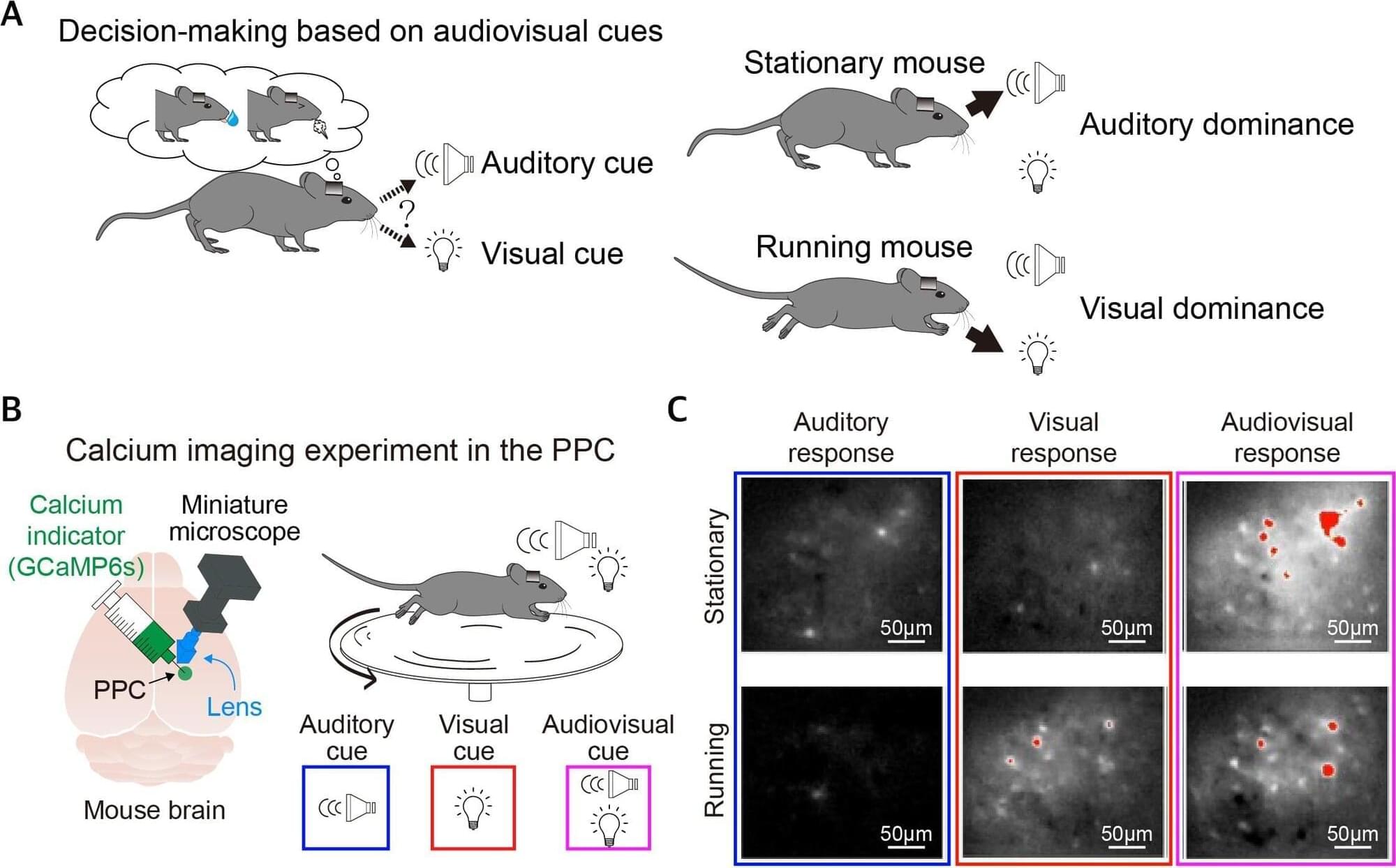
A research team at the Institute for Basic Science (IBS) has uncovered a fundamental principle of how the brain prioritizes vision and hearing differently depending on whether we are still or in motion. The study, led by Dr. Lee Seung-Hee, Associate Director of the IBS Center for Synaptic Brain Dysfunctions and Associate Professor at KAIST, provides new insights into how movement alters the brain’s sensory decision-making process.

In daily life, we constantly process visual (sight) and auditory () information to navigate the world. For instance, when watching a movie, our brain seamlessly integrates images and sounds to create a complete experience. However, when moving—such as when walking on a busy street—our brain may prioritize visual information over sound.

Until now, it was unclear how the brain decides which sense to prioritize in different situations. This is particularly relevant for individuals with sensory processing disorders such as autism or schizophrenia, where the brain may struggle to integrate sensory information correctly. Understanding how the brain naturally shifts between sensory inputs could lead to better treatments for these conditions.

The Worm That No Computer Scientist Can Crack

By way of an answer, I’ll offer one of the physicist Richard Feynman’s most famous dictums: What I cannot create, I do not understand. For much of its history, biology has been a reductionist science, driven by the principle that the best way to understand the mind-boggling complexity of living things is to dissect them into their constituent parts—organs, cells, proteins, molecules. But life isn’t a clockwork; it’s a dynamic system, and unexpected things emerge from the interactions between all those little parts. To truly understand life, you can’t just break it down. You have to be able to put it back together, too.

The C. elegans nematode is a tiny worm, barely as long as a hair is wide, with less than a thousand cells in its body. Of those, only 302 are neurons—about as small as a brain can get. “I remember, when my first child was born, how proud I was when they reached the age they could count to 302,” said Netta Cohen, a computational neuroscientist who runs a worm lab at the University of Leeds. But there’s no shame in smallness, Cohen emphasized: C. elegans does a lot with a little. Unlike its more unpleasant cousins, it’s not a parasite, outsourcing its survival needs to bigger organisms. Instead, it’s what biologists call a “free-living” animal. “It can reproduce, it can eat, it can forage, it can escape,” Cohen said. “It’s born and it develops, and it ages and it dies—all in a millimeter.”

Worm people like Cohen are quick to tell you that no fewer than four Nobel Prizes have been awarded for work on C. elegans, which was the first animal to have both its genome sequenced and its neurons mapped. But there’s a difference between schematics and an operating manual. “We know the wiring; we don’t know the dynamics,” Cohen said. “You would think that’s an ideal problem for a physicist or a computer scientist or a mathematician to solve.”

Study shows that some voices are more memorable than others, irrespective of who is listening to them

The term “memorability” refers to the likelihood that a particular stimulus, such as an object, face or sound, will be remembered by those exposed to it. Over the past few years, some psychology studies have been exploring the extent to which some stimuli are intrinsically more memorable than others, or in other words, whether people are generally more likely to remember them compared to other stimuli of the same type.

Researchers at the University of Chicago recently set out to specifically investigate the memorability of voices. Their findings, published in Nature Human Behaviour, suggest that some voices are more memorable than others and their memorability can be consistently predicted across different listeners.

“Research on intrinsic memorability—the consistencies in what people remember and forget—is a fairly new but active area of cognitive psychology,” Cambria Revsine, first author of the paper, told Medical Xpress. “Many studies from our lab and others have extensively explored this phenomenon over the past decade, finding that participants tend to remember the same images of faces, scenes, objects, and much more. However, no prior study to our knowledge has investigated the memorability of auditory stimuli.”

Marathon runners undergo reversible reductions in myelin in the brain during a race, study reveals

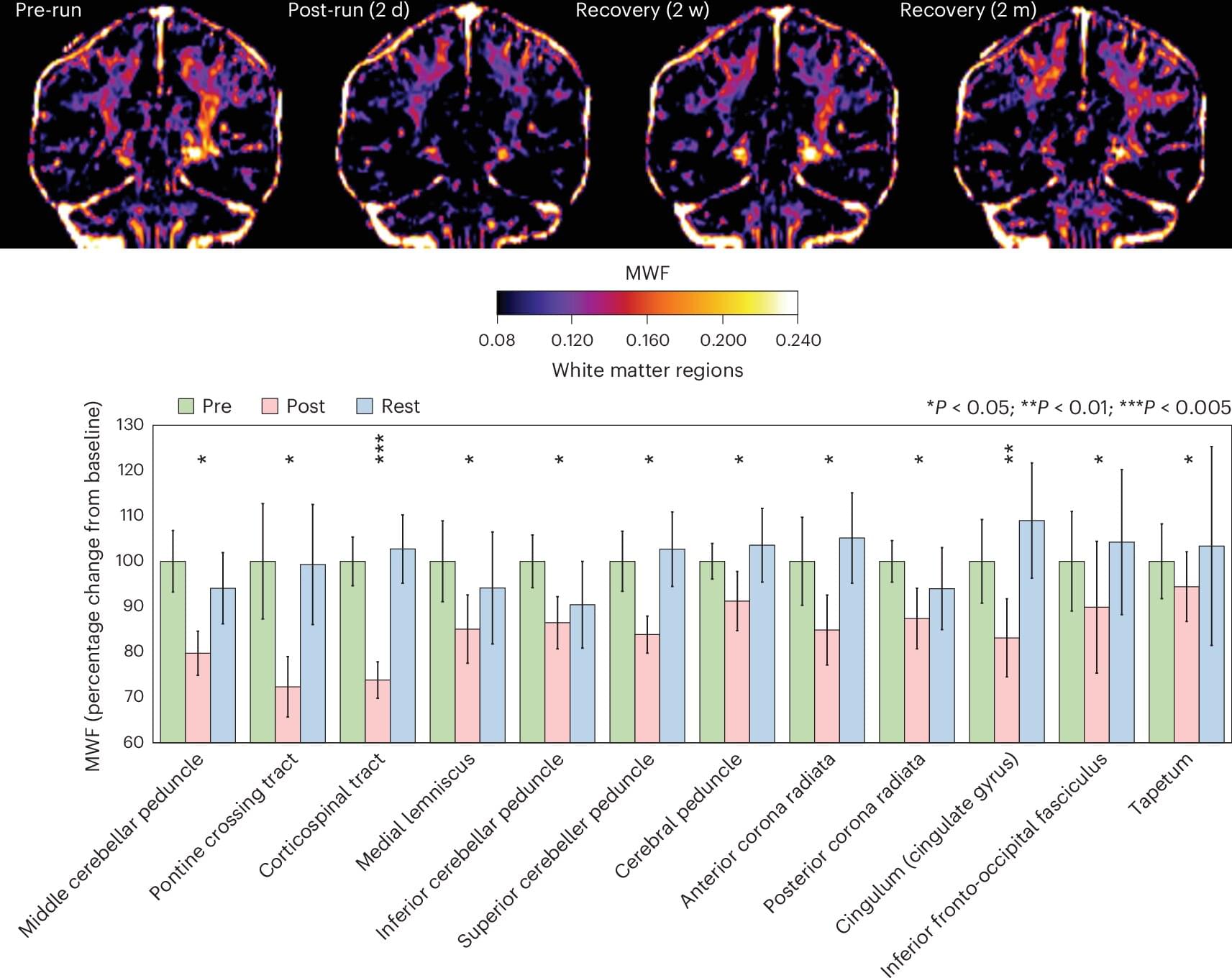
A team of neurologists, neuroradiologists and biomaterials specialists affiliated with several institutions in Spain has found that marathon runners undergo a reversible reduction in myelin in the brain during a race. In their study published in the journal Nature Metabolism, the group analyzed MRI scans of marathon runners before and after a race and then at later intervals to learn more about how participating in long races impacts the brain.

The at the journal have published a Research Briefing that outlines the work in the same issue and suggest that the team’s findings could influence the understanding of brain metabolism.

The researchers recruited 10 runners—eight male and two female—and performed MRI scans of their brains before they ran a 42K marathon. They administered a second scan 24 to 48 hours later. Two of the runners received an MRI two weeks later, and six runners were scanned two months after the race as a follow-up.

National study finds one in four adults misusing prescription stimulants

Research conducted by the National Institute on Drug Abuse, the Substance Abuse and Mental Health Services Administration, and the Centers for Disease Control and Prevention reveals that 1 in 4 adults using prescription stimulants engaged in misuse, and nearly 1 in 10 met the criteria for prescription stimulant use disorder (PSUD).

Findings show that amphetamine users were more likely to experience PSUD than those prescribed methylphenidate. Increased prescribing rates, particularly among middle-aged women, were observed, yet this demographic exhibited lower rates than younger .

Concerns over stimulant misuse have grown as prescribing rates for these medications, commonly used to treat attention-deficit/hyperactivity disorder (ADHD), have increased. Clinical practice guidelines for adult ADHD remain absent, leading to variations in diagnosis and treatment. Questions about appropriate use persist as research indicates both the protective benefits of ADHD pharmacotherapy and its potential risks, including misuse, overprescription, and development of use disorders.

Can melatonin supplements really ‘reverse’ DNA damage caused by lack of sleep?

Sleep isn’t just a luxury, it’s a vital process that helps our bodies repair and rejuvenate. Researchers have started to uncover how the quality and timing of sleep can affect more than just how rested we feel—it might also affect the very blueprint of our cells: our DNA.

A new study from Canada found that melatonin, a hormone known for its role in regulating sleep, might help reverse some of the DNA damage caused by years of poor sleep.

Melatonin is produced by the pineal gland in our brains when darkness falls. It signals to our bodies that it’s time to wind down and prepare for sleep. Beyond its sleep-inducing properties, melatonin is also a powerful antioxidant.

Cyborg Brain Implants: The Organoid Brain-Computer Interface (Human + Mouse + Computer)

Try brilliant FREE for 30 days: https://brilliant.org/ihm/
And get 20% off an annual membership!

Can you implant lab-grown brain tissue to heal brain damage? Kind of. What if you also implant an electrical stimulation device? The next generation of brain implants may be the Organoid Brain-Computer Interface (OBCI).

Learn about: brain organoids, dendritic spines, synapses, presynaptic and postsynaptic neurons, neurotransmitters.

Story of Einstein’s Brain: https://www.npr.org/2005/04/18/4602913/the-long-strange-jour…eins-brain

This New Tech Revolutionizes Biology… — YouTube

Dr. Michael Levin is on the verge of revolutionizing medicine by unlocking the bioelectric code that governs how cells communicate, heal, and build complex structures. His work reveals that intelligence exists at every level of biology—allowing us to reprogram tissues, regenerate limbs, and even suppress cancer by restoring cellular memory and connection.

As a listener of TOE you can get a special 20% off discount to The Economist and all it has to offer! Visit https://www.economist.com/toe.

Join My New Substack (Personal Writings): https://curtjaimungal.substack.com.

Listen on Spotify: https://tinyurl.com/SpotifyTOE

Become a YouTube Member (Early Access Videos):
/ @theoriesofeverything.

Links:

/* */