Researchers at École Polytechnique have demonstrated the first superconducting quantum circuit architecture that integrates a carbon nanotube.
Quantum technologies demand perfection: one photon at a time, every time, all with the same energy. Even tiny deviations in the number or energy of photons can derail devices, threatening the performance of quantum computers that someday could make up a quantum internet.
While this level of precision is difficult to achieve, Northwestern University engineers have developed a novel strategy that makes quantum light sources, which dispense single photons, more consistent, precise and reliable.
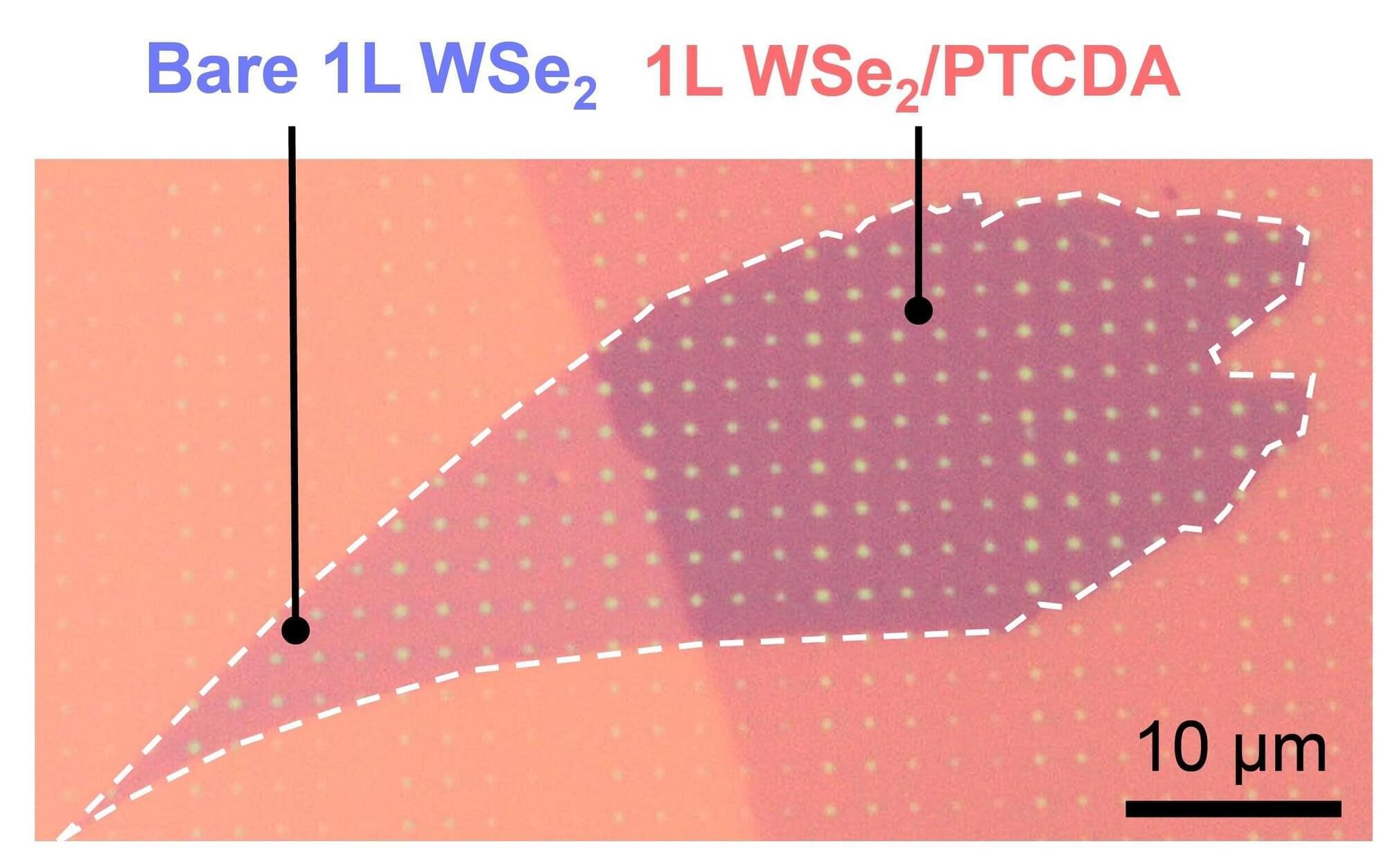
In a new study, the team coated an atomically thin semiconductor (tungsten diselenide) with a sheetlike organic molecule called PTCDA. The coating transformed the tungsten diselenide’s behavior—turning noisy signals into clean bursts of single photons. Not only did the coating increase the photons’ spectral purity by 87%, but it also shifted the color of photons in a controlled way and lowered the photon activation energy—all without altering the material’s underlying semiconducting properties.
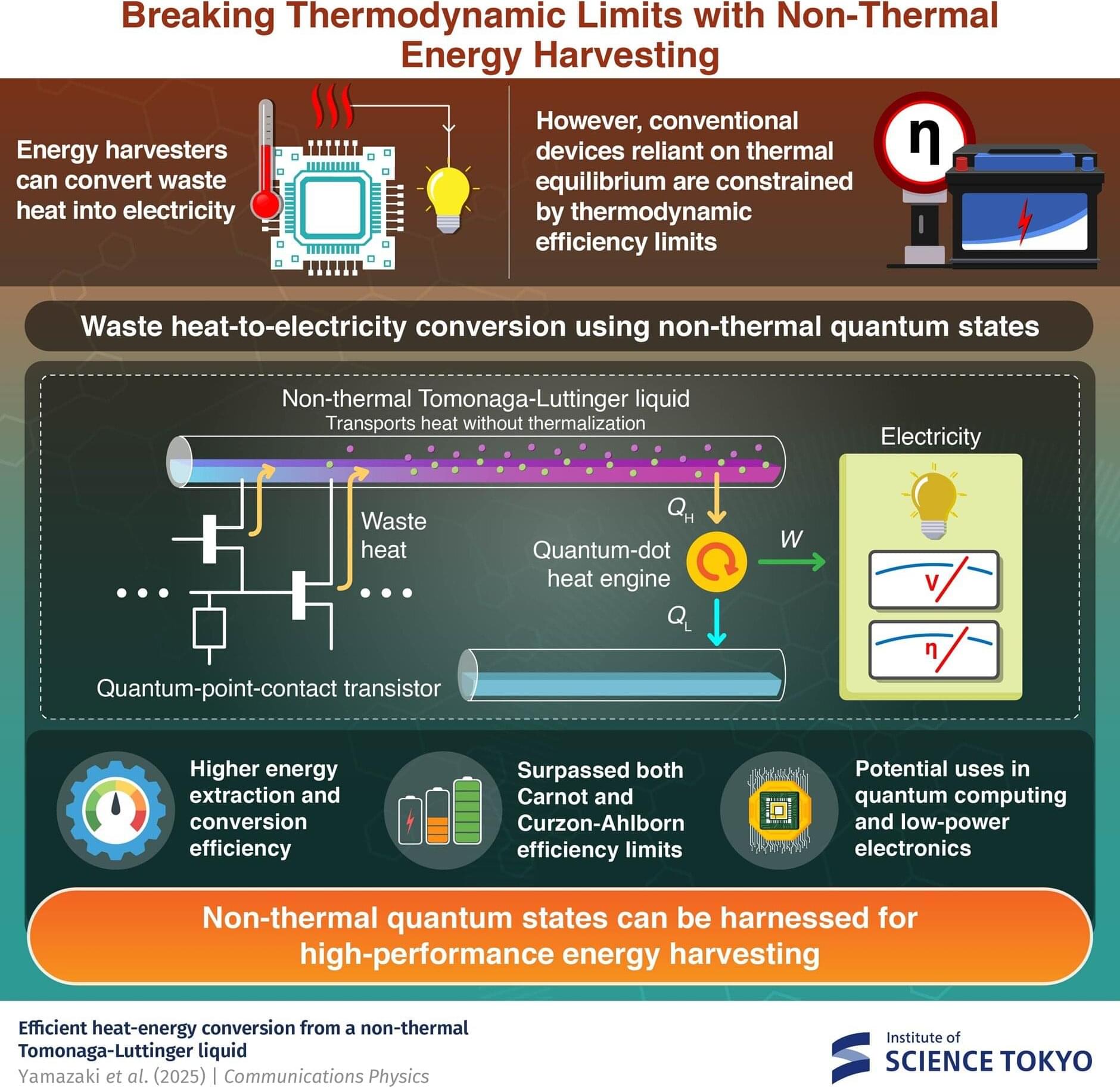
Harnessing quantum states that avoid thermalization enables energy harvesters to surpass traditional thermodynamic limits such as Carnot efficiency, report researchers from Japan. The team developed a new approach using a non-thermal Tomonaga-Luttinger liquid to convert waste heat into electricity with higher efficiency than conventional approaches. These findings pave the way for more sustainable low-power electronics and quantum computing.
Energy harvesters, or devices that capture energy from environmental sources, have the potential to make electronics and industrial processes much more efficient. We are surrounded by waste heat, generated everywhere by computers, smartphones, power plants, and factory equipment. Energy-harvesting technologies offer a way to recycle this lost energy into useful electricity, reducing our reliance on other power sources.
However, conventional energy-harvesting methods are constrained by the laws of thermodynamics. In systems that rely on thermal equilibrium, these laws impose fundamental caps on heat conversion efficiency, which describes the ratio of the generated electrical power and the extracted heat from the waste heat, for example, is known as the Carnot efficiency. Such thermodynamic limits, like the Curzon-Ahlborn efficiency, which is the heat conversion efficiency under the condition for obtaining the maximum electric power, have restricted the amount of useful power that can be extracted from waste heat.

Silicides—alloys of silicon and metals long used in microelectronics—are now being explored again for quantum hardware. But their use faces a critical challenge: achieving phase purity, since some silicide phases are superconducting while others are not.
The study, published in Applied Physics Letters by NYU Tandon School of Engineering and Brookhaven National Laboratory, shows how substrate choice influences phase formation and interfacial stability in superconducting vanadium silicide films, providing design guidelines for improving material quality.
The team, led by NYU Tandon professor Davood Shahrjerdi, focused on vanadium silicide, a material that becomes superconducting (able to conduct electricity without resistance) when cooled below its transition temperature of 10 Kelvin, or about −263°C. Its relatively high superconducting transition temperature makes it attractive for quantum devices that operate above conventional millikelvin temperatures.

Signal announced the introduction of Sparse Post-Quantum Ratchet (SPQR), a new cryptographic component designed to withstand quantum computing threats.
SPQR will serve as an advanced mechanism that continuously updates the encryption keys used in conversations and discarding the old ones.
Signal is a cross-platform, end-to-end encrypted messaging and calling app managed by the non-profit Signal Foundation, with an estimated monthly active user base of up to 100 million.

For over a hundred years, physics has rested on two foundational theories. Einstein’s general relativity describes gravity as the curvature of space and time, while quantum mechanics governs the behavior of particles and fields.
Each theory is highly successful within its own domain, yet combining them leads to contradictions, particularly in relation to black holes, dark matter, dark energy, and the origins of the universe.
My colleagues and I have been exploring a new way to bridge that divide. The idea is to treat information – not matter, not energy, not even spacetime itself – as the most fundamental ingredient of reality. We call this framework the quantum memory matrix (QMM).
Discover the world’s first computer powered by human brain cells! In this groundbreaking video, we dive into the revolutionary Neuroplatform by FinalSpark, merging biology with technology. Witness how biocomputing is transforming the future of artificial intelligence and computing with unparalleled energy efficiency and processing power. Subscribe now to stay updated on cutting-edge tech that blurs the lines between science fiction and reality! 🧠💻
#Biocomputing #Neuroplatform #AI #FutureTech #Innovation #FinalSpark #BrainPoweredComputer.
Stay ahead in 2024: Unlock the future of AI, tech, and innovative businesses! 🚀 Subscribe for the latest insights and be part of a community that learns, grows, and leads the way in a tech-driven world. Discover, ignite and soar into tomorrow with Quantum Spark.