Black holes can be difficult to study, so researchers have made a powerful quantum vortex in a tank of superfluid helium that acts as a simulation of a black hole.
By Leah Crane

Black holes can be difficult to study, so researchers have made a powerful quantum vortex in a tank of superfluid helium that acts as a simulation of a black hole.
By Leah Crane


Eighteen months ago, it was shown that different parts of the interior of the proton must be maximally quantum entangled with each other. This result, achieved with the participation of Prof. Krzysztof Kutak from the Institute of Nuclear Physics of the Polish Academy of Sciences (IFJ PAN) in Cracow and Prof. Martin Hentschinski from the Universidad de las Americas Puebla in Mexico, was a consequence of considerations and observations of collisions of high-energy photons with quarks and gluons in protons and supported the hypothesis presented a few years earlier by professors Dimitri Kharzeev and Eugene Levin.
Now, in a paper published in the journal Physical Review Letters, an international team of physicists has been presented a complementary analysis of entanglement for collisions between photons and protons in which secondary particles (hadrons) are produced by a process called diffractive deep inelastic scattering. The main question was: does entanglement also occur among quarks and gluons in these cases, and if so, is it also maximal?
Putting it in simple terms, physicists speak of entanglement between various quantum objects when the values of some feature of these objects are related. Quantum entanglement is not observed in the classical world, but its essence is easily explained by the toss of two coins. Each coin has two sides, and when it falls, it can take one of two mutually exclusive values (heads or tails) with the same probability.

Columbia University researchers have synthesized the first 2D heavy fermion material, CeSiI, a breakthrough in material science. This new material, easier to manipulate than traditional 3D heavy fermion compounds, opens up new possibilities in understanding quantum phenomena, including superconductivity. Credit: SciTechDaily.com.
Columbia University ’s creation of CeSiI, the first 2D heavy fermion material, marks a significant advancement in quantum material science. This development paves the way for new research into quantum phenomena and the design of innovative materials.
Researchers at Columbia University have successfully synthesized the first 2D heavy fermion material. They introduce the new material, a layered intermetallic crystal composed of cerium, silicon, and iodine (CeSiI), in a research article published today (January 17) in the scientific journal Nature.
This experimental milestone allows for the preservation of quantum information even when entanglement is fragile.
For the first time, researchers from the Structured Light Laboratory (School of Physics) at the University of the Witwatersrand in South Africa, led by Professor Andrew Forbes, in collaboration with string theorist Robert de Mello Koch from Huzhou University in China (previously from Wits University), have demonstrated the remarkable ability to perturb pairs of spatially separated yet interconnected quantum entangled particles without altering their shared properties.
“We achieved this experimental milestone by entangling two identical photons and customizing their shared wave-function in such a way that their topology or structure becomes apparent only when the photons are treated as a unified entity,” explains lead author, Pedro Ornelas, an MSc student in the structured light laboratory.

In quantum computing, the question as to what physical system and which degrees of freedom within that system may be used to encode quantum bits of information—qubits, in short—is at the heart of many research projects carried out in physics and engineering laboratories.
Superconducting qubits, spin qubits, and qubits encoded in the motion of trapped ions are already widely recognized as prime candidates for future practical applications of quantum computers; other systems need to be better understood and thus offer a stimulating ground for fundamental investigation.
Rebekka Garreis, Chuyao Tong, Wister Huang, and their colleagues in the group of Professors Klaus Ensslin and Thomas Ihn from the Department of Physics at ETH Zurich have been looking into bilayer graphene (BLG) quantum dots, known as a potential platform for spin qubits, to find out if another degree of freedom of BLG can be used to encode quantum information.
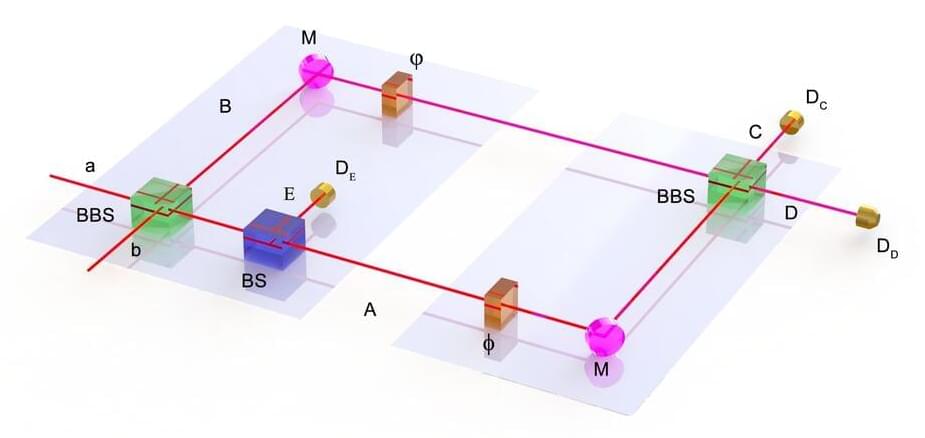
Understanding the nature of quantum objects’ behaviors is the premise for a reasonable description of the quantum world. Depending on whether the interference can be produced or not, the quantum object is endowed with dual features of a wave and a particle, i.e., the so-called wave-particle duality (WPD), which are generally observed in the so-called mutually exclusive experimental arrangements in the sense of Bohr’s complementarity principle.
Theoretical physicist John Wheeler proposed the delayed-choice experiment in the 1980s, pointing out that the methods used to observe photons will ultimately determine whether their behavior is like particles or waves.
In 2011, Ionicioiu and Terno proposed a quantum version of the delayed-choice experiment, by which the photon can be forced into a superposed state of the particle and wave and exhibits continuous morphing between those two sides with changing the controlling parameter of the ancilla.