Specialists from the University of Copenhagen created a chip that could be used to build a future quantum simulator.


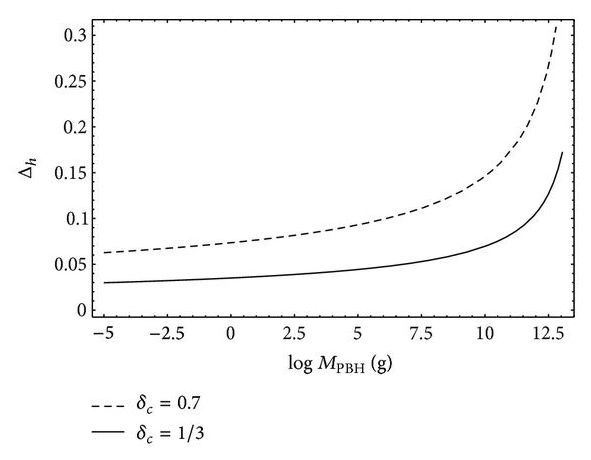
Fast spinning black holes could have features different from those predicted by general relativity.
General relativity is a profoundly complex mathematical theory, but its description of black holes is amazingly simple. A stable black hole can be described by just three properties: its mass, its electric charge, and its rotation or spin. Since black holes aren’t likely to have much charge, it really takes just two properties. If you know a black hole’s mass and spin, you know all there is to know about the black hole.
This property is often summarized by the no-hair theorem. Specifically, the theorem asserts that once matter falls into a black hole, the only characteristic that remains is mass. You could make a black hole out of a Sun’s worth of hydrogen, chairs, or those old copies of National Geographic from Grandma’s attic, and there would be no difference. Mass is mass as far as general relativity is concerned. In every case the event horizon of a black hole is perfectly smooth, with no extra features. As Jacob Bekenstein said, black holes have no hair.
But with all its predictive power, general relativity has a problem with quantum theory. This is particularly true with black holes. If the no-hair theorem is correct, the information held within an object is destroyed when it crosses the event horizon. Quantum theory says that information can never be destroyed. So the valid theory of gravity is contradicted by the valid theory of the quanta. This leads to problems such as the firewall paradox, which can’t decide whether an event horizon should be hot or cold.
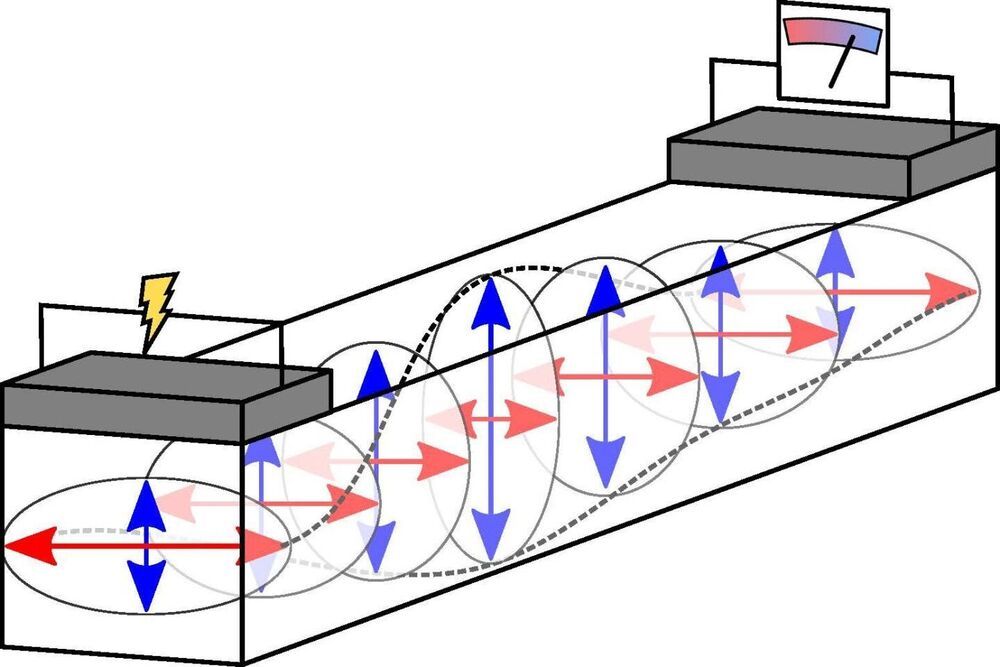
Be it with smartphones, laptops, or mainframes: The transmission, processing, and storage of information is currently based on a single class of material—as it was in the early days of computer science about 60 years ago. A new class of magnetic materials, however, could raise information technology to a new level. Antiferromagnetic insulators enable computing speeds that are a thousand times faster than conventional electronics, with significantly less heating. Components could be packed closer together and logic modules could thus become smaller, which has so far been limited due to the increased heating of current components.
Information transfer at room temperature
So far, the problem has been that the information transfer in antiferromagnetic insulators only worked at low temperatures. But who wants to put their smartphones in the freezer to be able to use it? Physicists at Johannes Gutenberg University Mainz (JGU) have now been able to eliminate this shortcoming, together with experimentalists from the CNRS/Thales lab, the CEA Grenoble, and the National High Field Laboratory in France as well as theorists from the Center for Quantum Spintronics (QuSpin) at the Norwegian University of Science and Technology. “We were able to transmit and process information in a standard antiferromagnetic insulator at room temperature—and to do so over long enough distances to enable information processing to occur”, said JGU scientist Andrew Ross. The researchers used iron oxide (α-Fe2O3), the main component of rust, as an antiferromagnetic insulator, because iron oxide is widespread and easy to manufacture.
Circa 2014
We propose the new dark matter particle candidate—the “black hole atom,” which is an atom with the charged black hole as an atomic nucleus and electrons in the bound internal quantum states. As a simplified model we consider the central Reissner-Nordström black hole with the electric charge neutralized by the internal electrons in bound quantum states. For the external observers these objects would look like the electrically neutral Schwarzschild black holes. We suppose the prolific production of black hole atoms under specific conditions in the early universe.

Researchers at Hokkaido University and Amoeba Energy in Japan have, inspired by the efficient foraging behavior of a single-celled amoeba, developed an analog computer for finding a reliable and swift solution to the traveling salesman problem—a representative combinatorial optimization problem.
Many real-world application tasks such as planning and scheduling in logistics and automation are mathematically formulated as combinatorial optimization problems. Conventional digital computers, including supercomputers, are inadequate to solve these complex problems in practically permissible time as the number of candidate solutions they need to evaluate increases exponentially with the problem size—also known as combinatorial explosion. Thus new computers called Ising machines, including quantum annealers, have been actively developed in recent years. These machines, however, require complicated pre-processing to convert each task to the form they can handle and have a risk of presenting illegal solutions that do not meet some constraints and requests, resulting in major obstacles to the practical applications.
These obstacles can be avoided using the newly developed ‘electronic amoeba,’ an analog computer inspired by a single-celled amoeboid organism. The amoeba is known to maximize nutrient acquisition efficiently by deforming its body. It has shown to find an approximate solution to the traveling salesman problem (TSP), i.e., given a map of a certain number of cities, the problem is to find the shortest route for visiting each city exactly once and returning to the starting city. This finding inspired Professor Seiya Kasai at Hokkaido University to mimic the dynamics of the amoeba electronically using an analog circuit, as described in the journal Scientific Reports. “The amoeba core searches for a solution under the electronic environment where resistance values at intersections of crossbars represent constraints and requests of the TSP,” says Kasai. Using the crossbars, the city layout can be easily altered by updating the resistance values without complicated pre-processing.

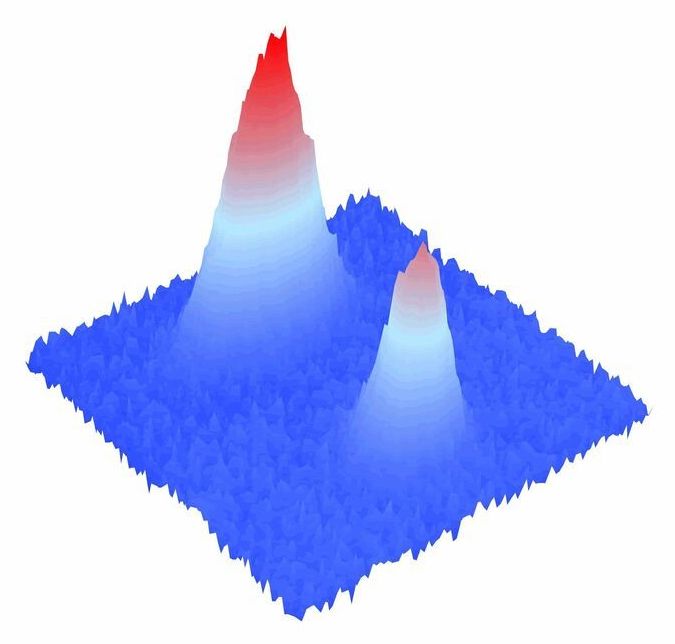
JILA researchers have developed tools to “turn on” quantum gases of ultracold molecules, gaining control of long-distance molecular interactions for potential applications such as encoding data for quantum computing and simulations.
The new scheme for nudging a molecular gas down to its lowest energy state, called quantum degeneracy, while suppressing chemical reactions that break up molecules finally makes it possible to explore exotic quantum states in which all the molecules interact with one another.
The research is described in the Dec. 10 issue of Nature. JILA is a joint institute of the National Institute of Standards and Technology (NIST) and the University of Colorado Boulder.
Researchers have found a way to protect highly fragile quantum systems from noise, which could aid in the design and development of new quantum devices, such as ultra-powerful quantum computers.
The researchers, from the University of Cambridge, have shown that microscopic particles can remain intrinsically linked, or entangled, over long distances even if there are random disruptions between them. Using the mathematics of quantum theory, they discovered a simple setup where entangled particles can be prepared and stabilized even in the presence of noise by taking advantage of a previously unknown symmetry in quantum systems.
Their results, reported in the journal Physical Review Letters, open a new window into the mysterious quantum world that could revolutionize future technology by preserving quantum effects in noisy environments, which is the single biggest hurdle for developing such technology. Harnessing this capability will be at the heart of ultrafast quantum computers.
Quantum computing startup IonQ today announced its road map for the next few years — following a similar move from IBM in September — and it’s quite ambitious, to say the least.
At our Disrupt event earlier this year, IonQ CEO and president Peter Chapman suggested that we were only five years away from having desktop quantum computers. That’s not something you’ll likely hear from the company’s competitors — who also often use a very different kind of quantum technology — but IonQ now says that it will be able to sell modular, rack-mounted quantum computers for the data center in 2023 and that by 2025, its systems will be powerful enough to achieve broad quantum advantage across a wide variety of use cases.
In an interview ahead of today’s announcement, Chapman showed me a prototype of the hardware the company is working on for 2021, which fits on a workbench. The actual quantum chip is currently the size of a half-dollar and the company is now working on essentially putting the core of its technology on a single chip, with all of the optics that make its system work integrated.