This is a video of Dirac’s first lecture of four on quantum mechanics delivered in 1975 in Christchurch, New Zealand.
The transcript of the lectures can be found in \.
This is a video of Dirac’s first lecture of four on quantum mechanics delivered in 1975 in Christchurch, New Zealand.
The transcript of the lectures can be found in \.
Crystals and glasses have opposite heat-conduction properties, which play a pivotal role in a variety of technologies. These range from the miniaturization and efficiency of electronic devices to waste-heat recovery systems, as well as the lifespan of thermal shields for aerospace applications.
The problem of optimizing the performance and durability of materials used in these different applications essentially boils down to fundamentally understanding how their chemical composition and atomic structure (e.g., crystalline, glassy, nanostructured) determine their capability to conduct heat. Michele Simoncelli, assistant professor of applied physics and applied mathematics at Columbia Engineering, tackles this problem from first principles — i.e., in Aristotle’s words, in terms of “the first basis from which a thing is known” — starting from the fundamental equations of quantum mechanics and leveraging machine-learning techniques to solve them with quantitative accuracy.
In research published on July 11 in the Proceedings of the National Academy of Sciences, Simoncelli and his collaborators Nicola Marzari from the Swiss Federal Technology Institute of Lausanne and Francesco Mauri from Sapienza University of Rome predicted the existence of a material with hybrid crystal-glass thermal properties, and a team of experimentalists led by Etienne Balan, Daniele Fournier, and Massimiliano Marangolo from the Sorbonne University in Paris confirmed it with measurements.

Quantum stochastic rectification is a process observed in some physical systems, which entails the conversion of random quantum fluctuations (i.e., quantum noise) and a small oscillating signal, such as a weak alternating current or AC voltage, into a steady output (e.g., a direct current, or DC). This quantum effect has been previously reported in magnetic tunnel junctions that are driven by both quantum mechanics and randomness (i.e., stochastic processes).
Researchers at the University of California–Irvine recently showed that the quantum stochastic rectification observed in individual molecules can be leveraged to study their intrinsic relaxation dynamics. Their approach, outlined in a paper published in Physical Review Letters, could inform the future study of molecular dynamics and advance the measurement of rapid processes that take place in single molecules at the atomic scale.
“A few years ago, I served on a Ph.D. Advancement committee and the graduate student discussed his thesis research involving stochastic processes in nm-scale magnetic tunnel junctions,” Wilson Ho, senior author of the paper, told Phys.org. “The signal in his experiment was affected by the thermal noise and showed a transition when the driving frequency was varied.
A new experiment involving a network of entangled atomic clocks could finally help us test how quantum mechanics fits with general relativity.
Quantum mechanics is our best understanding of the universe at atomic and subatomic scales. With it, we have revolutionized our understanding of physics on teeny tiny scales. General relativity – first outlined by Albert Einstein in 1915 – meanwhile, is our best understanding of gravity. According to the theory, which has so far passed every test we have thrown at it, gravity is not a force but the result of the curvature of spacetime around matter.


IN A NUTSHELL 🚀 Brown University students developed a novel imaging technique using quantum entanglement to capture 3D images. 🔬 The method employs infrared light for illumination and visible light for imaging, enhancing depth resolution without costly infrared cameras. 🧪 The team solved the issue of phase wrapping by using two sets of entangled photons.
Quantum mechanics is generally regarded as the physical theory that is our best candidate for a fundamental and universal description of the physical world. The conceptual framework employed by this theory differs drastically from that of classical physics. Indeed, the transition from classical to quantum physics marks a genuine revolution in our understanding of the physical world.
One striking aspect of the difference between classical and quantum physics is that whereas classical mechanics presupposes that exact simultaneous values can be assigned to all physical quantities, quantum mechanics denies this possibility, the prime example being the position and momentum of a particle. According to quantum mechanics, the more precisely the position (momentum) of a particle is given, the less precisely can one say what its momentum (position) is. This is (a simplistic and preliminary formulation of) the quantum mechanical uncertainty principle for position and momentum. The uncertainty principle played an important role in many discussions on the philosophical implications of quantum mechanics, in particular in discussions on the consistency of the so-called Copenhagen interpretation, the interpretation endorsed by the founding fathers Heisenberg and Bohr.
This should not suggest that the uncertainty principle is the only aspect of the conceptual difference between classical and quantum physics: the implications of quantum mechanics for notions as (non)-locality, entanglement and identity play no less havoc with classical intuitions.
A team of researchers in Finland has set a new world record for how long a quantum bit, known as a qubit, can hold onto its information.
They have pushed the coherence time of a superconducting transmon qubit to a full millisecond at best, with a median time of half a millisecond. That might sound brief, but in the world of quantum computing, it’s a massive improvement that could change the game.
Longer coherence times mean qubits can run more operations and quantum computers can perform more calculations before errors start to appear.
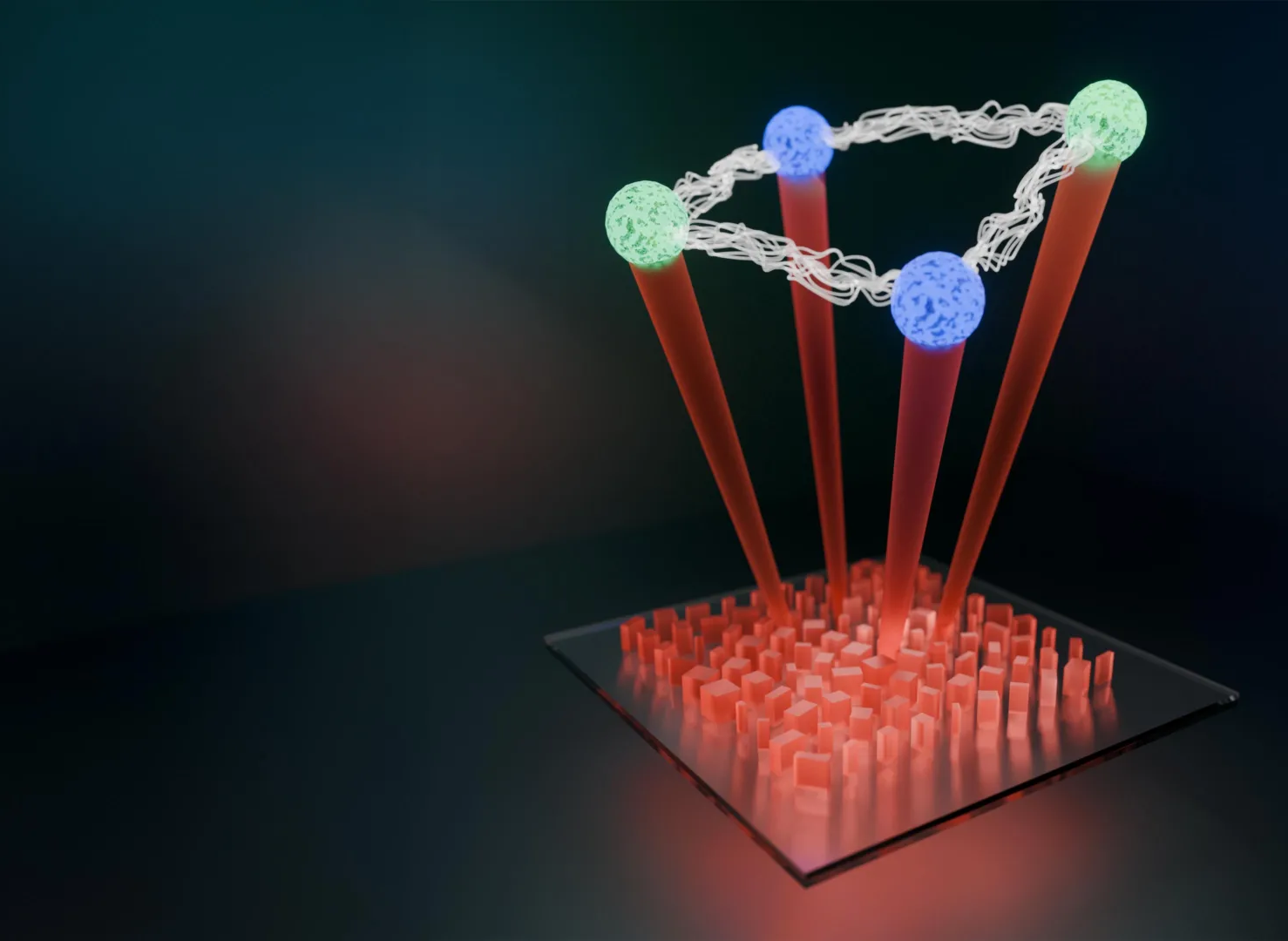
Researchers at Harvard have created a groundbreaking metasurface that can replace bulky and complex optical components used in quantum computing with a single, ultra-thin, nanostructured layer. This innovation could make quantum networks far more scalable, stable, and compact. By harnessing the power of graph theory, the team simplified the design of these quantum metasurfaces, enabling them to generate entangled photons and perform sophisticated quantum operations — all on a chip thinner than a human hair. It's a radical leap forward for room-temperature quantum technology and photonics.
