A very nice flying robot design! 😃

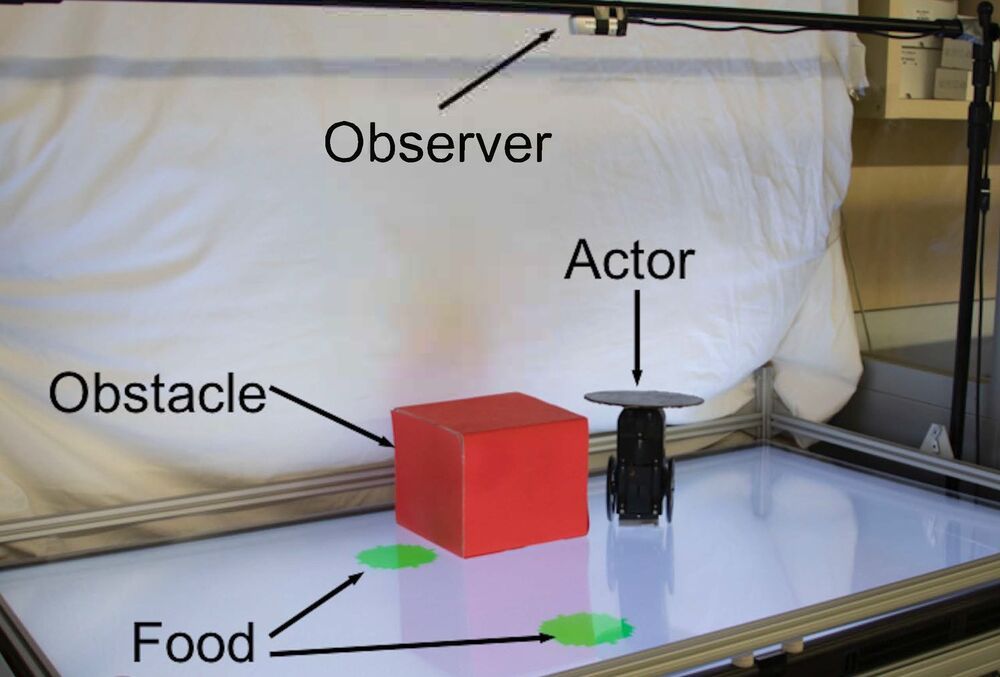
We are fascinated by machines that can control cars, compose symphonies, or defeat people at chess, Go, or Jeopardy! While more progress is being made all the time in artificial intelligence (AI), some scientists and philosophers warn of the dangers of an uncontrollable superintelligent AI. Using theoretical calculations, an international team of researchers, including scientists from the Center for Humans and Machines at the Max Planck Institute for Human Development, shows that it would not be possible to control a superintelligent AI. Their study is published in the Journal of Artificial Intelligence Research.
Suppose in the not-too-distant future that a research team builds an AI system with intelligence superior to that of humans, so it can learn independently. Connected to the Internet, the AI would have access to all of humanity’s data. It could replace existing programs and take control of all machines globally.
Would this produce a utopia or a dystopia? Would the AI cure cancer, bring about world peace, and prevent a climate disaster? Or would it destroy humanity and take over the Earth?
HURRY. I’m getting old.
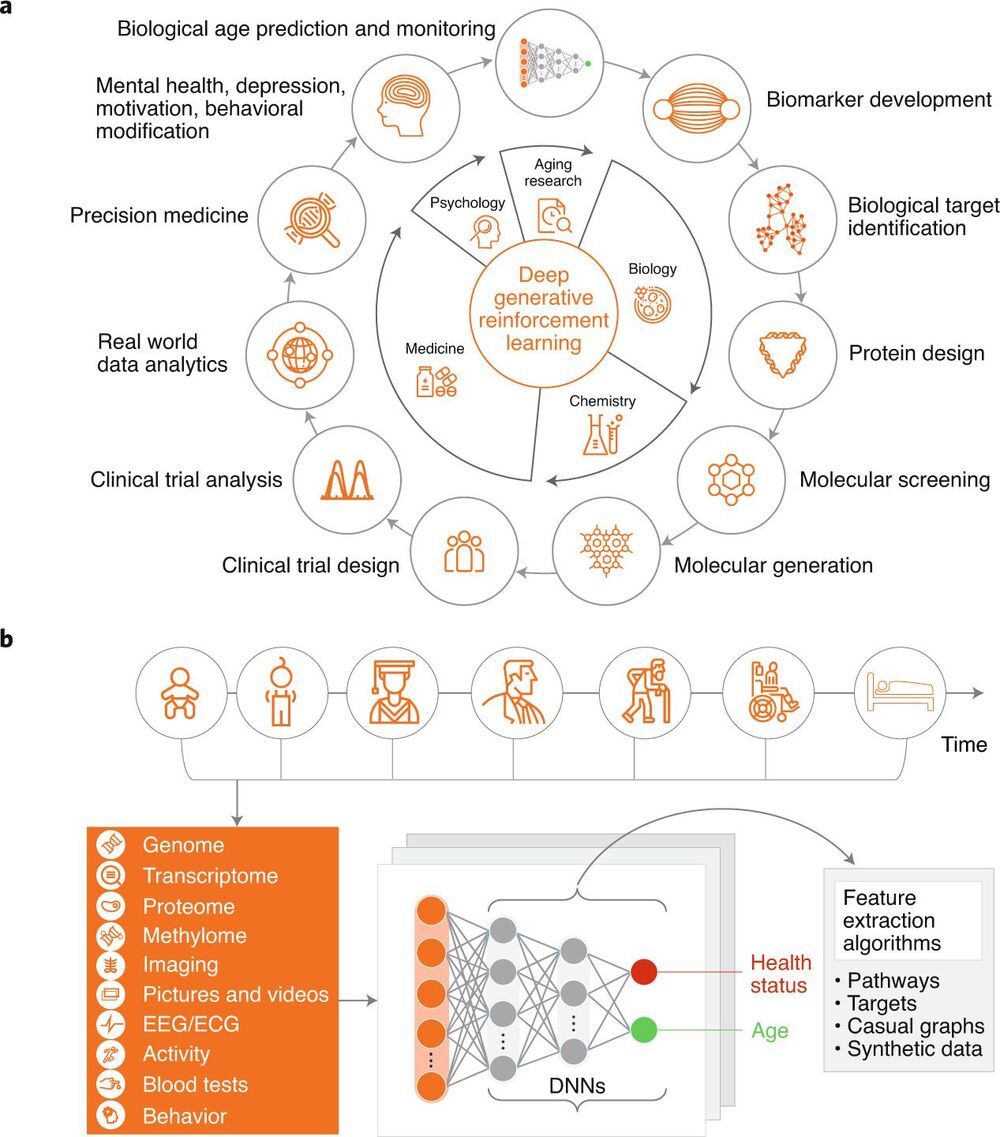
Recent advances in deep learning enabled the development of AI systems that outperform humans in many tasks and have started to empower scientists and physicians with new tools. In this Comment, we discuss how recent applications of AI to aging research are leading to the emergence of the field of longevity medicine.
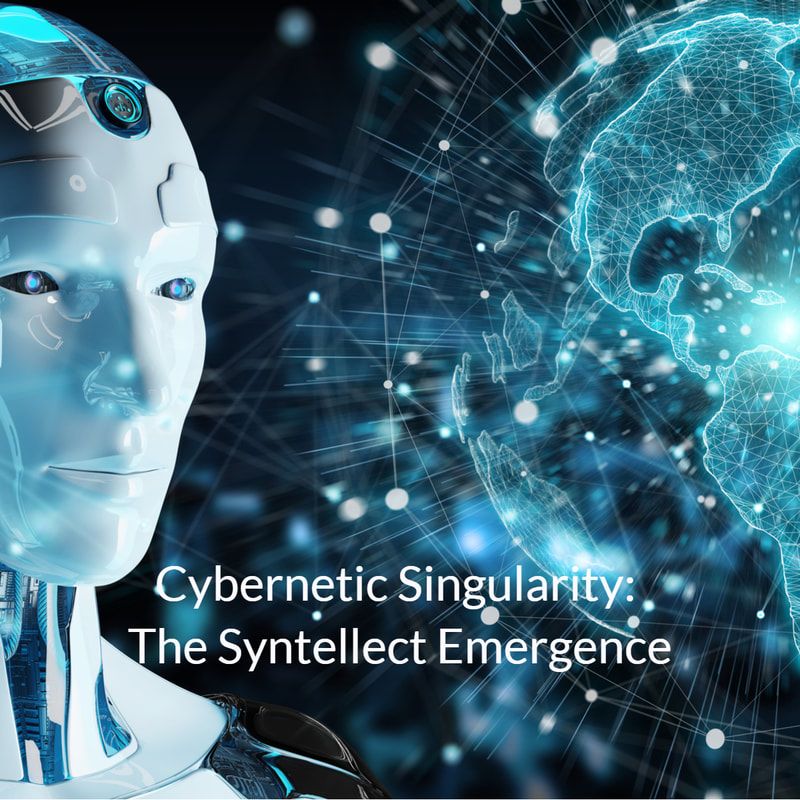
“By contemplating the full spectrum of scenarios of the coming technological singularities, many can place their bets in favor of the Cybernetic Singularity which is the surest path to cybernetic immortality and engineered godhood as opposed to the AI Singularity when Homo sapiens is hastily retired as a senescent parent. This meta-system transition from the networked Global Brain to the Gaian Mind is all about evolution of our own individual minds; it’s all about our own Self-Transcendence.”-Alex M. Vikoulov, The Cybernetic Singularity: The Syntellect Emergence #CyberneticSingularity #SyntellectEmergence #CyberneticTheoryofMind #AlexMVikoulov #consciousness #phenomenology #evolution #cybernetics #SyntellectHypothesis #PhilosophyofMind #QuantumTheory #PhysicsofTime #PressRelease #NewBookRelease #AmazonKindle #AlexVikoulov #EcstadelicMediaGroup
Ecstadelic Media Group releases a new non-fiction book The Cybernetic Singularity: The Syntellect Emergence, The Cybernetic Theory of Mind series by Alex M. Vikoulov as a Kindle eBook (Press Release, San Francisco, CA, USA, January 102021 08.00 PM PST)
Circa 2019 😃
The La Moto Volante from French company Lazareth demonstrated its first stable hover. NASA’s helicopter that will fly on Mars has passed its flight tests. And Boston Dynamics’ upgraded Handle robot is a champ at warehouse Tetris.
CNET playlists: https://www.youtube.com/user/CNETTV/playlists.
Download the new CNET app: https://cnet.app.link/GWuXq8ExzG
Like us on Facebook: https://www.facebook.com/cnet.
Follow us on Twitter: https://www.twitter.com/cnet.
Follow us on Instagram: http://bit.ly/2icCYYm

Compared to standard machine learning models, deep learning models are largely superior at discerning patterns and discriminative features in brain imaging, despite being more complex in their architecture, according to a new study in Nature Communications led by Georgia State University.
Advanced biomedical technologies such as structural and functional magnetic resonance imaging (MRI and fMRI) or genomic sequencing have produced an enormous volume of data about the human body. By extracting patterns from this information, scientists can glean new insights into health and disease. This is a challenging task, however, given the complexity of the data and the fact that the relationships among types of data are poorly understood.
Deep learning, built on advanced neural networks, can characterize these relationships by combining and analyzing data from many sources. At the Center for Translational Research in Neuroimaging and Data Science (TReNDS), Georgia State researchers are using deep learning to learn more about how mental illness and other disorders affect the brain.
Symbiosis by combining humans with artificial intelligence is Elon Musk’s #Neuralink corporate goal and I agree that is a great strategy for the future and why he is the richest person in the world now. 🌎
Some smart robots can perform complex tasks on their own, without the programmers understanding how they learned them.
The maker of a defunct cloud photo storage app that pivoted to selling facial recognition services has been ordered to delete user data and any algorithms trained on it, under the terms of an FTC settlement.
The regulator investigated complaints the Ever app — which gained earlier notoriety for using dark patterns to spam users’ contacts — had applied facial recognition to users’ photographs without properly informing them what it was doing with their selfies.
Under the proposed settlement, Ever must delete photos and videos of users who deactivated their accounts and also delete all face embeddings (i.e. data related to facial features which can be used for facial recognition purposes) that it derived from photos of users who did not give express consent to such a use.