Toggle light / dark theme

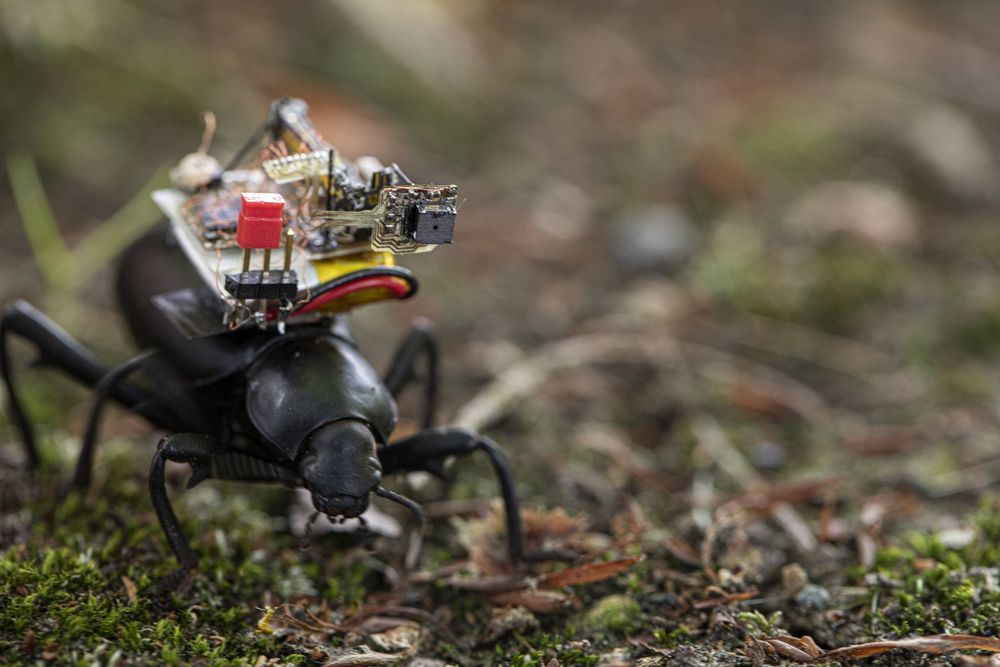
A GoPro for beetles: Researchers create a robotic camera backpack for insects

In the movie “Ant-Man,” the title character can shrink in size and travel by soaring on the back of an insect. Now researchers at the University of Washington have developed a tiny wireless steerable camera that can also ride aboard an insect, giving everyone a chance to see an Ant-Man view of the world.

The camera, which streams video to a smartphone at 1 to 5 frames per second, sits on a mechanical arm that can pivot 60 degrees. This allows a viewer to capture a high-resolution, panoramic shot or track a moving object while expending a minimal amount of energy. To demonstrate the versatility of this system, which weighs about 250 milligrams—about one-tenth the weight of a playing card—the team mounted it on top of live beetles and insect-sized robots.

The results will be published July 15 in Science Robotics.

Liquid-Metal-Driven Micromachines for the Next Cutting-edge Technology

face_with_colon_three yay closer to foglet bodies: 3.


Is the T-1000 no longer science fiction?

It is a human dream to realize a robot with automatic mechanical functions similar to the robots presented in several science-fiction movies and series such as “Ex Machina”, “Black Mirror”, “The Terminator”, etc.

More specifically, the idea of a liquid-metal-based robot able to transform its structure from solid to liquid, slip through narrow channels, and self-repair from any physical damage has always fascinated the scientific community engaged in cutting-edge technological discoveries. Beside the science-fiction background, micromachines able to gain energy from chemical reactions are attracting lots of attention as they emerged as ideal candidates for microrobots used in the field of microfabrication, detection/sensing, and personalized drug delivery.

4 Automatic Outlier Detection Algorithms in Python

The presence of outliers in a classification or regression dataset can result in a poor fit and lower predictive modeling performance.

Identifying and removing outliers is challenging with simple statistical methods for most machine learning datasets given the large number of input variables. Instead, automatic outlier detection methods can be used in the modeling pipeline and compared, just like other data preparation transforms that may be applied to the dataset.

In this tutorial, you will discover how to use automatic outlier detection and removal to improve machine learning predictive modeling performance.

This Deep-Learning AI Can Code Just Like a Programmer

A team of computer scientists has developed a new AI that can write code and predict software solutions for programmers navigating through numerous application programming interfaces (APIs).

For years, research scientists have been studying how programs can generate instant feedback that coders can address immediately. A wide range of applications has already been created, all of which aim to detect faulty or questionable lines of code. While this has only been minimally integrated into most developers’ software tools, a team of computer scientists from Rice University has recently figured out a way for developers and programmers to receive feedback on their code while suggesting solutions for their programs—all through artificial intelligence (AI).

3 Ways Artificial Intelligence Will Change Healthcare

It’s no secret that healthcare costs have risen faster than inflation for decades. Some experts estimate that healthcare will account for over 20% of the US GDP by 2025. Meanwhile, doctors are working harder than ever before to treat patients as the U.S. physician shortage continues to grow. Many medical professionals have their schedules packed so tightly that much of the human element which motivated their pursuit of medicine in the first place is reduced.

In healthcare, artificial intelligence (AI) can seem intimidating. At the birthday party of a radiologist friend, she gently expressed how she felt her job would be threatened by AI in the coming decade. Yet, for most of the medical profession, AI will be an accelerant and enabler, not a threat. It would be good business for AI companies as well to help, rather than attempt to replace, medical professionals.

In a previous article, I expressed three ways in which I consistently see AI adding value: speed, cost and accuracy. In healthcare, it’s no different. Here are three examples of how AI will change healthcare.

Computers on verge of designing their own programs

Computer programmers may soon design the ultimate program: A program that designs programs.

Last week, a team led by Justin Gottschlich, director of the machine programming research group at Intel, announced the creation of a new machine learning system that designs its own . They call the system MISIM, Machine Inferred Code Similarity.

Gottschlich explained, “Intel’s ultimate goal for machine programming is to democratize the creation of software. When fully realized, machine programming will enable everyone to create software by expressing their intention in whatever fashion that’s best for them, whether that’s code, or something else. That’s an audacious goal, and while there’s much more work to be done, MISIM is a solid step toward it.”

Parts Come Together This Year for DARPA’s Robotic In-Space Mechanic

Eyeing a launch in 2023, DARPA’s Robotic Servicing of Geosynchronous Satellites (RSGS) program will focus the remainder of this year on completing the elements of the robotic payload. The objective of RSGS is to create an operational dexterous robotic capability to repair satellites in geosynchronous Earth orbit (GEO), extending satellite life spans, enhancing resilience, and improving reliability for the current U.S. space infrastructure.

Earlier this year, DARPA partnered with Space Logistics LLC, a wholly owned subsidiary of Northrop Grumman, to provide the spacecraft bus, launch, and operations of the integrated spacecraft. DARPA will provide the payload that flies on the bus, including the robotic arms, through an agreement with the U.S. Naval Research Laboratory (NRL).

In 2021, NRL will integrate the robotic arms onto the payload structure, and then is expected to begin environmental tests by the end of same year. After launch in 2023, it will take approximately nine months to reach GEO, and the program anticipates servicing satellites in mid-2024.

The Panopticon Is Already Here

Despite China’s considerable strides, industry analysts expect America to retain its current AI lead for another decade at least. But this is cold comfort: China is already developing powerful new surveillance tools, and exporting them to dozens of the world’s actual and would-be autocracies. Over the next few years, those technologies will be refined and integrated into all-encompassing surveillance systems that dictators can plug and play.


Xi Jinping is using artificial intelligence to enhance his government’s totalitarian control—and he’s exporting this technology to regimes around the globe.

/* */