Discover the groundbreaking capabilities of Xiaomi’s CyberDog 2, a bio-inspired quadruped robot leaping forward in robotics!
The “Beneficial AGI Summit & Unconference” is a new event organized by SingularityNet and TrueAGI in collaboration with others. The Millennium Project is one of the sponsors of the event and our Jerome Glenn, Executive Director and co-founder of The Millennium Project, and José Cordeiro, MP Board member and RIBER and Venezuela Nodes Chair, are members of the organizing committee of the event. The Beneficial AGI summit will take place both online and physically and c/o Hilton Panama in Panama City. The streaming is free, get your ticket.
The objective of the conference is to bring together the leading voices in AI in actions to catalyze the emergence of beneficial AGI. Key themes of the event are: Constitution & Governance Framework, Global Brain Collective, Simulation / Gaming Environments, Scenarios analysis process, Potential scenarios (from 1 to 7).
On the first two days of the BGI Summit, Feb. 27–28, top thought leaders from around the globe will engage in comprehensive, detailed discussions of a wide range of questions regarding various approaches to AGI and their ethical, economic, psychological, political, environmental and other implications. The focus will be on discussing issues, making conceptual progress, forming collaborations, and engaging in the practical actions aimed at catalyzing the emergence of beneficial AGI based on the ideas and connections set in motion by all involved.
Imagine that.
Uncle Sam has quietly deployed a new secret weapon designed to catch bad guys trying to steal from taxpayers: artificial intelligence.
Starting around late 2022, the Treasury Department began using enhanced fraud-detection methods powered by AI to spot fraud, CNN has learned.
The strategy mirrors what is already being done in the private sector. Banks and payment companies are increasingly turning to AI to root out suspicious transactions – which the technology can often do with lightning speed.
One major area of our lives that uses largely “hidden” AI is transportation. Millions of flights and train trips are coordinated by AI all over the world. These AI systems are meant to optimize schedules to reduce costs and maximize efficiency.
Artificial intelligence can also manage real-time road traffic by analyzing traffic patterns, volume and other factors, and then adjusting traffic lights and signals accordingly. Navigation apps like Google Maps also use AI optimization algorithms to find the best path in their navigation systems.
AI is also present in various everyday items. Robot vacuum cleaners use AI software to process all their sensor inputs and deftly navigate our homes.
Joscha Bach, Principal AI Engineer at Intel Labs Cognitive Computing group and member of our Scientific Advisory Board, and Rana Gujral, CEO at Behavioral Signals, on a FIRESIDE CHAT to talk about Artificial Consciousness and New Language Models: The changing fabric of our society, at DeepFest 2023.
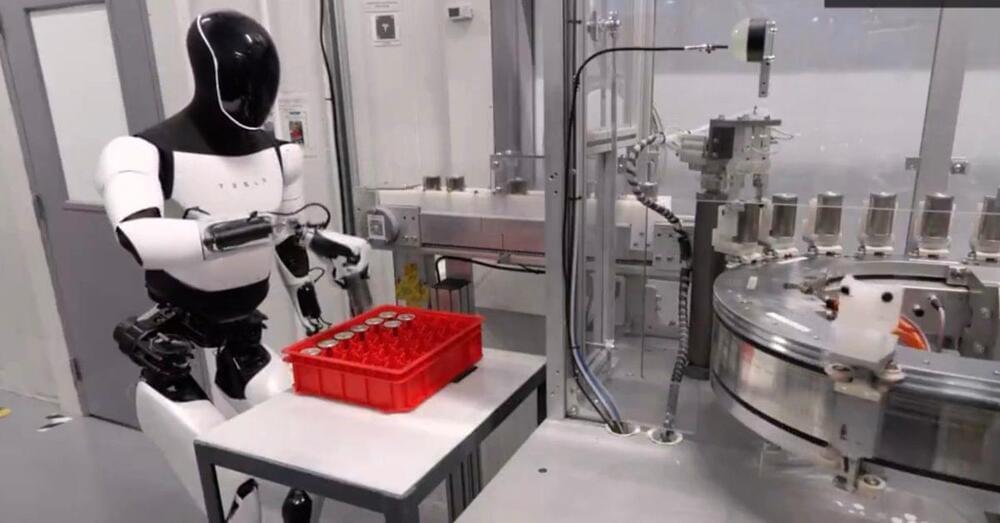
Just days after Elon Musk shared the progress of Tesla’s Optimus robot, Figure AI has released an image of its own humanoid robot at work.
Called “Figure 01,” this humanoid robot is seen being put to work in a warehouse.
In the one-minute and 21-second clip released on YouTube (embedded below), Figure 1 can be seen fetching and moving boxes all on its own.
Spacetime is a conceptual model that fuses the three dimensions of space (length, width, and breadth) with the fourth dimension of time. By doing so, a four-dimensional geometric object is created. Researchers have recently used a similar way of thinking to study AI environments, leading to a unique reframing of AI problems in geometric terms.
Dr. Thomas Burns, a Ph.D. graduate and Visiting Researcher at the Okinawa Institute of Science and Technology (OIST), and Dr. Robert Tang, a mathematician at Xi’an Jiaotong-Liverpool University and a former post-doctoral researcher at OIST, wanted to study AI systems from a geometric perspective to more accurately represent their properties.
They have determined that the occurrence of a “geometric defect,” a failure of what is called Gromov’s Link Condition, correlates exactly to where there is potential for collision between moving AI agents. Their findings have been published in the journal Transactions on Machine Learning Research.
China ruled on a case of infringement of copyright by an AI-generated service, the first effective ruling of its kind globally, which provided a judicial answer to the dilemma of whether the content generated by AI service providers infringes on copyright, media reported on Monday.
According to the 21st Century Business Herald, the Guangzhou Internet Court ruled that the an AI company had infringed the plaintiff’s copyright and adaptation rights to the Ultraman works in the process of providing generative AI services, and should bear relevant civil liability.
The protagonist of this case was the super IP Ultraman. In this case, the copyright owner of the “Ultraman” works exclusively authorized the copyright of the series images to the plaintiff, while the defendant company operated a website, providing services with AI conversation and AI-generated painting functions.