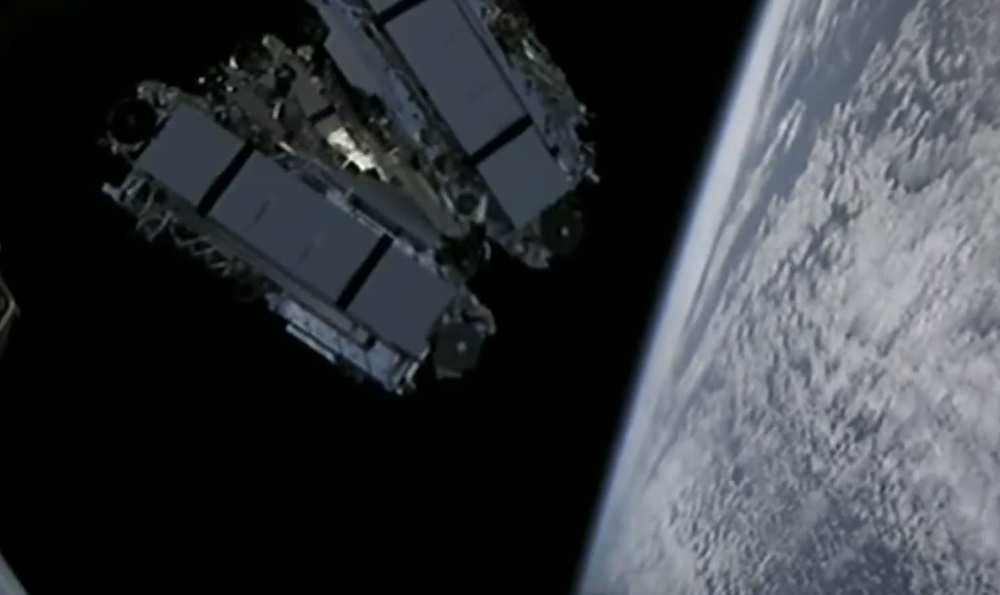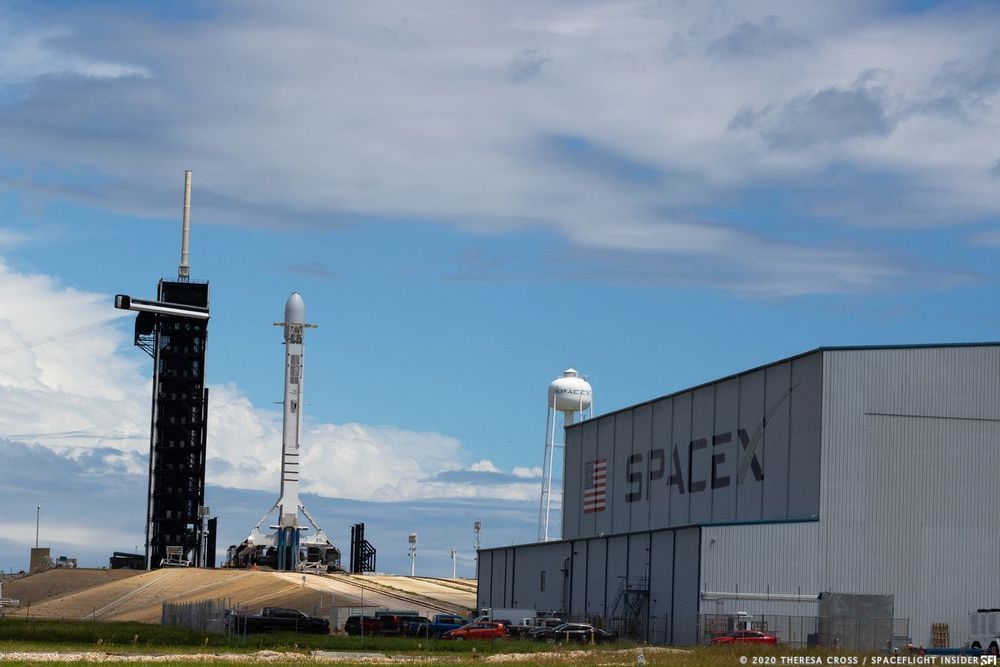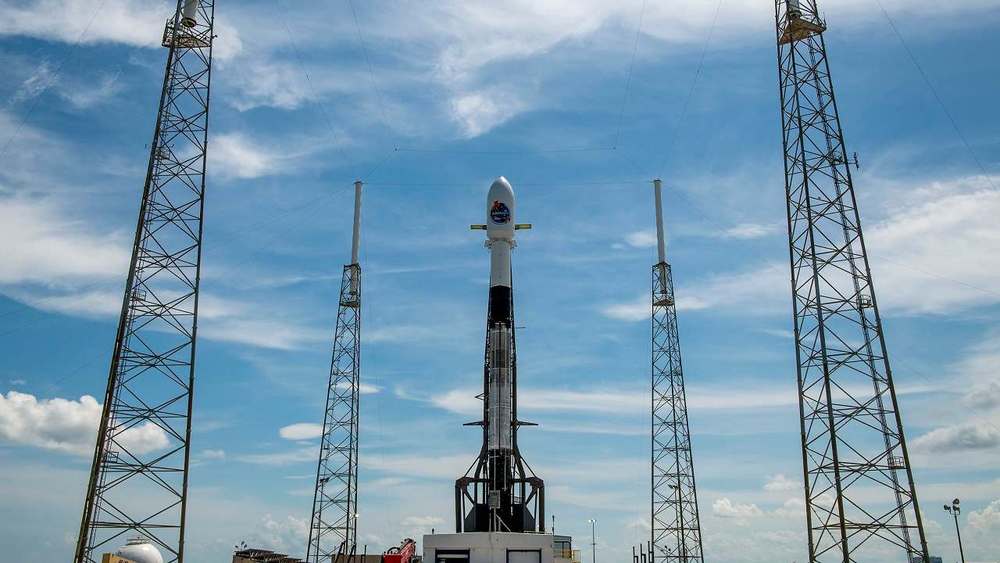
Live coverage of the countdown and launch of a SpaceX Falcon 9 rocket from pad 39A at NASA’s Kennedy Space Center in Florida. The mission will launch SpaceX’s tenth batch of Starlink broadband satellites. Text updates will appear automatically below. Follow us on Twitter.
Category: satellites – Page 142
SpaceX nails second Falcon nosecone recovery in one month
SpaceX has successfully recovered two pairs of Falcon 9 payload fairings (nosecones) – one twice-flown – in one month after twin ships GO Ms. Tree and GO Ms. Chief returned to port on July 2nd.
Around 45 minutes after Falcon 9 B1060 lifted off for the first time with the US military’s third upgraded GPS III satellite in tow and around 40 minutes after the rocket’s payload fairing deployed, both fairing halves gently splashed down in the Atlantic Ocean just a few miles apart. Lacking their main recovery nets in an odd configuration, Ms. Tree and Ms. Chief both fished one half out of the ocean with smaller secondary nets before placing the fairings on their decks for technicians to secure them.
A little more than two weeks prior, both ships were in the midst of recovering the Starlink-8 mission’s twice-flown fairings from the ocean, safely returning them – intact – to shore for the first time since SpaceX began fairing reuse. As SpaceX itself noted at the tail end of its GPS III SV03 webcast, the intact recovery of the mission’s fairing halves all but guarantees that they’ll be reused in the near future.
NASA Funds Harvard Hunt for Alien “Technological Civilizations”
A team of astronomers from Harvard and other institutions are collaborating on a new project to scan the skies for technological signatures from alien civilizations.
It’s a noteworthy new project, as it’s the first to receive a NASA grant for SETI-specific research in more than 30 years, according to a statement.
“Technosignatures relate to signatures of advanced alien technologies similar to, or perhaps more sophisticated than, what we possess,” said Avi Loeb, the chair of the Harvard astronomy department Harvard, in a statement. “Such signatures might include industrial pollution of atmospheres, city lights, photovoltaic cells (solar panels), megastructures, or swarms of satellites.”
Elon Musk calls Jeff Bezos a copy cat after Amazon buys self-driving startup
Tesla Inc. Chief Executive Officer Elon Musk called Amazon.com CEO Jeff Bezos “a copy cat” on Twitter after the online retailer announced it is acquiring self-driving startup Zoox Inc.
.@JeffBezos is a copy 🐈 haha https://twitter.com/ft/status/1276401808068526080— Elon Musk (@elonmusk) June 26, 2020
It’s not the first time Musk, who also serves as CEO of SpaceX, has taken jabs at Bezos. Earlier this month, Musk made headlines when he said it was “time to break up Amazon” in a tweet. He also called Bezos, who runs rocket-launch startup Blue Origin LLC, a copy cat in April 2019 after hearing of plans for a satellite-based internet service to rival his own company’s.
NASA Extends Deep Space Atomic Clock Mission
Smart phone apps provide nearly instantaneous navigation on Earth; the Deep Space Atomic Clock could do the same for future robotic and human explorers.
As the time when NASA will begin sending humans back to the Moon draws closer, crewed trips to Mars are an enticing next step. But future space explorers will need new tools when traveling to such distant destinations. The Deep Space Atomic Clock mission is testing a new navigation technology that could be used by both human and robotic explorers making their way around the Red Planet and other deep space destinations.
In less than a year of operations, the mission has passed its primary goal to become one of the most stable clocks to ever fly in space; it is now at least 10 times more stable than atomic clocks flown on GPS satellites. In order to keep testing the system, NASA has extended the mission through August 2021. The team will use the additional mission time to continue to improve the clock’s stability, with a goal of becoming 50 times more stable than GPS atomic clocks.
China ‘becoming true space power’ as satellite launch completes BeiDou system
Observers said that the fully fledged system could put China in a competitive position against the world’s three other satellite navigation networks – the US-owned Global Positioning System (GPS), the European Union’s Galileo and Russia’s Glonass. It could also expand China’s international engagement and offer an alternative to other countries that had been reliant on US technology, they said.
Final satellite in the navigation network – China’s answer to the US-owned GPS – is sent into orbit on Tuesday after technical problems delayed it by a week.