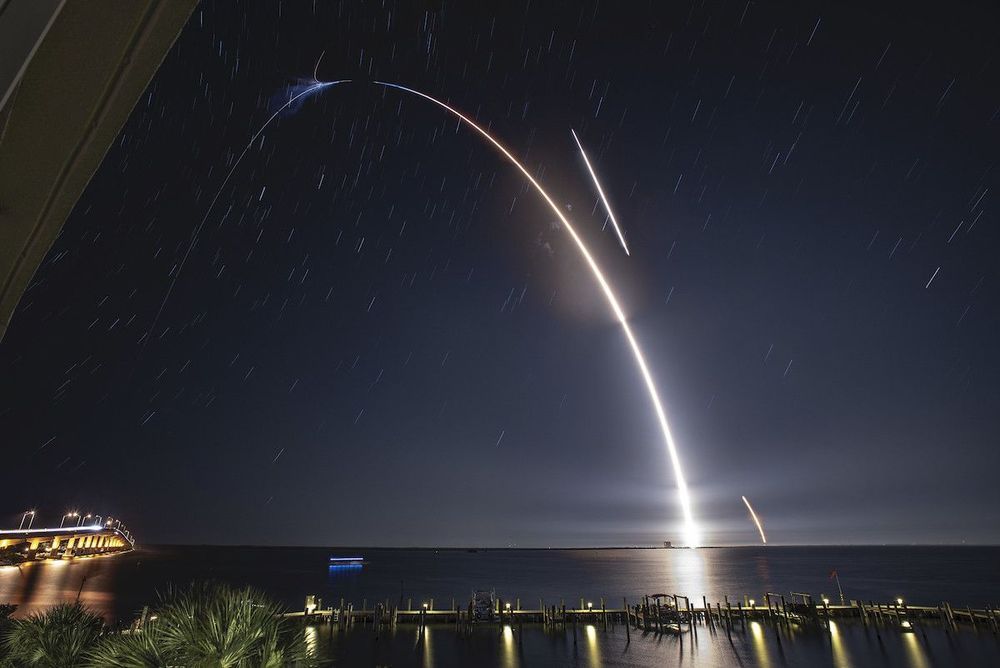
After SpaceX’s eighth Starlink internet satellite launch, the company released a video of its Falcon 9 rocket jettisoning two $3 million fairings.
Category: satellites – Page 143
5 trillion bytes a day: SpaceX engineers flash some facts about Starlink satellites
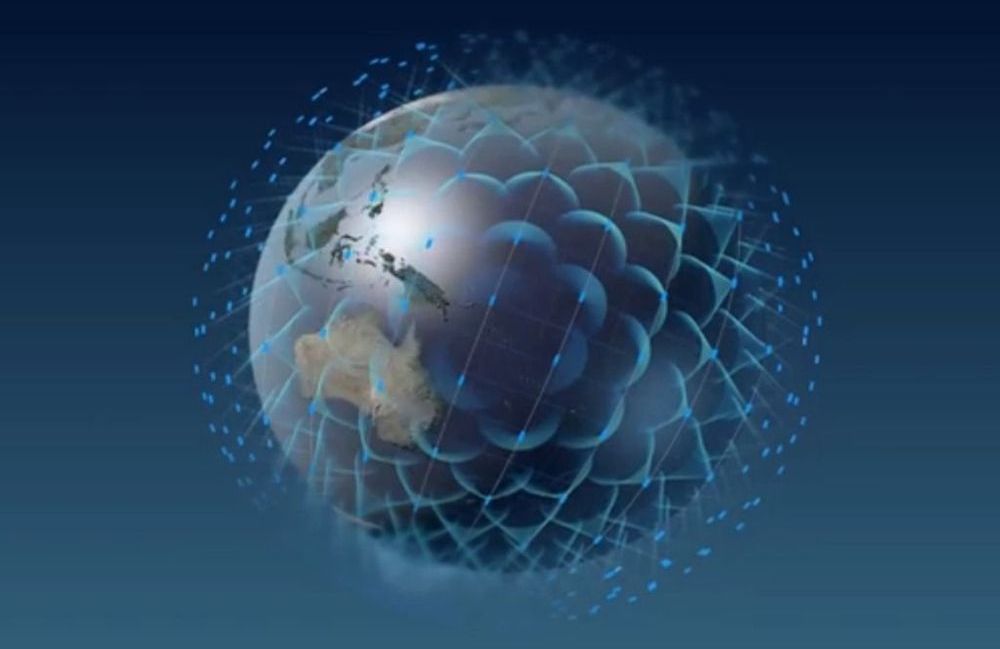
SpaceX’s Starlink satellite constellation is still deep into testing mode, but it’s already generating 5 trillion bytes of data on a daily basis and getting software updates on a weekly basis.
Those are a couple of the nuggets coming from a weekend Reddit “Ask Me Anything” session featuring SpaceX’s software team.
The main focus of the online chat was SpaceX’s successful mission sending NASA astronauts Bob Behnken and Doug Hurley to the International Space Station in a Crew Dragon capsule — but one of the team members, Matt Monson, has moved on from Dragon to take charge of Starlink software development.
Air Force Pilots Are About to Do Battle With Autonomous Drones
Changing Course
The Air Force announced an AI initiative called “Skyborg” last March with the goal of flying fighter jets without anyone at the controls. Now, Shanahan says that the Air Force may be more interested in swarm drones and other uses for AI than necessarily taking the pilot out of a fighter plane’s cockpit.
“Maybe I shouldn’t be thinking about a 65ft-wingspan, maybe it is a small autonomous swarming capability,” Shanahan told BBC News. “The last thing I would claim is that carriers and fighters and satellites are going away in the next couple of years.”
SpaceX to launch 60 Starlink satellites for megaconstellation tonight. Here’s how to watch
SpaceX will launch its next batch of Starlink internet satellites into orbit tonight (June 3) after two weeks of weather delays and the company’s historic first astronaut flight.
A Falcon 9 rocket, which SpaceX has already flown four past missions, will launch 60 new Starlink satellites into orbit from the company’s pad at Launch Complex 40 at Cape Canaveral Air Force Base in Florida. Liftoff is set for 9:25 p.m. EDT (0125 June 4 GMT).
A new plasma engine will allow less expensive, more efficient, and longer space missions
Researchers at Universidad Carlos III de Madrid (UC3M) have patented a new spatial plasma-fueled engine capable of satellite and spacecraft propulsion, with magnetic field geometry and configuration that would minimize losses on walls and their erosion, thereby resolving issues of efficiency, durability, and operating restrictions of engines that are currently in orbit.
A new scheme for satellite-based quantum-secure time transfer
Researchers at the University of Science and Technology of China have recently introduced a new satellite-based quantum-secure time transfer (QSTT) protocol that could enable more secure communications between different satellites or other technology in space. Their protocol, presented in a paper published in Nature Physics, is based on two-way quantum key distribution in free space, a technique to encrypt communications between different devices.
“Our main idea was to realize quantum-secure time transfer in order to resolve the security issues in practical time–frequency transfer,” Feihu Xu, one of the researchers who carried out the study, told Phys.org.
Quantum key distribution (QKD) is a technique to achieve secure communication that utilize cryptographic protocols based on the laws of quantum mechanics. Quantum key distribution protocols can generate secret security keys based on quantum physics, enabling more secure data transfer between different devices by spotting attackers who are trying to intercept communications.
First Object Teleported from Earth to Orbit
Essentially a quantum radar teleportation device could entangle objects anywhere in the universe.
Last year, a Long March 2D rocket took off from the Jiuquan Satellite Launch Centre in the Gobi Desert carrying a satellite called Micius, named after an ancient Chinese philosopher who died in 391 B.C. The rocket placed Micius in a Sun-synchronous orbit so that it passes over the same point on Earth at the same time each day.
Micius is a highly sensitive photon receiver that can detect the quantum states of single photons fired from the ground. That’s important because it should allow scientists to test the technological building blocks for various quantum feats such as entanglement, cryptography, and teleportation.
Solving the space junk problem
Space is getting crowded. Aging satellites and space debris crowd low-Earth orbit, and launching new satellites adds to the collision risk. The most effective way to solve the space junk problem, according to a new study, is not to capture debris or deorbit old satellites: it’s an international agreement to charge operators “orbital-use fees” for every satellite put into orbit.