Toggle light / dark theme

Astronomers Use Hubble Data and Computational Modeling to Study Exoplanet Weather

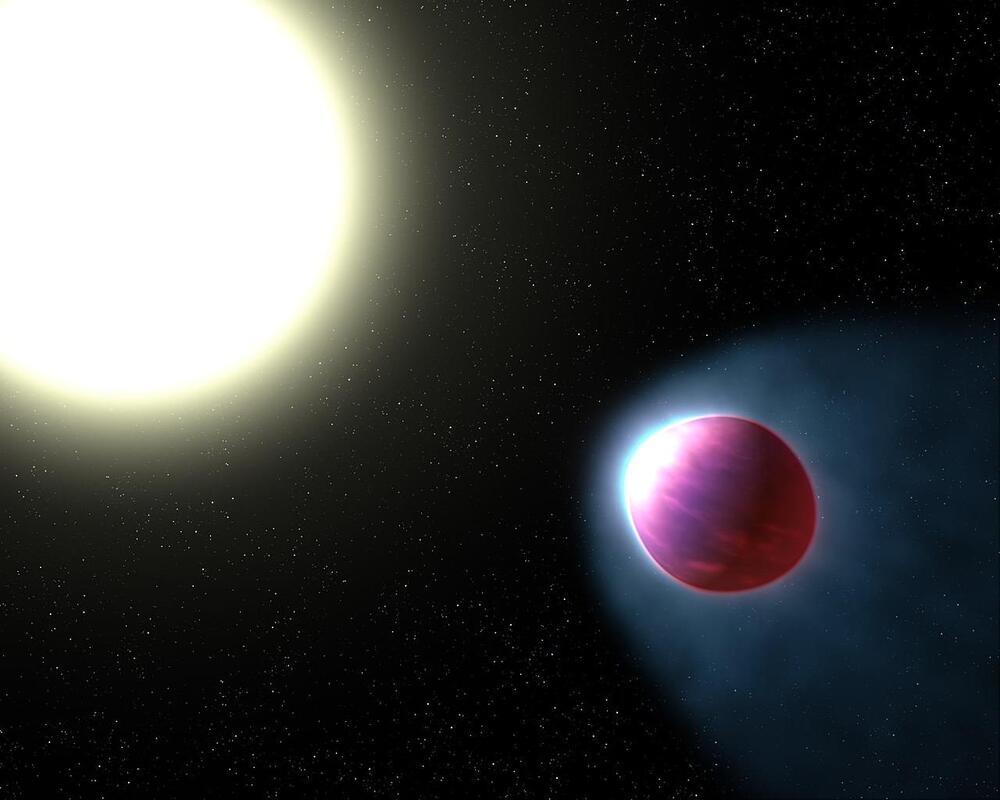
Meteorologists on Earth struggle to predict the weather, but what about scientists trying to predict the weather on exoplanets that are light-years from Earth? This is what a recently accepted study to The Astrophysical Journal Supplement hopes to unveil as an international team of researchers used data from NASA’s Hubble Space Telescope to conduct a three-year investigation into weather patterns on WASP-121 b, which is a “hot Jupiter” that orbits its star in just over one day and located approximately 880 light-years from Earth. This study holds the potential to not only advance our understanding of exoplanets and their atmospheres, but also how we study them, as well.

Artist impression of WASP-121 b orbiting its host star. (Credit: NASA, ESA, and G. Bacon (STSci))

“The assembled dataset represents a significant amount of observing time for a single planet and is currently the only consistent set of such repeated observations,” said Dr. Quentin Changeat, who is an Honorary Research Fellow in the Department of Astronomy at University College London and lead author of the study. “The information that we extracted from those observations was used to infer the chemistry, temperature, and clouds of the atmosphere of WASP-121 b at different times. This provided us with an exquisite picture of the planet changing over time.”
Coronal mass ejection from colossal New Year’s Eve solar flare will strike Earth today

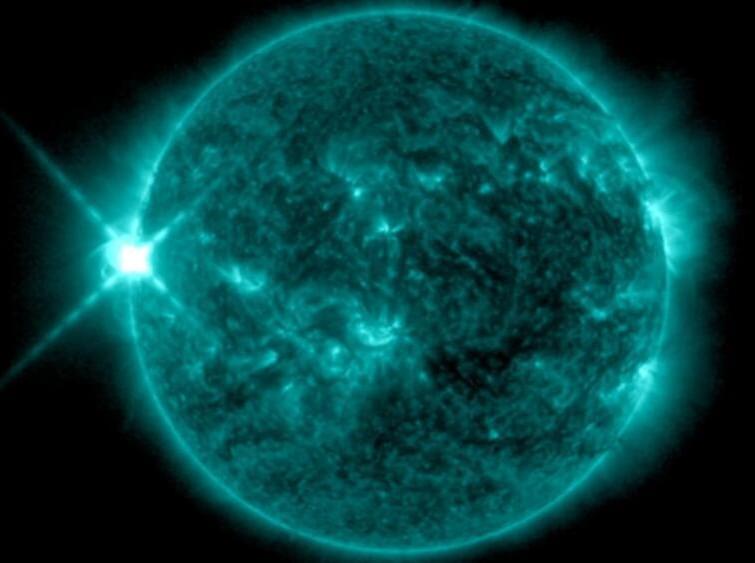
Earth will be struck today by a coronal mass ejection from a huge solar flare that erupted from the sun on New Year’s Eve.

The New Year’s Eve flare created a CME, a huge bubble of plasma from a region of the sun called the corona, which is equivalent to the sun’s outer atmosphere, and this has an Earth-directed component. Though this massive ejection of plasma will only graze the magnetic bubble surrounding our planet Tuesday (Jan. 2), the magnetosphere, it could trigger a geomagnetic storm that could affect communications and power infrastructure.

The coronal mass ejection CME was hurled into space by an X-class solar flare that burst from the surface of the sun at 4:55 p.m. EST (2155 GMT) on Sunday (Dec. 31). It is the most powerful flare that has happened on the sun during the current solar cycle, solar cycle 25, which began in Dec. 2019. In fact, the flare that ended 2023 with a bang is the largest that has been observed since Sept. 10, 2017, according to the Space Weather Prediction Center of the National Oceanic And Atmospheric Administration (NOAA).

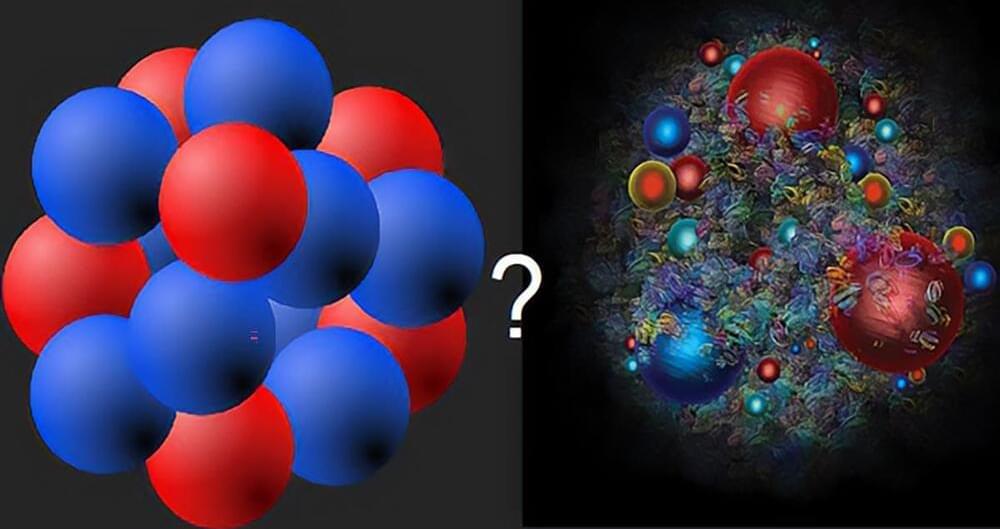
Quantum Vortex Reveal: The Distinct Dance of Quark and Nucleon Liquids

Matter inside neutron stars can have different forms: a dense liquid of nucleons or a dense liquid of quarks.

Recent studies reveal that in neutron stars, quark liquids are fundamentally different from nucleon liquids, as evidenced by the unique color-magnetic field in their vortices. This finding challenges previous beliefs in quantum chromodynamics and offers new insights into the nature of confinement.

The science of neutron star matter.

/* */