Toggle light / dark theme

New Discovery Indicates an Alternative Gravity Theory

Dwarf galaxies are small, faint galaxies that are often found in or close to bigger galaxies or galaxy clusters. As a result, they could be impacted by their larger companions’ gravitational effects.

“We introduce an innovative way of testing the standard model based on how much dwarf galaxies are disturbed by gravitational tides’ from nearby larger galaxies,” said Elena Asencio, a Ph.D. student at the University of Bonn and the lead author of the story.

Tides occur when gravity from one body pulls on various areas of another body differently. These are comparable to tides on Earth, which form when the moon exerts a stronger pull on the side of the Earth that faces the moon.

What happens if you grow plants on the Moon? New study shows how they react

If (or when) human exploration of our planetary neighbours goes ahead, this is a question that future colonists would have to tackle.

What do you need to make your garden grow? As well as plenty of sunshine alternating with gentle showers of rain — and busy bees and butterflies to pollinate the plants — you need good, rich soil to provide essential minerals. But imagine you had no rich soil, or showers of rain, or bees and butterflies. And the sunshine was either too harsh and direct or absent — causing freezing temperatures.


4FR / iStock.

The researchers behind the study cultivated the fast-growing plant Arabidopsis thaliana in samples of lunar regolith (soil) brought back from three different places on the Moon by the Apollo astronauts.

Heaviest element ever discovered in exoplanet atmosphere

When it comes to finding habitable exoplanets, the next big challenge is not just spotting exoplanets or looking at their orbits, but getting a better understanding of what conditions there might be like by analyzing their atmospheres. New tools like the James Webb Space Telescope will allow us to peer into the atmospheres of exoplanets and see what they are composed of, which can affect the planet’s surface temperature, pressure, and weather systems.

Now, astronomers using the European Southern Observatory’s Very Large Telescope (ESO’s VLT), a ground-based telescope located in Chile, have discovered the heaviest element ever in an exoplanet atmosphere. Looking at two ultra-hot gas giants called WASP-76 b and WASP-121 b, the researchers identified the element barium in their atmospheres.

These two planets orbit extremely close to their respective stars and thus have extremely high surface temperatures which can go over 1,000 degrees Celsius. On one of the planets, WASP-76 b, it gets so got that iron falls from the sky as rain. But the researchers were surprised to find barium high in the atmospheres of these planets because it is so heavy.

The future of space construction may have just been revolutionized by a new walking robot

The E-Walker has been tried and tested on Earth, but it’s yet to prove itself in space.

Large construction projects in space may be one step closer to reality, thanks to a new walking space robot. Researchers have designed the E-Walker — a state-of-the-art walking robot — to take on the behemoth task of space construction. A robot prototype has already been tested here on Earth by assembling a 25m Large Aperture Space Telescope. The telescope would usually be built in space, which is the E-Walker’s future duty.

Doubling up on its potential duties, a smaller-scale prototype of the same robot has also been created and shows promise for large construction applications on Earth, such as maintenance of wind turbines.

The team’s findings were presented in the journal Frontiers in Robotics and AI.


IStock/Vitaly Kusaylo.

Researchers have designed the E-Walker – a state-of-the-art walking robot – to take on the behemoth task of space construction. A robot prototype has already been tested here on Earth by assembling a 25m Large Aperture Space Telescope. The telescope would usually be built in space, which is the E-Walker’s future duty.

The National Science Foundation plans to build an educational center at the Arecibo Observatory

Unfortunately, the organization will not be rebuilding the damaged observatory.

The U.S. National Science Foundation issued a solicitation on Thursday for a new multidisciplinary, world-class educational center at the Arecibo Observatory in Puerto Rico, according to a statement by the organization. The center will serve as a hub for STEM education and outreach.


Dennisvdw/iStock.

STEM programs and initiatives.

Matter Ejected From Crashing Neutron Stars Appeared to Break Light Speed

When astronomers around the world watched the epic collision between two neutron stars in 2017, the main event was just the beginning. The after-effects, both immediate and longer-term, of such a massive, never-before-seen merger were bound to be exciting, interesting, and deeply informative.

And now scientists have revealed a doozy. As the two neutron stars slammed together, they ejected a jet of material that, to our eyes, appeared to blast into space at seven times the speed of light.

This, of course, is impossible, according to our current understanding of physics. It’s a phenomenon known as superluminal speed, which in spite of its name is actually an illusion based on our viewing angle.

NASA’s Swift and Fermi missions detect exceptional cosmic blast

Astronomers around the world are captivated by an unusually bright and long-lasting pulse of high-energy radiation that swept over Earth on Sunday, Oct. 9. The emission came from a gamma-ray burst (GRB)—the most powerful class of explosions in the universe—that ranks among the most luminous events known.

On Sunday morning Eastern time, a wave of X-rays and passed through the solar system, triggering detectors aboard NASA’s Fermi Gamma-ray Space Telescope, Neil Gehrels Swift Observatory, and Wind spacecraft, as well as others. Telescopes around the world turned to the site to study the aftermath, and new observations continue.

Called GRB 221009A, the provided an unexpectedly exciting start to the 10th Fermi Symposium, a gathering of gamma-ray astronomers now underway in Johannesburg, South Africa. “It’s safe to say this meeting really kicked off with a bang—everyone’s talking about this,” said Judy Racusin, a Fermi deputy project scientist at NASA’s Goddard Space Flight Center in Greenbelt, Maryland, who is attending the conference.

NASA’s Lucy spacecraft prepares to swing by Earth

On Oct. 16, at 7:04 a.m. EDT, NASA’s Lucy spacecraft, the first mission to the Jupiter Trojan asteroids, will skim the Earth’s atmosphere, passing a mere 220 miles (350 kilometers) above the surface. By swinging past Earth on the first anniversary of its launch, Lucy will gain some of the orbital energy it needs to travel to this never-before-visited population of asteroids.

The Trojan asteroids are trapped in orbits around the sun at the same distance as Jupiter, either far ahead of or behind the giant planet. Lucy is currently one year into a twelve-year voyage. This gravity assist will place Lucy on a new trajectory for a two-year orbit, at which time it will return to Earth for a second gravity assist. This second assist will give Lucy the energy it needs to cross the main asteroid belt, where it will observe asteroid Donaldjohanson, and then travel into the leading Trojan asteroid swarm. There, Lucy will fly past six Trojan asteroids: Eurybates and its satellite Queta, Polymele and its yet unnamed satellite, Leucus, and Orus. Lucy will then return to Earth for a third gravity assist in 2030 to re-target the spacecraft for a rendezvous with the Patroclus-Menoetius binary asteroid pair in the trailing Trojan asteroid swarm.

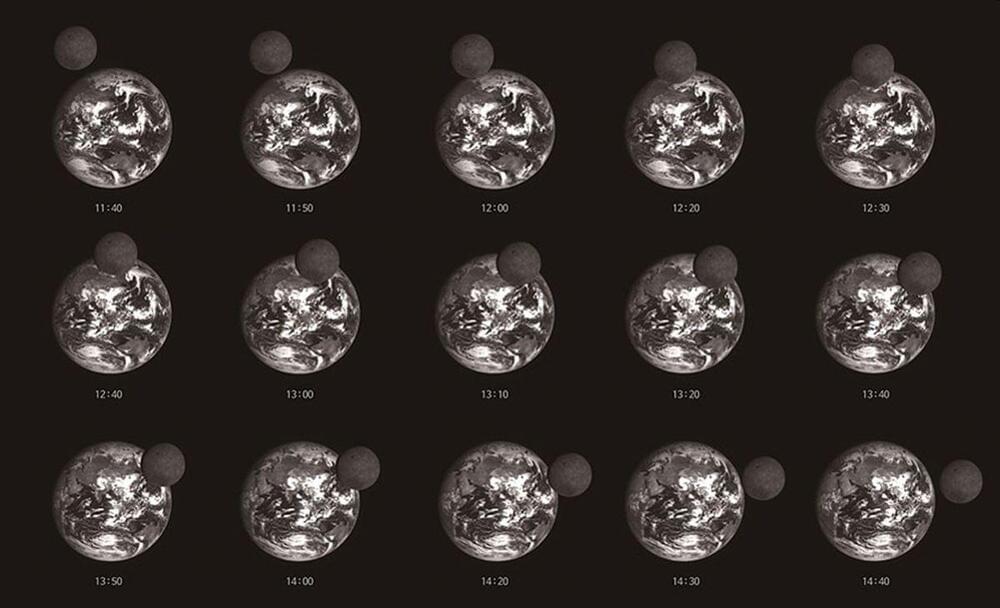
For this first gravity assist, Lucy will appear to approach Earth from the direction of the sun. While this means that observers on Earth will not be able to see Lucy in the days before the event, Lucy will be able to take images of the nearly full Earth and moon. Mission scientists will use these images to calibrate the instruments.

/* */