A NASA spacecraft named Lucy rocketed into the sky with diamonds Saturday on a 12-year quest to explore eight asteroids.

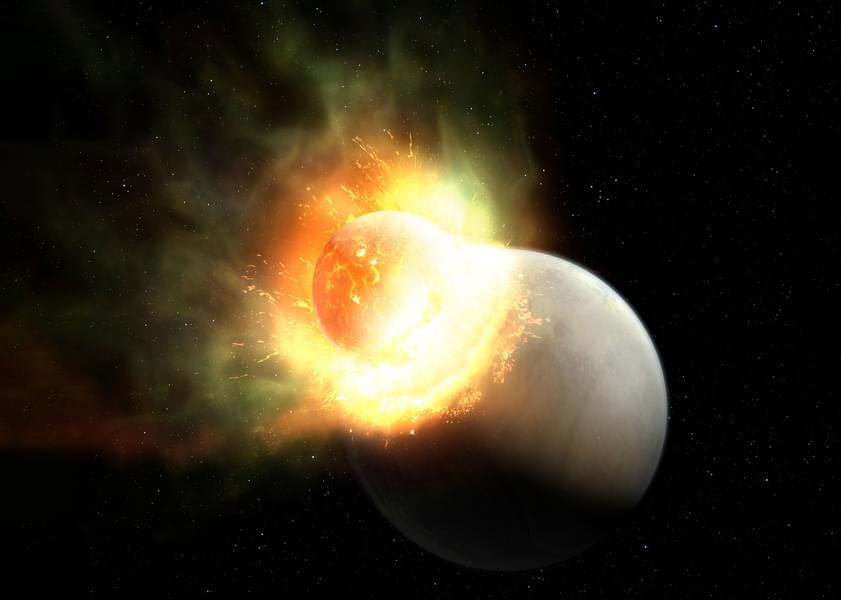
Such planetary smashups are likely common in young solar systems, but they haven’t been directly observed.
Young planetary systems generally experience extreme growing pains, as infant bodies collide and fuse to form progressively larger planets. In our own solar system, the Earth and moon are thought to be products of this type of giant impact. Astronomers surmise that such smashups should be commonplace in early systems, but they have been difficult to observe around other stars.
Now astronomers at MIT, the National University of Ireland Galway, Cambridge University, and elsewhere have discovered evidence of a giant impact that occurred in a nearby star system, just 95 light years from Earth. The star, named HD 172,555 is about 23 million years old, and scientists have suspected that its dust bears traces of a recent collision.
The MIT-led team has observed further evidence of a giant impact around the star. They determined that the collision likely occurred between a roughly Earth-sized terrestrial planet and a smaller impactor at least 200,000 years ago, at speeds of 10 kilometers per second, or more than 22,000 miles per hour.
Scroll down to watch the video.
Imagine if we could control earthquakes and tsunamis to generate power. Or maybe even terraform every planet in the solar system. These are just a couple of the things that might happen if human civilization was to advance in the future.
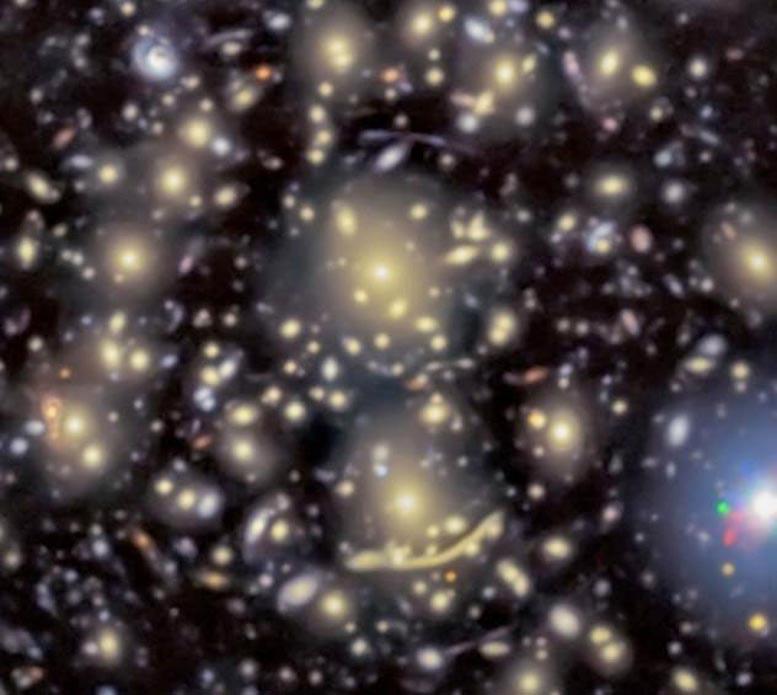
New images have revealed detailed clues about how the first stars and structures were formed in the Universe and suggest the formation of the galaxy got off to a fitful start.
An international team of astronomers from the University of Nottingham and Centro de Astrobiología (CAB, CSIC-INTA) used data from the Hubble Space Telescope (HST) and the Gran Telescopio Canarias (GTC), the so-called Frontier Fields, to locate and study some of the smallest faintest galaxies in the nearby universe. This has revealed the formation of the galaxy was likely to be fitful. The first results have just been published in the journal Monthly Notices of the Royal Astronomical Society (MNRAS).
One of the most interesting questions that astronomers have been trying to answer for decades is how and when the first galaxies formed. Concerning the how, one possibility is that the formation of the first stars within galaxies started at a steady pace, slowly building up a more and more massive system. Another possibility is that the formation was more violent and discontinuous, with intense, but short-lived bursts of star formation triggered by events such as mergers and enhanced gas accretion.
And it’s based on a kind of plasma.
A new design of a plasma jet engine was unveiled last year by a group of researchers in China. While not a new technology in and of itself, this new design could be the secret to allowing the use of these engines in the atmosphere — not just limited to space.
While the thrust output is still pretty puny when compared to conventional atmospheric engines, once scaled, this new type of engine could prove revolutionary for the aerospace industry.
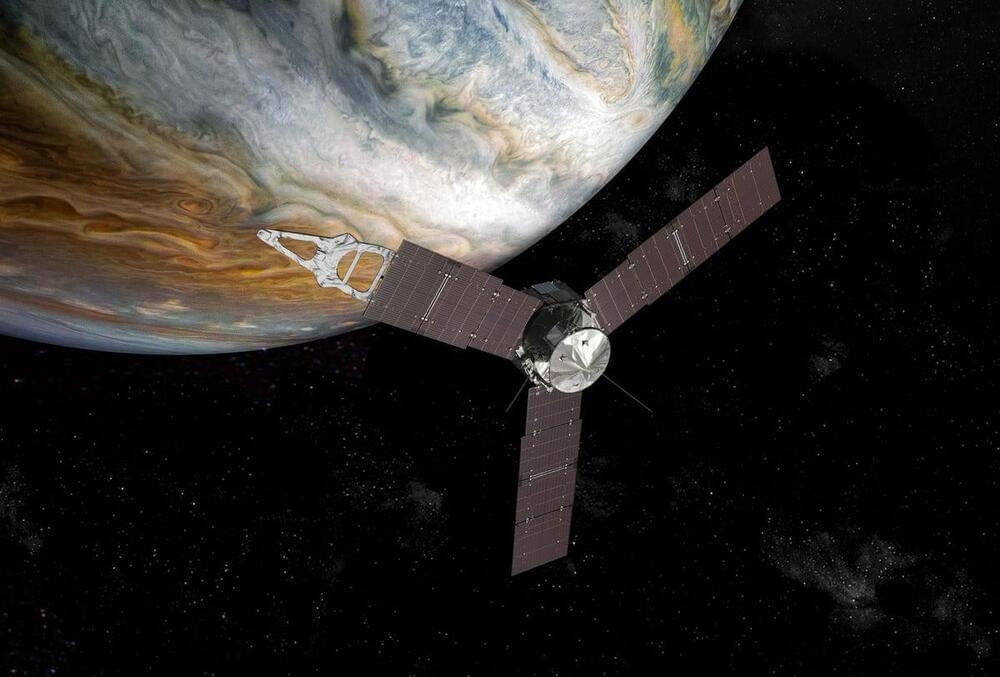
The first images are now coming through to NASA from this week’s flyby of Jupiter by its Juno spacecraft.
This latest close flyby is the 37th of the mission, but this basketball court-sized spacecraft’s images of the giant planet never cease to amaze.
This week’s images even include a rare photo of Jupiter’s moon Europa.
Right now the theme in space is not only billionaires crossing the Karman line… we are now looking to go further than we’ve ever ventured to study asteroids. Also, we’re trying a new tactic to see if we can successfully divert an asteroid from wiping us all out.
Lucy launched Saturday from Florida. Despite a problem with the solar array panels not latching completely, NASA is confident the mission won’t be severely impacted.
I also talked to Harvard astronomer Jonathan McDowell about the Double Asteroid Redirection Test or DART that is scheduled for November.
HI! I am a news anchor and I have a passion for making videos and I love sharing parts of my experience with you, the viewer!
Your support for my channel means a lot. Thanks for watching and if you have any video ideas, shoot me an email, [email protected].
Check out my website, elianasheriff.com.
Follow me on instagram @elianainspace.
Tweet me @esherifftv.
WANT COOL STARBASE PHOTOS?
Brilliant breakdown of a fascinating topic, this.
Use code WENDOVER14 for up to 14 FREE MEALS across your first 5 HelloFresh boxes plus free shipping at https://bit.ly/3cpIz8a.
Watch Extremities at http://youtube.com/extremities.
Buy a Wendover Productions t-shirt: https://standard.tv/collections/wendover-productions/product…ions-shirt.