Toggle light / dark theme

Dark Origins of One of Jupiter’s Grand Light Shows Revealed by NASA’s Juno Spacecraft

The gas-giant orbiter is illuminating the provenance of Jovian polar light shows.

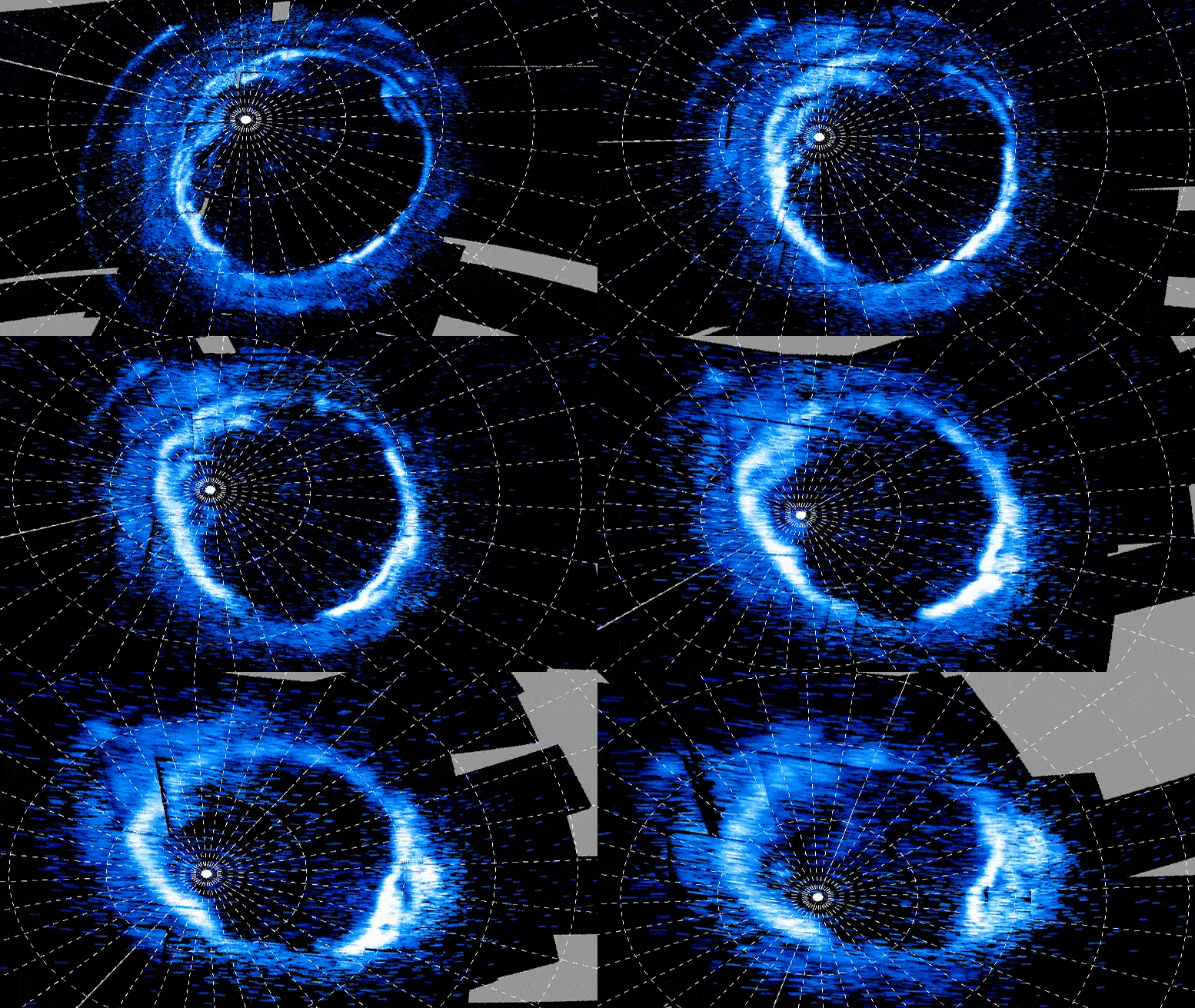
New results from the Ultraviolet Spectrograph instrument on NASA ’s Juno mission reveal for the first time the birth of auroral dawn storms – the early morning brightening unique to Jupiter ’s spectacular aurorae. These immense, transient displays of light occur at both Jovian poles and had previously been observed only by ground-based and Earth-orbiting observatories, notably NASA’s Hubble Space Telescope. Results of this study were published March 16 in the journal AGU Advances.

First discovered by Hubble’s Faint Object Camera in 1994, dawn storms consist of short-lived but intense brightening and broadening of Jupiter’s main auroral oval – an oblong curtain of light that surrounds both poles – near where the atmosphere emerges from darkness in the early morning region. Before Juno, observations of Jovian ultraviolet aurora had offered only side views, hiding everything happening on the nightside of the planet.
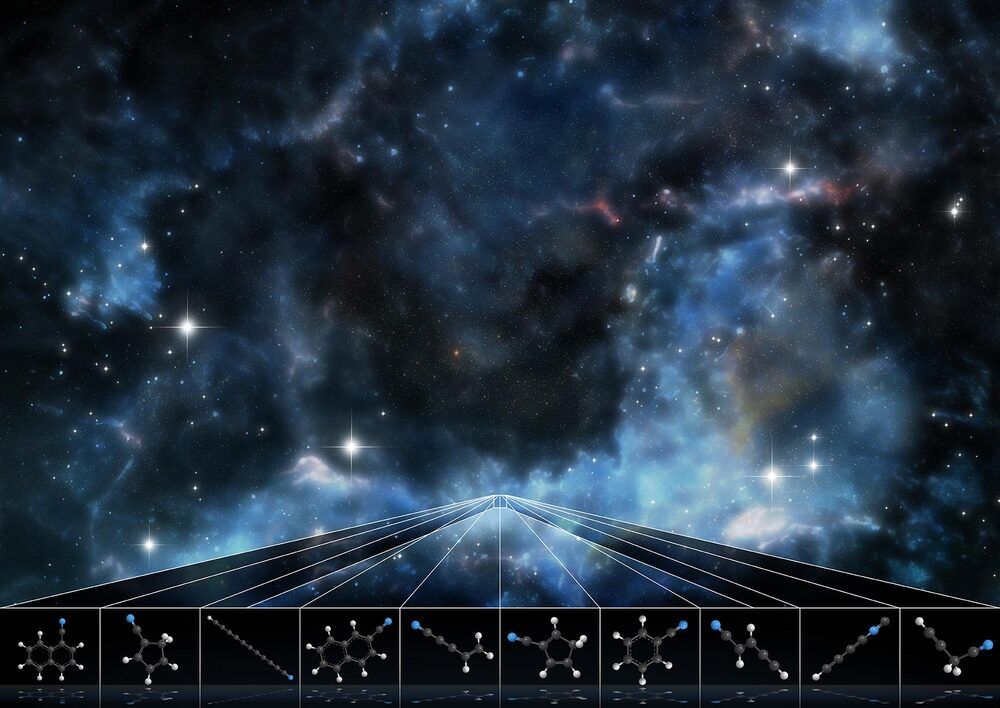

GOTHAM Investigators Uncover Warehouse-Full of Complex Molecules Never Before Seen in Space

Radio observations of a cold, dense cloud of molecular gas reveal more than a dozen unexpected molecules.

Scientists have discovered a vast, previously unknown reservoir of new aromatic material in a cold, dark molecular cloud by detecting individual polycyclic aromatic hydrocarbon molecules in the interstellar medium for the first time, and in doing so are beginning to answer a three-decades-old scientific mystery: how and where are these molecules formed in space?

“We had always thought polycyclic aromatic hydrocarbons were primarily formed in the atmospheres of dying stars,” said Brett McGuire, Assistant Professor of Chemistry at the Massachusetts Institute of Technology, and the Project Principal Investigator for GOTHAM, or Green Bank Telescope (GBT) Observations of TMC-1: Hunting Aromatic Molecules. “In this study, we found them in cold, dark clouds where stars haven’t even started forming yet.”

Starting a Mega-Project, such as Space Elevator

7 Feb 2021


ISEC has great hopes for this new year. We have two studies coming to their conclusions, a Baseline Architecture, our conference is scheduled (25÷6 May), and we intend to participate in several others. Our current plans include working with potential sponsors as we present an aggressive program to the space community saying we are here and ready to help your vision. So, I thought I would give you a quick philosophical look at where I think we are and where we need to go. (background body of knowledge at www.isec.org)

Pete’s View of the Space Elevator Adventure: I have been in three mega-projects in space…I was in at the beginning of each; as such, here are my thoughts on success in Mega-Projects.

SLS Core Stage Firing Test 2 Green Run Hot Fire

Success! The SLS Core Stage had a successful eight minute hot fire test at NASA’s Stennis Space Center on 18 March 2021. See the run down to and the full duration eight minute firing of the Core Stage of the Artemis 1 Space Launch System. Now on to KSC and launch!

Engines fire at timestamp 44:09

For gardening in your space habitat (or on Earth) Galactic Gregs has teamed up with True Leaf Market to bring you a great selection of seed for your planting. Check it out: http://www.pntrac.com/t/TUJGRklGSkJGTU1IS0hCRkpIRk1K

“Meteorological Beast in Our Solar System” – Powerful Stratospheric Winds Measured on Jupiter for the First Time

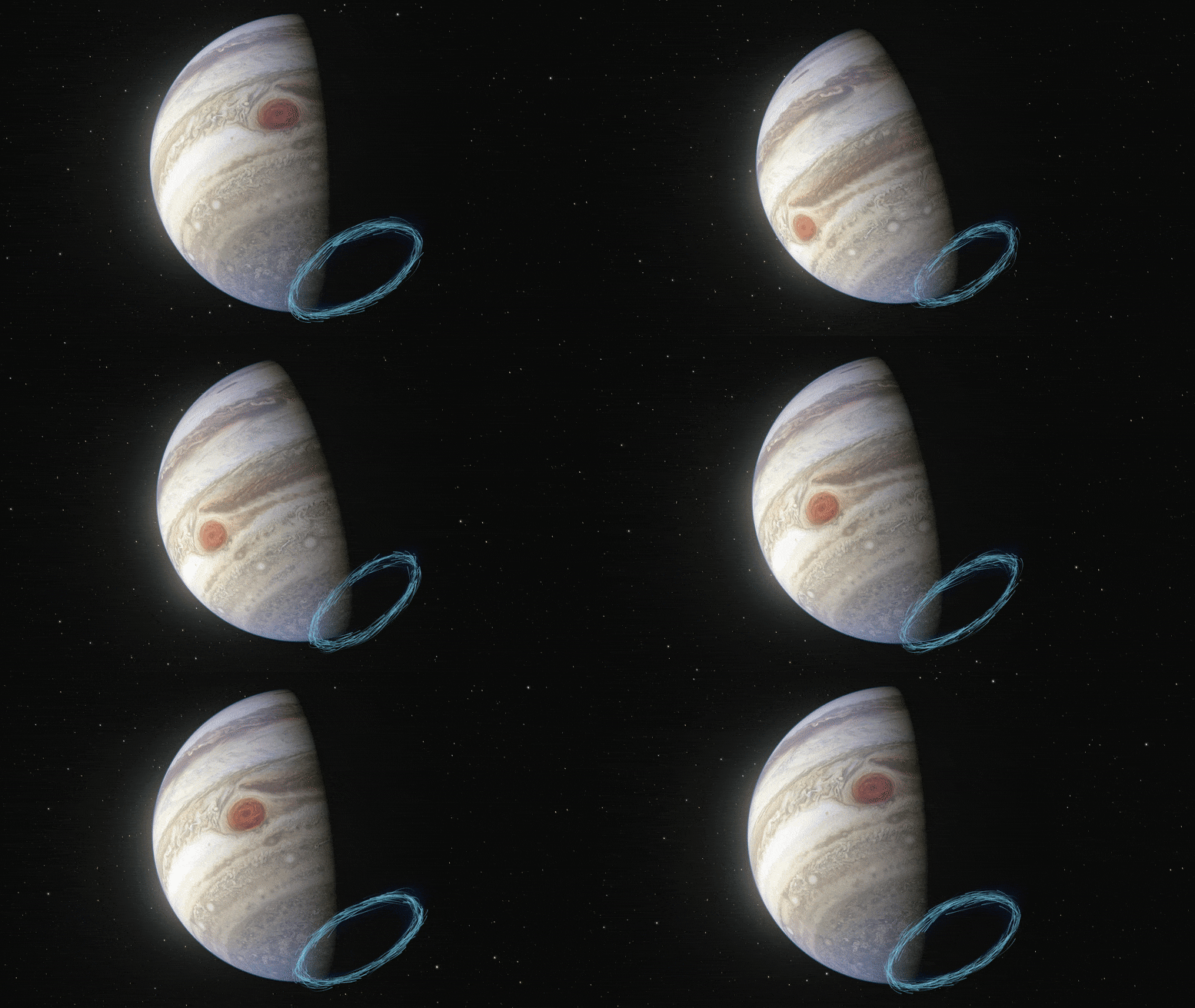
“The most spectacular result is the presence of strong jets, with speeds of up to 400 meters per second, which are located under the aurorae near the poles,” says Cavalié. These wind speeds, equivalent to about 1450 kilometers an hour, are more than twice the maximum storm speeds reached in Jupiter’s Great Red Spot and over three times the wind speed measured on Earth’s strongest tornadoes.

“Our detection indicates that these jets could behave like a giant vortex with a diameter of up to four times that of Earth, and some 900 kilometers in height,” explains co-author Bilal Benmahi, also of the Laboratoire d’Astrophysique de Bordeaux. “A vortex of this size would be a unique meteorological beast in our Solar System,” Cavalié adds.

Hear Perseverance drive! Raw and unfiltered from Mars 🔊

Listen to Perseverance drive! Raw and unfiltered from Mars.


Perseverance captured audio while driving on the surface of Mars’ Jezero Crater on Sol 16. The raw and unfiltered recording has been combined here with imagery captured on the same sol. Full Story: https://www.space.com/perseverance-rover-sounds-driving-mars.

Credit: Space.com | imagery & audio: NASA/JPL-Caltech | produced & edited by Steve Spaleta (http://www.twitter.com/stevespaleta)

Pillars of the Space Industry

Topic: Current Space Industry Engagement.

Do Subscribe the video.

Welcome!


The debut of “Space Matters-Pillars of the Space Industry” is scheduled to take place this coming Saturday, March 20th at 10:00AM PST.

Greetings Space Lovers! I wanted to personally invite each of you to join us in supporting the world premiere of the awesome new television show “Space Matters”, hosted by Rhonda Stevenson, of Tau Zero Foundation! The show airs this coming Saturday, March 20th @ 10am PST! Please download the e360tv app to view on Roku, IOS, Android, and other live streaming platforms.

/* */