Thought to lurk deep within Neptune and Uranus, the extreme material is actually half as hot as the surface of the sun.
Read more
5 Mysterious Photos Taken By NASA On The Moon!
Our curiosity has led us to investigate, every aspect and every corner of the moon.
But sometimes, when you’re looking for something, you can find unpleasant surprises, which may disturb you for a long time.
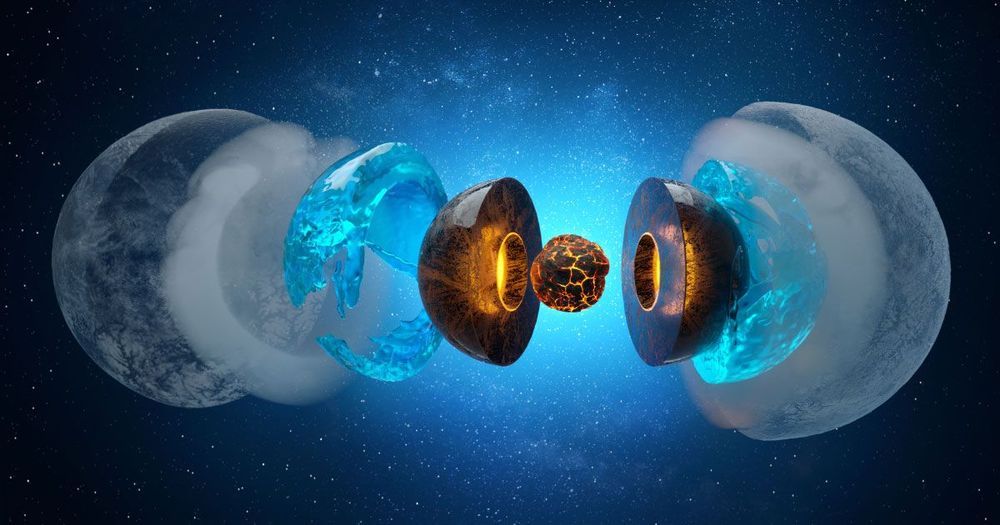
The findings, published today in Nature, confirm the existence of “superionic ice,” a new phase of water with bizarre properties. Unlike the familiar ice found in your freezer or at the north pole, superionic ice is black and hot. A cube of it would weigh four times as much as a normal one. It was first theoretically predicted more than 30 years ago, and although it has never been seen until now, scientists think it might be among the most abundant forms of water in the universe.
A new experiment confirms the existence of “superionic ice,” a bizarre form of water that might comprise the bulk of giant icy planets throughout the universe.

The Milky Way at 38,000ft
This image was taken over the Atlantic Ocean somewhere between Greenland and Iceland. It points towards the galactic centre of our Milky Way. The brightest object to the top right is Jupiter. Other objects that can be seen include The Dark Horse, Pipe Nebula, M23 Cluster, M8 Lagoon Nebula, M20 Trifid Nebula, M22 Globular Cluster, M6 Butterfly Cluster, M7 Cluster among others. How many can you find?

📣Discovery Alert: These three new planets are 🔥🔥🔥.
📣 Discovery Alert: These three new planets are 🔥 🔥 🔥
Qatar-8b, 9b and 10b are all gas giants like our own Jupiter and Saturn, but in such tight orbits \xE2\x95️ around their parent stars ☀️ that they hover between 1,457 degrees to 3,000 degrees F.
In Jules Verne’s famous classic 20,000 Leagues Under the Sea, the iconic submarine Nautilus disappears into the Moskenstraumen, a massive whirlpool off the coast of Norway. In space, stars spiral around black holes; on Earth, swirling cyclones, tornadoes and dust devils rip across the land.
All these phenomena have a vortex shape, which is commonly found in nature, from galaxies to milk stirred into coffee. In the subatomic world, a stream of elementary particles or energy will spiral around a fixed axis like the tip of a corkscrew. When particles move like this, they form what we call “vortex beams.” These beams imply that the particle has a well-defined orbital angular momentum, which describes the rotation of a particle around a fixed point.
Thus, vortex beams can give us new ways of interacting with matter, e.g. enhanced sensitivity to magnetic fields in sensors, or generating new absorption channels for the interaction between radiation and tissue in medical treatments (e.g. radiotherapy). But vortex beams also enable new channels in basic interactions among elementary particles, promising new insights into the inner structure of particles such as neutrons, protons or ions.
In the end, it wasn’t meant to be. Microsoft had pulled out all the stops for its Build 2019 developer conference keynote on Monday morning. The company had partnered with Epic Games and Industrial Light & Magic chief creative officer John Knoll for a hugely ambitious demo of its Hololens 2 headset that aimed to recreate the Apollo 11 moon landing, 50 years after the fact, in mixed reality.
All had worked out well during multiple rehearsals over the last few days. But when Knoll and science journalist and “Man on the Moon” author Andrew Chaikin were set to go on stage on Monday, the demo just didn’t run. Microsoft stalled by extending its pre-show ImagineCup competition until the show’s moderator couldn’t think of any more questions to ask. Then Knoll and Chaikin went on stage, giving it one more go — and the mixed-reality overlays simply refused to appear.