New technique could significantly reduce emissions and provide a boost to the aviation industry.

Circa 2008
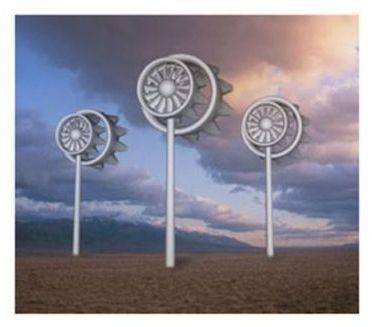
December 122008 Massachusetts-based FloDesign has developed a wind turbine that could generate electricity at half the cost of conventional wind turbines. The company’s design, which draws on technology developed for jet engines, circumvents a fundamental limit to conventional wind turbines. Typically, as wind approaches a turbine, almost half of the air is forced around the blades rather than through them, and the energy in that deflected wind is lost. At best, traditional wind turbines capture only 59.3 percent of the energy in wind, a value called the Betz limit.
Jet engine wind turbine
FloDesign is a spin-off from the aerospace company FloDesign based in Wilbraham, MA which recently raised $6 million in its first round of venture financing. Their turbine design surrounds its wind-turbine blades with a shroud that directs air through the blades and speeds it up, which increases power production. The shroud concept is based on the same principles as a high bypass jet engine design that is used by all commercial jet aircraft engines to reduce noise and significantly improve efficiency. The new design generates as much power as a conventional wind turbine with blades twice as big in diameter. The smaller blade size and other factors allow the new turbines to be packed closer together in the field compared to conventional turbines, increasing the amount of power that can be generated per acre of land.
There were the cleaners, with large padded feet, who were apparently polishing their way the whole length…’ — Arthur C. Clarke, 1972.
IceBot Antarctic (Planetary?) Robotic Explorers Made Of Ice ‘Some will combine in place to form more complicated structures, like excavators or centipedes.’ — Greg Bear, 2015.
Study: Robots Encourage Humans To Take Risks Not exactly Three Laws compliant.
BladeBUG Robots Clean Massive Wind Turbine Blades ‘There were the cleaners, with large padded feet, who were apparently polishing their way the whole length…’ — Arthur C. Clarke, 1972.
IceBot Antarctic (Planetary?) Robotic Explorers Made Of Ice ‘Some will combine in place to form more complicated structures, like excavators or centipedes.’ — Greg Bear, 2015.
Study: Robots Encourage Humans To Take Risks Not exactly Three Laws compliant.

Over the past few years, researchers have been trying to develop new designs for perovskite solar cells that could improve their performance, efficiency and stability over time. One possible way of achieving this is to combine 2-D and 3D halide perovskites in order to leverage the advantageous properties of these two different types of perovskites.
The two-dimensional crystal structure of 2-D halide perovskites is highly resistant to moisture; thus, it could help to increase the performance and durability of solar cells with a light-absorbing 3D halide perovskite layer. However, most of the strategies for combining 2-D and 3D halide perovskites proposed so far simply entail mixing these two materials together (e.g., mixing 2-D precursors with a solution-based 3D perovskite or reacting 2-D precursor solutions on top of a 3D perovskite layer).
Researchers at Seoul National University and Korea University have recently devised an alternative approach for creating solar cells that combine 2-D and 3D halide perovskites. This approach, outlined in a paper published in Nature Energy, could help to simultaneously improve both the efficiency and long-term stability of these cells.

This eco village is 100% self-sufficient

Solar powered yacht. 😃
Pierpaolo Lazzarini designs the ‘Pagurus’, a solar-powered amphibious catamaran. via: Myshify.
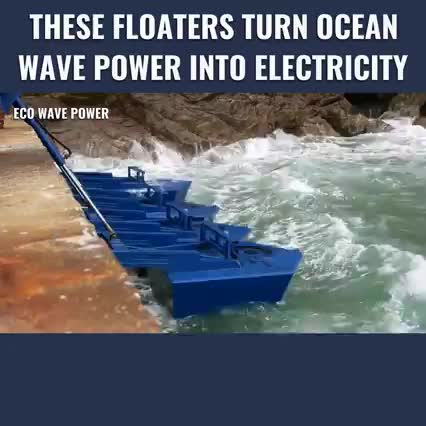
Using ocean/sea waves for power. 😃
This is the Eco Wave Power, an innovative and affordable technology that produces clean, renewable energy from ocean waves. (More info: https://youtu.be/BrDua3j1U3M)
Circa 2020
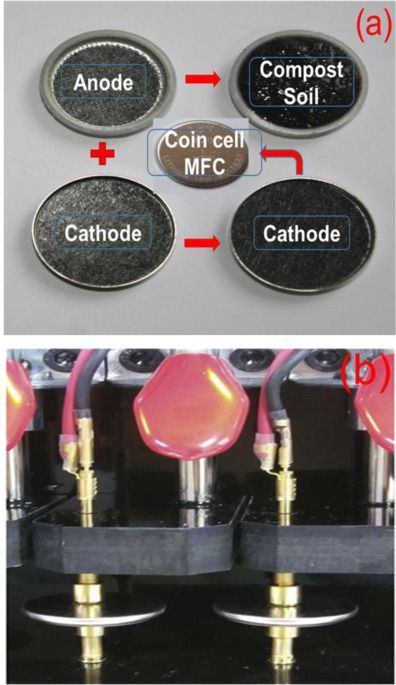
The acute problem of eutrophication increasing in the environment is due to the increase of industrial wastewater, synthetic nitrogen, urine, and urea. This pollutes groundwater, soil and creates a danger to aquatic life. Therefore, it is advantageous to use these waste materials in the form of urea as fuel to generate power using Microbial Fuel Cell (MFC). In this work, we studied the compost soil MFC(CSMFC) unlike typical MFC with urea from the compost as fuel and graphite as a functional electrode. The electrochemical techniques such as Cyclic Voltammetry, Chronoamperometry are used to characterise CSMFC. It is observed that the CSMFC in which the compost consists of urea concertation of 0.5 g/ml produces maximum power. Moreover, IV measurement is carried out using polarization curves in order to study its sustainability and scalability. Bacterial studies were also playing a significant role in power generation. The sustainability study revealed that urea is consumed in CSMFC to generate power. This study confirmed that urea has a profound effect on the power generation from the CSMFC. Our focus is to get power from the soil processes in future by using waste like urine, industrial wastewater, which contains much amount of urea.