China’s state media, the Global Times, claims the country has developed the world’s largest electric-powered quadruped bionic robot. And to be honest, that thing looks just like a yak.
Bizarre appearances aside, this comes as the latest in China’s push to become a global leader in robotics by 2025. And also, of course, in military tech.… See more.
China claims that it has developed the largest electric-powered quadruped robot in the world! And the nation is rapidly approaching its 2025 goal.
We routinely simulate the universe on all of its scales, from planets to large fractions of the cosmos. Today we’re going to see how it’s possible to build a universe in a computer — and see whether there’s a limit to what we can simulate.
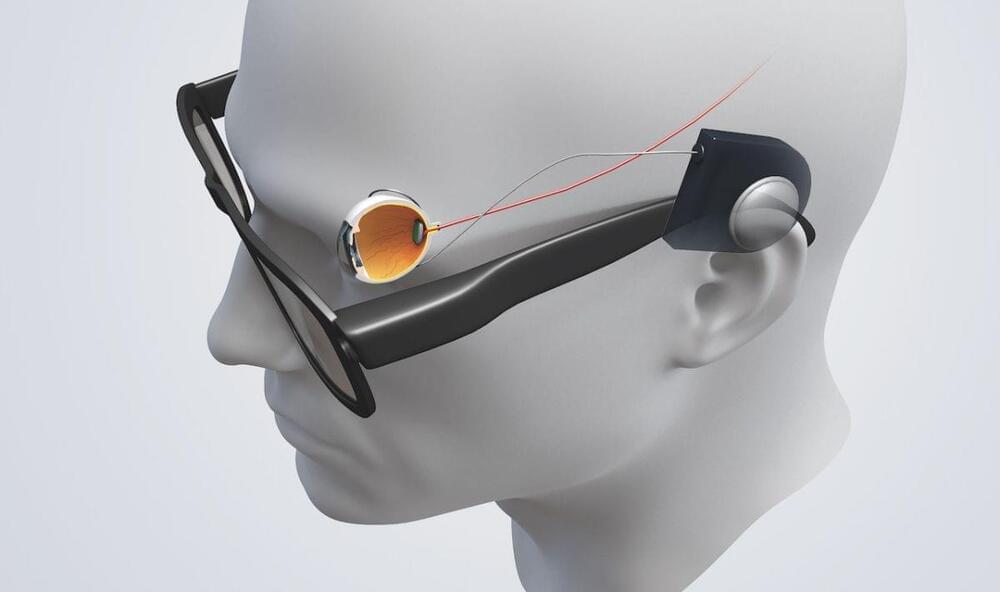
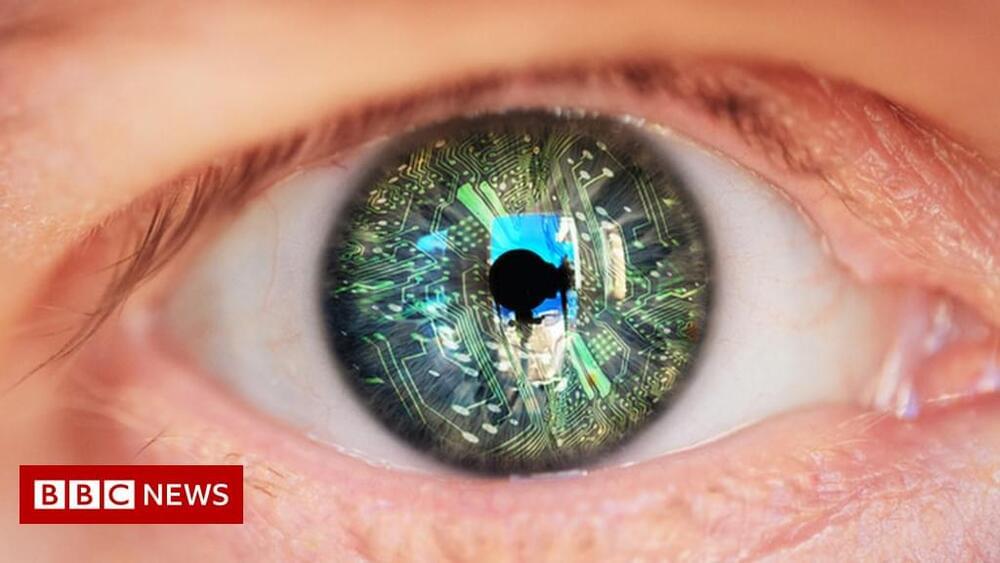
A new technology solution that will provide low-power systems for use in bionic eyes, has been jointly developed by academics from the Harbin Institute of Technology in China and Northumbria University.
Working in partnership with a research group led by Professor PingAn Hu from the Harbin Institute, Northumbria’s Professor Richard Fu described their newly developed method for controlling the artificial synaptic devices used in bionic retinas, robots, and visual prostheses, as a “significant breakthrough.”
The team discovered that injecting elements of the soft metal, indium, into a two-dimensional (2D) material called molybdenum disulfide (MoS2), could improve electrical conductivity and reduce power consumption of the optical synapses used in the development of bionic eyes.
46:15–58:52 CHAPTER 2 : Biological Aging a. “Programmed Cell Death” Theory of Aging b. “Intercellular Competition” Theory of Aging c. “Antagonistic Pleiotropy” Theory of Aging.
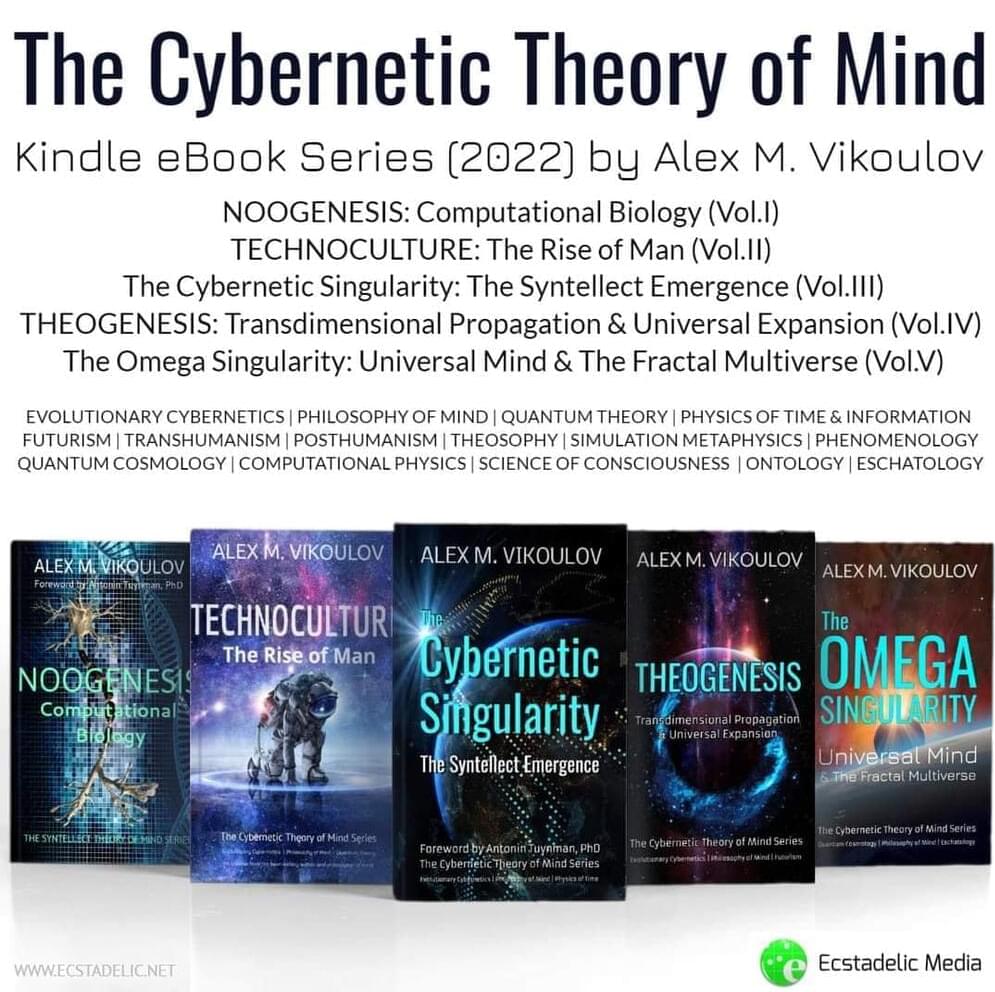
COUNTDOWN TO RELEASE: Here comes the next and final installment in The Cybernetic Theory of Mind series ― The Omega Singularity: Universal Mind & The Fractal Multiverse ― which is now available to pre-order as a Kindle eBook on Amazon. In this final book of the series, we discuss a number of perspectives on quantum cosmology, computational physics, theosophy and eschatology. How could dimensionality be transcended yet again? What is the fractal multiverse? What is the ultimate destiny of our universe? Why does it matter to us? What is the Omega Singularity? These are some of the questions addressed in this concluding volume of my eBook series.
This final book V of The Cybernetic Theory of Mind series is an admittedly highly speculative theoretical work where we’ll be testing the limits of our imagination envisioning the prospects of our distant future and the deepest secrets of hyperreality. In our fractal, computational Omniverse (all multiversal structure combined, all that is) one may assume that an infinitely large number of civilizational minds, syntellects, have followed or will follow a path, similar to ours, in their evolutionary processes. At the highest level of existence and perceptual experience, that we can rightfully call ‘Dimensionality of Hypermind’, universal minds would form some sort of multiversal network of minds, layer after layer seemingly ad infinitum.
The Cybernetic Theory of Mind series is a collection of books by evolutionary cyberneticist and philosopher Alex M. Vikoulov on the ultimate nature of reality, consciousness, the physics of time, computational physics, philosophy of mind, foundations of quantum physics, the technological singularity, transhumanism, posthumanism, the impending phase transition of humanity, the simulation hypothesis, economic theory, the extended Gaia theory, transcendental metaphysics and God. If you’re eager to familiarize with probably the most advanced ontological framework to date or if you’re already familiar with the Syntellect Hypothesis which, with this series, is now presented to you as the full-fledged Cybernetic Theory of Mind, you should get this book five of the series which corresponds to Part V of The Syntellect Hypothesis: Five Paradigms of the Mind’s Evolution.
2.7 billion people on this planet have “deskless jobs,” many of which require bending, lifting, moving, and carrying. German Bionic just released the fifth generation Cray X AI-enhanced power suit, or exoskeleton, to help those billions of people with almost 70 pounds of additional lifting capacity, reducing the risk of back injury and repetitive stress injuries. The Cray X is already in use at BMW, IKEA, and the French delivery service DPD, and will be launched internationally in January 2022.
The AI-powered suit boosts productivity, reduces error rates, decreases accidents, and results in a 25% reduction in the number of sick days workers take, German Bionic says.
The smart exoskeleton market has been estimated to be growing 41.3% a year to a nearly $2 billion industry by 2025, with applications in construction, shipping and receiving, healthcare, and the military. But it’s not just for the billions in the workforce.
This new wearable robotic suit can boost human strength, and it is powered by artificial intelligence — taking human augmentation to new levels.
What robot: German Bionic just announced an exoskeleton called Cray X with a plethora of features. It includes assisted walking, waterproofing, and an updated energy management system.
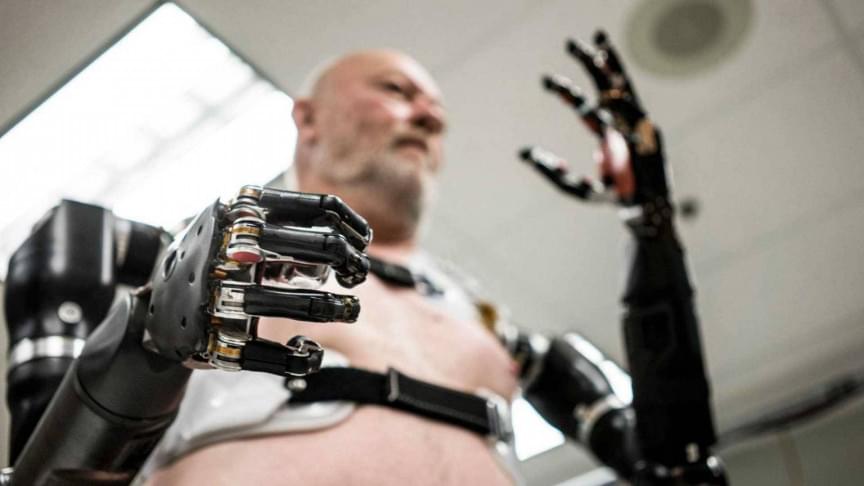
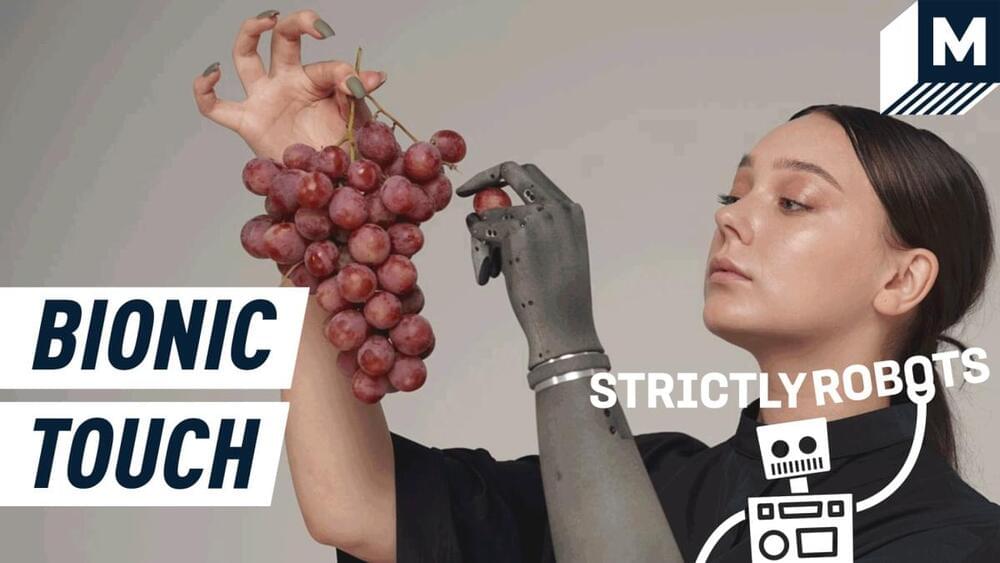
In the first episode of Humans+, Motherboard dives into the world of future prosthetics, and the people working on closing the gap between man and machine.
We follow Melissa Loomis, an amputee from Ohio, who had experimental nerve reversal surgery and is going to Johns Hopkins’ Applied Physics Lab to test out its latest Modular Prosthetic Limb, a cutting-edge bionic arm funded in part by DARPA. Neuro-interfacing machinery is a game changer in terms rehabilitating patients, but what possibilities do these advancements open for the future?
Could we interest you in a humanoid vessel to transfer your consciousness into?
Humans have always been fascinated with the concept of immortality but what seems to be even more exciting to some is the thought of using technology to make immortality a real-world application. A movement called transhumanism is even devoted to using science and technology to augment our bodies and our minds, and to allow humans to merge with machines, eradicating old age as a cause of death. So the big question is — can we really evade death?
From Hans Moravec’s classic book Mind Children to Gene Roddenberry’s iconic TV series Star Trek: The Next Generation, the idea of uploading a person’s feelings, memories, and experiences onto a machine, has been explored in many popular non-fiction and fiction works. However, whether or not mind uploading could become a reality, like 3D printers, robots, and driverless cars? We are yet to find out.