VR companies around the world are planning to offer live views of the Earth from space within the next few years.
Dr Stuart Clark writes Across the Universe for the Guardian, and is the author of The Search for Earth’s Twin (Quercus).
VR companies around the world are planning to offer live views of the Earth from space within the next few years.
Dr Stuart Clark writes Across the Universe for the Guardian, and is the author of The Search for Earth’s Twin (Quercus).


Not everyone is convinced. Critics point out that one of the points of exponential growth is that it cannot carry on forever. After a 50-year run, Moore’s Law is stuttering. Singularitarians retort that the laws of physics define a limit to how much computation you can cram into a given amount of matter, and that humans are nowhere near that limit. Even if Moore’s Law slows, that merely postpones the great day rather than preventing it. Others say the Singularity is just reli…gion in new clothes, reheated millenarianism with transistors and Wi-Fi instead of beards and thunderbolts. (One early proponent of Singularitarian and transhumanist ideas was Nikolai Federov, a Russian philosopher born in 1829 who was interested in resurrecting the dead through scientific means rather than divine ones.) And those virtual-reality utopias do look an awful lot like heaven. Perhaps the best way to summarise the Singularity comes from the title of a book published in 2012: the Rapture of the Nerds.
And will it lead to the extermination of all humans?
by T.C.
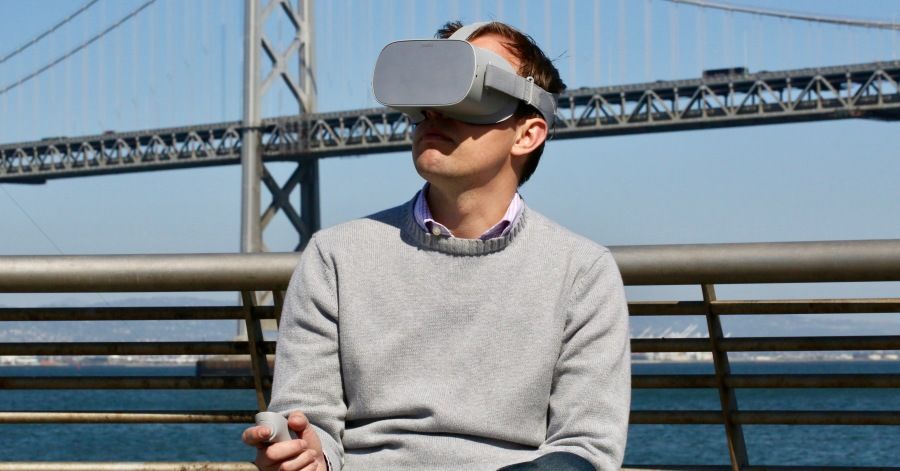
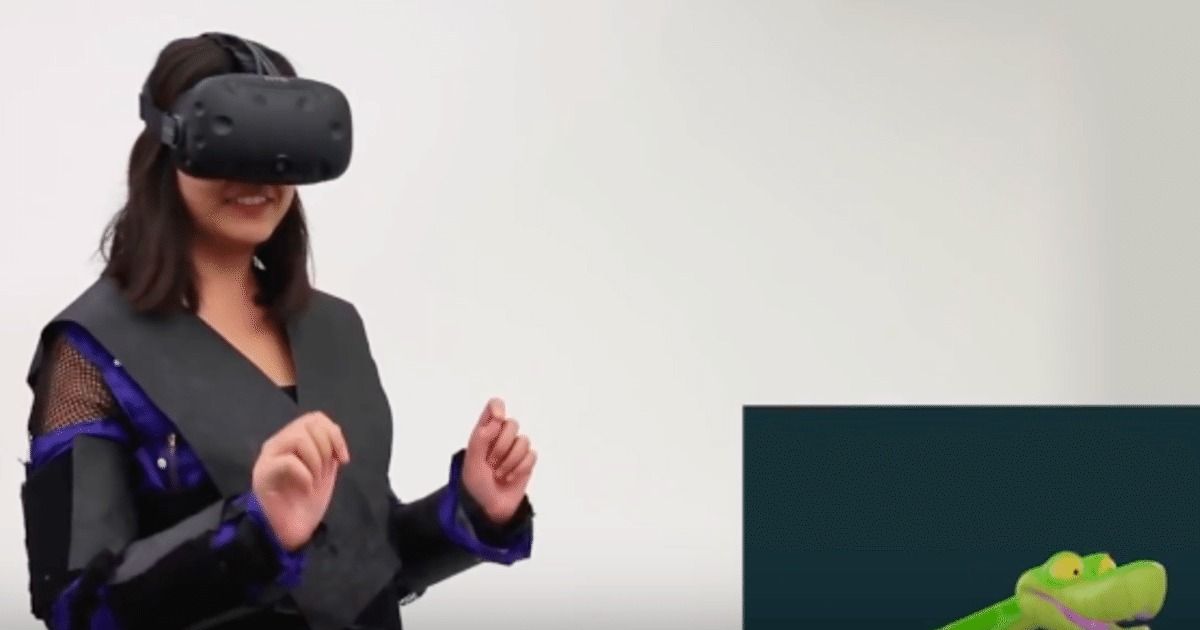
Virtual reality is a gateway to powerful experiences. Strap on a pair of VR goggles, look around, and the scene you see will adjust, in real time, to match your gaze. But the technology is a visual one. Virtual reality doesn’t include touch, although there are controllers that provide “hand presence,” allowing you to manipulate objects in the virtual world, or shoot a simulated gun. So while VR today could simulate a Westworld -like setting, you’re not going to be actually feeling the hug of a cowboy-robot on your body while using any of the major platforms—at least not for a while.
The Force Jacket, a garment from Disney Research, aims to address that gap. Made out of a converted life jacket, the prototype uses embedded airbags that inflate, deflate, or even vibrate to literally give its wearer a feeling of being touched. When coupled with VR software, the setup can simulate something bizarre—a snake slithering on you—or more pedestrian: getting hit by a snowball. In brief, the sensation of touch you feel on your actual body can match what you see in a virtual one. (The device is the result of a research project, so these lifejacket-garments aren’t exactly on sale on Amazon. It’s also not the first research to focus on incorporating haptics into VR.)
“If you’ve experienced virtual reality or augmented reality, it’s largely based in this immersive visual world,” says Alexandra Delazio, the lead researcher on the jacket project and currently a research engineer at the University of Pittsburgh, where she works on technology for people with disabilities. “The real world is not just visual—it’s full of force and pressure-based interaction.” The goal of the jacket is to bring that sense of touch to the virtual world, or maybe even offer a way for someone far away to give you a hug.
https://www.patreon.com/GrayScott
Newsletter — https://www.grayscott.com/newsletter
Twitter: @grayscott
Instagram: https://www.instagram.com/gray_scott/
Transcript:
We are headed towards a post Singularity simulated future and everything points towards us becoming a simulated species and being able to upload our consciousness quantify our consciousness and put that into a simulation.
And I don’t necessarily think it’s us that may control it.
I think it’s going to be the AI systems, the quantum computers of the future, those systems will create the simulations, they will draw us in, some may do it on purpose and some by accident. Whether that’s a choice that we make or whether a choice the machines make is something we’ll have to find out when we get to the future.
I wrote about the Sim Generation in a book called The Future of Business, and the idea was that this generation that we are seeing right now, they are the simulated generation, so by the time that they reach their early twenties living inside of simulated virtual reality for those kids, it’s not going to be uncommon, it’s not going to be foreign to them.
Tour the ISS to catch up with the astronauts and hear their testimonials about what it feels like to watch Earth from space every day.
The National Geographic Channel has one major treat coming up for its viewers, reports Space.com.
Channel officials have disclosed the tantalizing news that they have made the first 3D Virtual Reality (VR) film ever shot in space.

You might only know JPEG as the default image compression standard, but the group behind it has now branched out into something new: JPEG XS. JPEG XS is described as a new low-energy format designed to stream live video and VR, even over WiFi and 5G networks. It’s not a replacement for JPEG and the file sizes themselves won’t be smaller; it’s just that this new format is optimized specifically for lower latency and energy efficiency. In other words, JPEG is for downloading, but JPEG XS is more for streaming.
The new standard was introduced this week by the Joint Photographic Experts Group, which says that the aim of JPEG XS is to “stream the files instead of storing them in smartphones or other devices with limited memory.” So in addition to getting faster HD content on your large displays, the group also sees JPEG XS as a valuable format for faster stereoscopic VR streaming plus videos streamed by drones and self-driving cars.
“We are compressing less in order to better preserve quality, and we are making the process faster while using less energy,” says JPEG leader Touradj Ebrahimi in a statement. According to Ebrahimi, the JPEG XS video compression will be less severe than with JPEG photos — while JPEG photos are compressed by a factor of 10, JPEG XS is compressed by a factor of 6. The group promises a “visual lossless” quality to the images of JPEG XS.
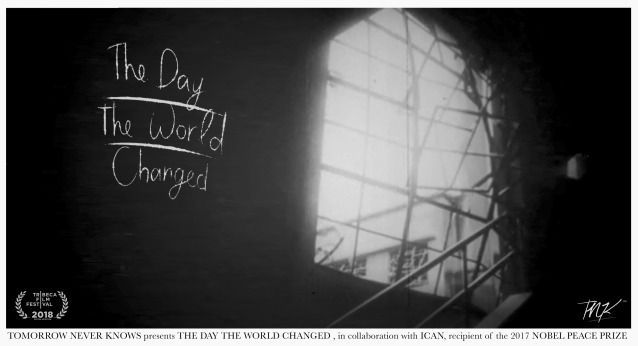
Four virtual reality (VR) veterans from Discovery Digital, Oculus Story Studio and Lightshed officially launched their new company out of stealth mode in San Francisco this week. Dubbed Tomorrow Never Knows, the new studio aims to use virtual and augmented reality as well as other emerging technologies including artificial intelligence for groundbreaking storytelling projects, said co-founder and CEO Nathan Brown in an interview with Variety this week.
“The thesis behind the company is to consistently violate the limits of storytelling, forcing the creation of new tools, methodologies and workflow and to do this intentionally so we create original creative and technology IP,” he said.
Before founding Tomorrow Never Knows, Brown co-founded Discovery VR, which has become one of the most ambitious network-backed VR outlets. Also hailing from Discovery VR is Tomorrow Never Knows co-founder Tom Lofthouse. They are joined by Gabo Arora, whose previous work as the founder of Lightshed included VR documentaries like “Clouds Over Sidra” and “Waves of Grace,” as well as Oculus Story Studio co-founder Sachka Unseld, the director of the Emmy Award-winning VR animation short “Henry” and the Emmy-nominated VR film “Dear Angelica.”
The tech-industry is led by sci-fi nerds who want to create the things they read about, or saw on screen.
We all stand to benefit, provided that is, they can avoid the ethical pitfalls depicted in science fiction.
Steven Spielberg’s new film “Ready Player One” imagines a future where people live much of their lives in virtual reality. Do science fiction’s predictions of the future ever come true? Yes. And it’s no surprise, given that the tech industry is led by sci-fi fans turning their visions into reality.
If you’re watching this on your phone it is partly thanks to Captain Kirk.
In Star Trek, first broadcast in 1966 he used a pocket-sized device to communicate with his crew.