Toggle light / dark theme

Organoids — growing mini BRAINS

Organoids are an incredible tool for research into the brain. Cerebral organoids are created by growing human stem cells in a bioreactor. They might be the key to unlocking the answers to many of our questions about the brain. We explain how they’re made and some of the discoveries they’ve helped with so far!

✍ Script by Duranka Perera (https://www.durankaperera.com/)
✍ Thumb by “Broken” Bran — https://twitter.com/BranGSmith.

Support us on Patreon: https://www.patreon.com/Brainbook_
Thank you to our supporters:

Morag Forbes.
Patrick Kohl.
Ronald Coleman Dees.
Alex Rofini.
Helen Whitley.

Discover more on our website.
https://www.brainbookcharity.org.

Follow us on:
Twitter: https://www.twitter.com/realbrainbook.
Instagram: https://www.instagram.com/brainbook_
Facebook: https://www.facebook.com/realbrainbook
Native Language Influences Brain Wiring, New Study Claims

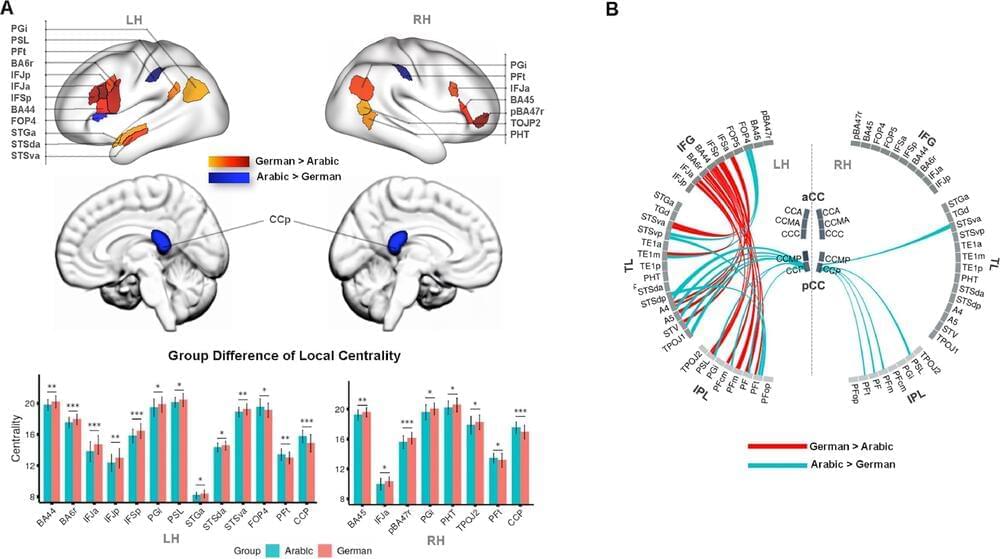
Scientists have found evidence using neuroimaging that the native language people speak may affect the way that their brains are wired.

Researchers from Max Planck Institute for Human Cognitive and Brain Sciences in Leipzig analyzed and compared the brain scans of native Arabic and German speakers. The languages were selected for the reason that they are significantly different.

Their results indicate the native language of an individual can influence the connectivity between areas of their brains.

What if You Give a Rat Human Brain Cells? You Can Control Its Behavior… — YouTube

Scientists transplanted human cerebral organoids (“minibrains”) into rats, to better study brain disorders. The neurons grown in vivo looked more like mature human brain cells than those grown in vitro, and they made better models of Timothy syndrome. The human minibrains formed deep connections with the rat brains, received sensory information, and drove the rat’s behavior.

More on how minibrains are grown and used, and the issue of organoid consciousness: https://www.youtube.com/watch?v=u6FGq7_t3Eo.

On the topic of organoid sentience and playing pong: https://www.youtube.com/watch?v=67r7fDRBlNc.

Support the channel: https://www.patreon.com/ihmcurious.

Sitcom music by John Bartmann: https://johnbartmann.com

Growing Mini-Brains in a Lab: Cerebral Organoids Could Save Your Life, But Has Science Gone Too Far?

Chapters:
0:00 Intro.
0:43 Growing Organoids.
2:57 Minibrains in Science & Medicine.
4:46 Giving Minibrains Psychedelics.
5:26 Minibrains With Eyes.
6:30 Can Minibrains Feel?
7:22 Looking For Consciousness.
9:03 The Future of Minibrain Research.
10:47 Human Minibrains Grafted Onto Mice.
12:10 What’s Next?

Videography by Island Fox Media.

Sound by Kutan Katas.

Patreon: https://www.patreon.com/IhmCurious.

Twitter: https://twitter.com/IhmCurious.

Music.

Inside a mini-brain (with eyes?) lab

If a free-floating brain could feel pain or ‘wake up,’ how would we know? That’s an important ethical question — and it’s one we need to ask more often as labs around the world create new organoids, or miniature human organs. To answer it we talked to Jay Gopalakrishnan at his ‘mini brain’ lab for centrosome and cytoskeleton biology in Düsseldorf, Germany.

STUDY: https://www.cell.com/cell-stem-cell/fulltext/S1934-5909(21)00295-2

#brains #organoids #ethics #Germany #India.

More Science unscripted:

- Spotify — https://open.spotify.com/show/12TYXSLLcUf9nw7QVyBZXp.
- Apple — https://podcasts.apple.com/us/podcast/science-unscripted/id253428066
- Google — https://podcasts.google.com/feed/aHR0cHM6Ly9yc3MuZHcuY29tL3h…Y3JpcHRlZA
- Deezer: https://www.deezer.com/de/show/40077
- Amazon — https://music.amazon.co.uk/podcasts/d5edfb46-a6e2-4d31-b…unscripted.

DW science:

A Single Enzyme Could Be Behind Some People’s Depression, Scientists Say

For a while now, we’ve known there’s a complex interplay between our hormones, guts, and mental health, but untangling the most relevant connections within our bodies has proved challenging.

New research has found a single enzyme that links all three, and its presence may be responsible for depression in some women during their reproductive years.

Wuhan University medical researcher Di Li and colleagues compared the blood serum of 91 women aged between 18 and 45 years with depression and 98 without. Incredibly, those with depression had almost half the serum levels of estradiol – the primary form of estrogen our bodies use during our fertile years.

/* */