I’m excited to announce the third episode of our new series, What’s New in Science, co-hosted by Sabine Hossenfelder. Once again, Sabine and I each brought a few recent science stories to the table, and we took turns introducing them before diving into thoughtful discussions. It’s a format that continues to spark engaging exchanges, and based on the feedback we’ve received, it’s resonating well with listeners.
This time, we covered a wide range of intriguing topics. We began with the latest buzz from the Dark Energy Spectroscopic Instrument suggesting that dark energy might be changing over time. I remain skeptical, but the possibility alone is worth a closer look. We followed that with results from the Euclid space telescope, which has already identified nearly 500 strong gravitational lensing candidates—an impressive yield from just the early data.
This illustration is a conceptual drawing of a neuromorphic computer. Each wafer in the stacks of octagons, about the diameter of a vinyl record, houses a billion synapses. The white strands are fiber optic connections. Courtesy/LANL.
Physicist Dr. Lídia Del Rio, Essentia Foundation’s Research Fellow for Quantum Information Theory at the University of Zürich, explains to Hans Busstra one of the strangest quantum conundra confronting the foundations of physics: the Frauchiger-Renner (FR) thought experiment.
Scientific papers discussed in this video:
Quantum theory cannot consistently describe the use of itself. Daniela Frauchiger & Renato Renner: https://www.nature.com/articles/s4146… experiments in a quantum computer, Nuriya Nurgalieva, Simon Mathis, Lídia del Rio, Renato Renner: https://arxiv.org/abs/2209.06236 Other interesting links related to the video: Quantum ‘thought experiment software’ https://github.com/XuemeiGu/Quanundrum Great Quantum artwork by Nuriya Nurgalieva: https://www.theoryverse.com/art Part One: Modelling Observers 00:00 Introduction 04:13 The object-subject divide in quantum mechanics 07:58 How would you explain the Wigner’s Friend thought experiment? 09:40 Observations are not facts 12:16 Is collapse relative? 14:11 Losing information = measurement 15:38 How do you model the agent in quantum mechanics? 17:54 What is reversibility in QM? Part Two: Explaining the Frauchiger-Renner Thought Experiment 22:14 Lídia explains Maxwell’s Demon and how the demon can be modelled 29:28 Formatting the ‘hard drive’ of the demon equals the energy gained 31:20 Lídia explains the Frauchiger-Renner thought experiment 41:51 The quantum circuit of the FR experiment 50:31 Where the experiment gets really weird 54:52 How to make sense of the weirdness? Part Three: The Implications and Meaning of the FR Experiment 1:03:59 What assumptions CANNOT all be true? 1:07:47 Critique from the physics community on the FR experiment 1:13:30 The philosophical implications of the FR experiment 1:16:04 Agreeing or disagreeing on Heisenberg cuts 1:17:27 Quanundrum software to test thought experiments 1:20:14 (No title – you might want to add something here) 1:23:16 Does the FR experiment “favor” a many-worlds interpretation, or does it require an epistemic approach? 1:25:04 Every theory, at some point, breaks 1:26:57 On the (in)completeness of quantum theory 1:29:35 What the FR experiment could mean for quantum computers… 1:32:06 What makes the FR experiment REALLY strange? 1:35:31 You cannot have an outside view AND know what’s going on inside… 1:36:01 What does it mean philosophically? 1:40:16 What if objective collapse or many-worlds is true? 1:43:20 Do you believe in free will? 1:45:54 Lídia does believe in an objective world… 1:47:15 What would a world weirder than quantum mechanics look like? 1:52:37 Where does thinking about “different” universes become relevant for physics? 1:55:51 On What the Bleep Do We Know, quantum woo, and the real meaning of quantum mechanics… 1:57:52 Nature doesn’t care about our Heisenberg cut… 1:59:33 Quantum mechanics and non-dualism 2:02:04 Physicists should be aware of their own faiths, religion, and mortality… 2:04:06 On the nature of the self, and how Lídia’s work has informed her outlook on life 2:09:31 Final words Sesame Street Russian Dolls video, under fair use: • Sesame Street Matryoshka Doll 10 All music licensed under Storyblocks and Soundstripe All stock footage licensed under Storyblocks Interview content copyright by Essentia Foundation, 2025 www.essentiafoundation.org.
Thought experiments in a quantum computer. Nuriya Nurgalieva, Simon Mathis, Lídia del Rio, Renato Renner: https://arxiv.org/abs/2209.
The approach uses lasers and holograms to detect misalignments as small as 0.017 nanometers. Researchers at the University of Massachusetts Amherst have developed a new method for aligning 3D semiconductor chips by shining a laser through concentric metalenses patterned onto the chips, creating a
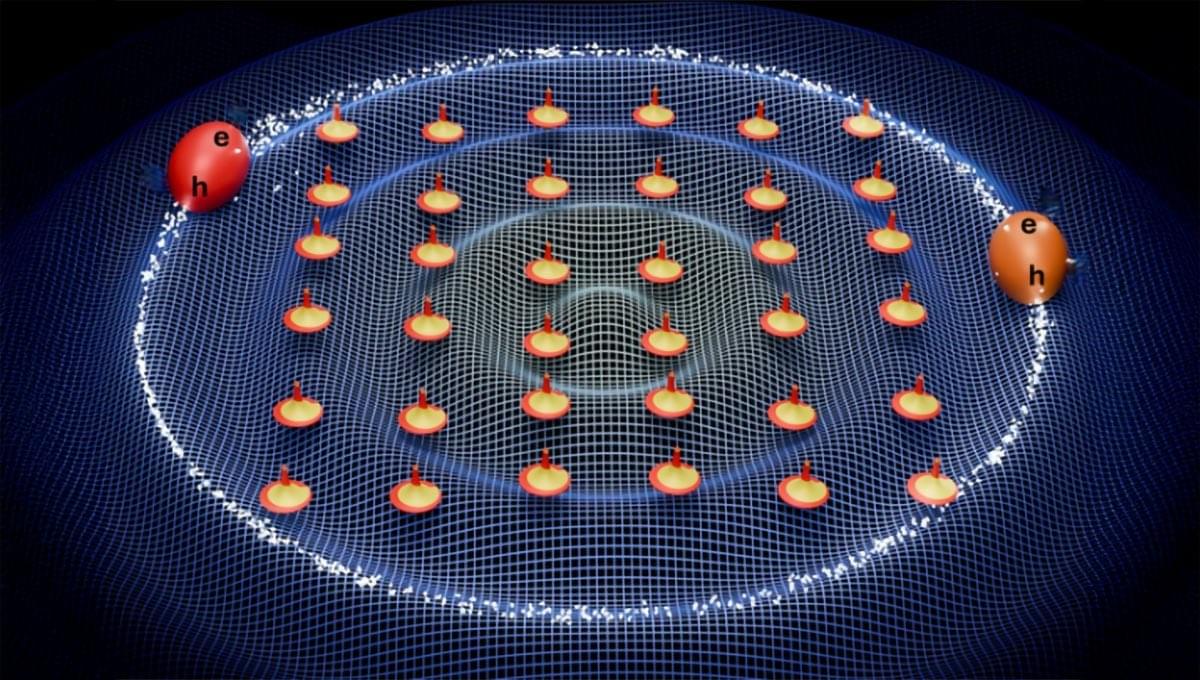
Physicists have discovered that electronic excitations in 2D magnets can interact through spin waves – ripples in a material’s magnetic structure.
This breakthrough allows excitons (electron-hole pairs) to influence one another indirectly, like objects disturbing water. The interaction, demonstrated in a magnetic semiconductor called CrSBr, can be toggled on and off with magnetic fields, opening doors to revolutionary technologies like optical modulators, logic gates, and especially quantum transducers for future quantum computers and communication systems.
A study from Technion unveils a newly discovered form of quantum entanglement in the total angular momentum of photons confined in nanoscale structures. This discovery could play a key role in the future miniaturization of quantum communication and computing components.
Quantum physics sometimes leads to very unconventional predictions. This is what happened when Albert Einstein and his colleagues, Boris Podolsky and Nathan Rosen (who later founded the Faculty of Physics at Technion), found a scenario in which knowing the state of one particle immediately affects the state of the other particle, no matter how great the distance between them. Their historic 1935 paper was nicknamed EPR after its three authors (Einstein–Podolsky–Rosen).
The idea that knowing the state of one particle will affect another particle located at a huge distance from it, without physical interaction and information transfer, seemed absurd to Einstein, who called it “spooky action at a distance.”
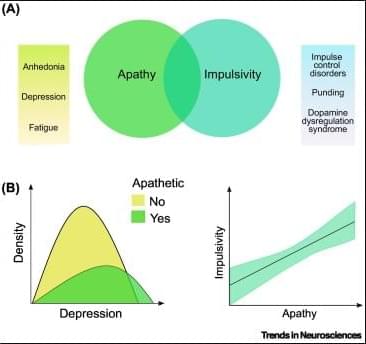
Neurobehavioural disturbances such as loss of motivation have profound effects on the lives of many people living with Parkinson’s disease (PD), as well as other brain disorders. The field of decision-making neuroscience, underpinned by a plethora of work across species, provides an important framework within which to investigate apathy in clinical populations. Here we review how changes in a number of different processes underlying value-based decision making may lead to the common phenotype of apathy in PD. The application of computational models to probe both behaviour and neurophysiology show promise in elucidating these cognitive processes crucial for motivated behaviour. However, observations from the clinical management of PD demand an expanded view of this relationship, which we aim to delineate. Ultimately, effective treatment of apathy may depend on identifying the pattern in which decision making and related mechanisms have been disrupted in individuals living with PD.
Physicists have replicated the famous Schrödinger’s cat experiment at hotter temperatures than ever before. The breakthrough is a small but significant step toward quantum computers that can work at normal temperatures.
TAMPA, Fla. — British in-orbit manufacturing venture Space Forge has appointed technology veteran Atul Kumar to set up a semiconductor business in the United States, aiming to bolster domestic chip production as efforts to reduce reliance on foreign suppliers gather pace.
Kumar, a materials scientist with more than two decades of experience in the sector, is tasked with developing manufacturing operations under Space Forge’s U.S. subsidiary to support the terrestrial and in-space growth of semiconductor substrates, the company announced April 10.
The move comes as the U.S. ramps up efforts to reduce its dependence on chips from abroad, driven by supply chain disruptions, national security concerns and mounting trade tensions — particularly with China.