Toggle light / dark theme

Cosmic Conundrum Cracked: Scientists Solve the Riddle of the Milky Way’s Satellite Galaxies

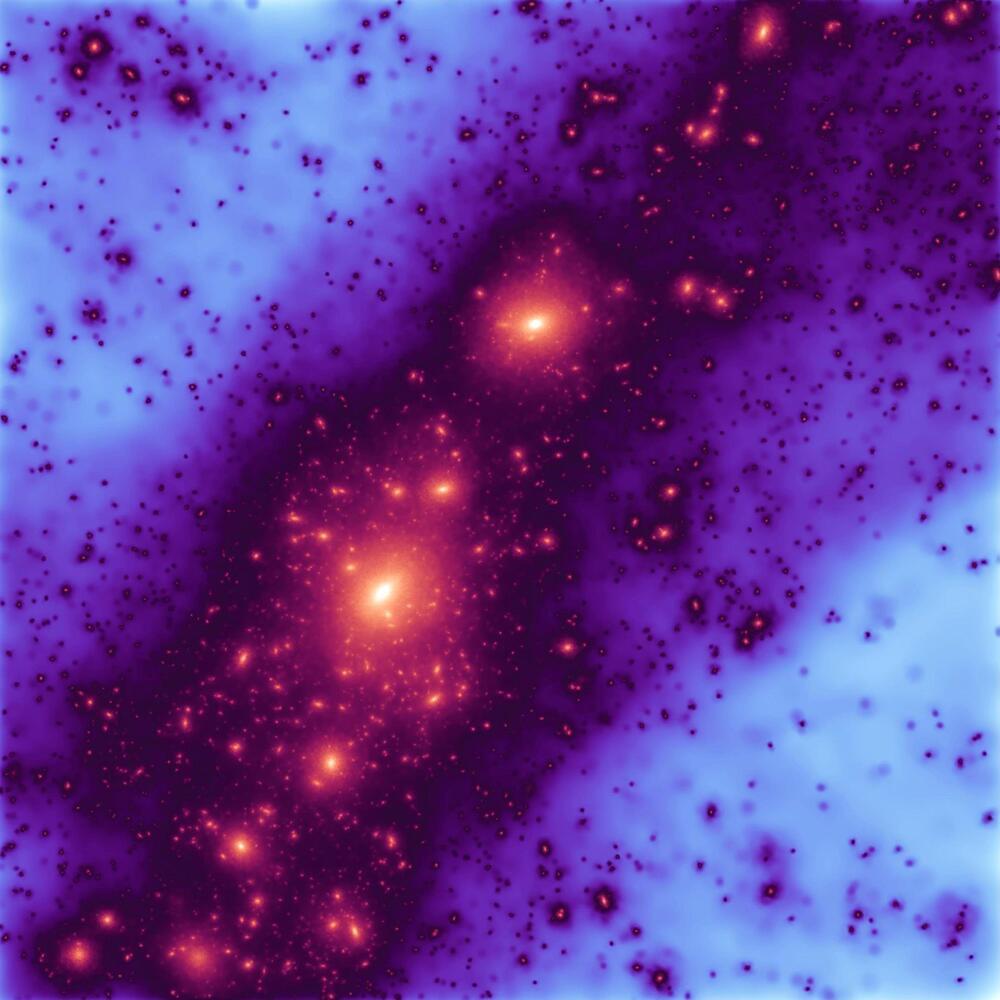
Astronomers say they have solved an outstanding problem that challenged our understanding of how the Universe evolved – the spatial distribution of faint satellite galaxies orbiting the Milky Way.

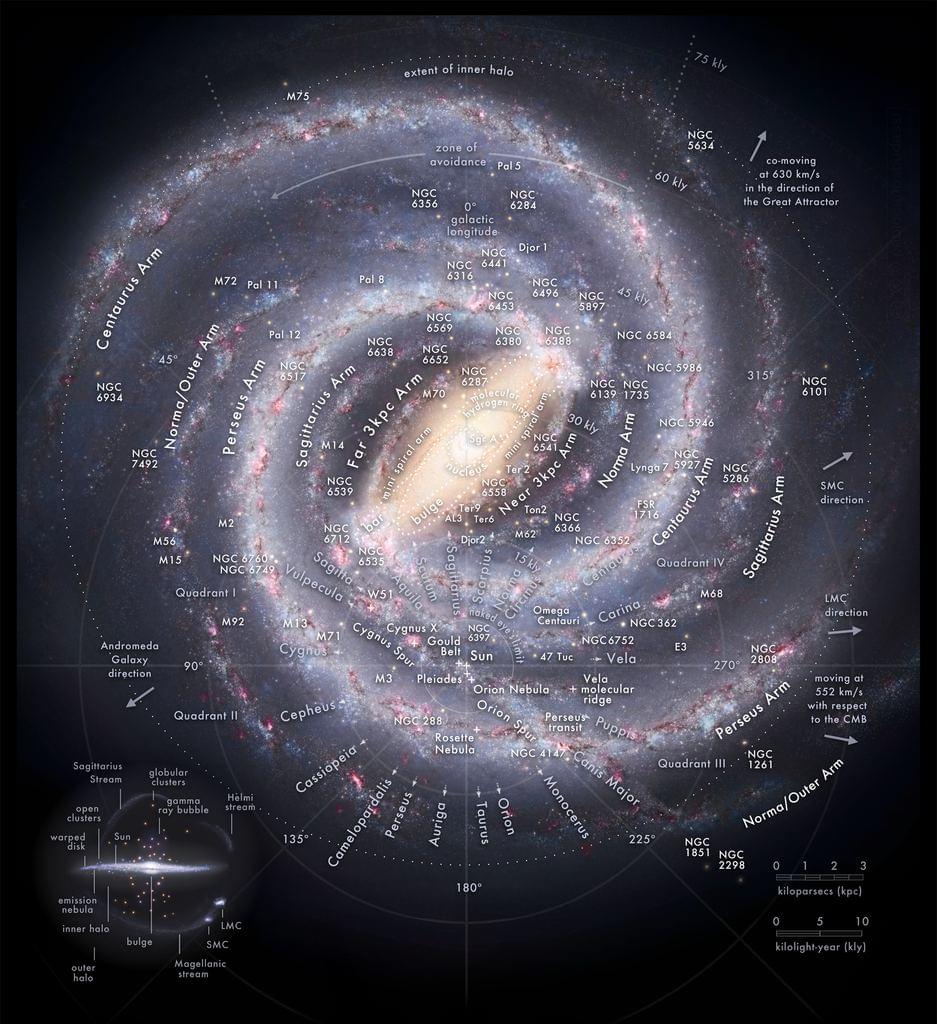
The Milky Way is the galaxy that contains our Solar System, and is named for its appearance from Earth. It is a barred spiral galaxy that contains an estimated 100–400 billion stars and has a diameter between 150,000 and 200,000 light-years.

New Superluminal Theory Transforms Our Concept of Time with “Extension” of Special Relativity

Theoretical physicists from Warsaw and Oxford universities argue that a superluminal world possessing three temporal dimensions and one dimension in space could potentially change our concept of time, according to a new paper.

The researchers involved say they have developed “an extension of special relativity” that incorporates three individual time dimensions with a single space dimension, which helps explain how observations made by “superluminal” observers—inertial observers moving faster than the speed of light—might appear.

Within such a framework, the researchers argue that spontaneous events that can occur in the absence of a deterministic cause and other strange phenomena would be experienced by observers moving faster than the speed of light within a vacuum, concepts that potentially transform our concept of time as we know it.

Is the Milky Way… Normal?

Studying the large-scale structure of our galaxy isn’t easy. We don’t have a clear view of the Milky Way’s shape and features like we do of other galaxies, largely because we live within it. But we do have some advantages. From within, we’re able to carry out close-up surveys of the Milky Way’s stellar population and its chemical compositions. That gives researchers the tools they need to compare our own galaxy to the many millions of others in the Universe.

This week, an international team of researchers from the USA, UK, and Chile released a paper that does just that. They dug through a catalogue of ten thousand galaxies produced by the Sloan Digital Sky Survey, searching for galaxies with similar attributes to our own.

They discovered that the Milky Way has twins – many of them – but just as many that are only superficially similar, with fundamental differences buried in the data. What they discovered has implications for the future evolution of our own galaxy.

NASA Discovers Pair of Super-Earths With 1,000-Mile-Deep Oceans

In the 1995 post-apocalyptic action film “Waterworld” Earth’s polar ice caps have completely melted, and the sea level has risen to over 5 miles, covering nearly all of the land. Astronomers have uncovered a pair of planets that are true “water worlds,” unlike any planet found in our solar system.

Slightly larger than Earth, they don’t have the density of rock. And yet, they are denser than the gas-giant outer planets orbiting our Sun. So, what are they made of? The best answer is that these exoplanets have global oceans at least 500 times deeper than the average depth of Earth’s oceans, which simply are a wet veneer on a rocky ball.

The soggy worlds orbit the red dwarf star Kepler-138, located 218 light-years away in the constellation Lyra. The planets were found in 2014 with NASA.

OpenAI releases Point-E, an AI that generates 3D models

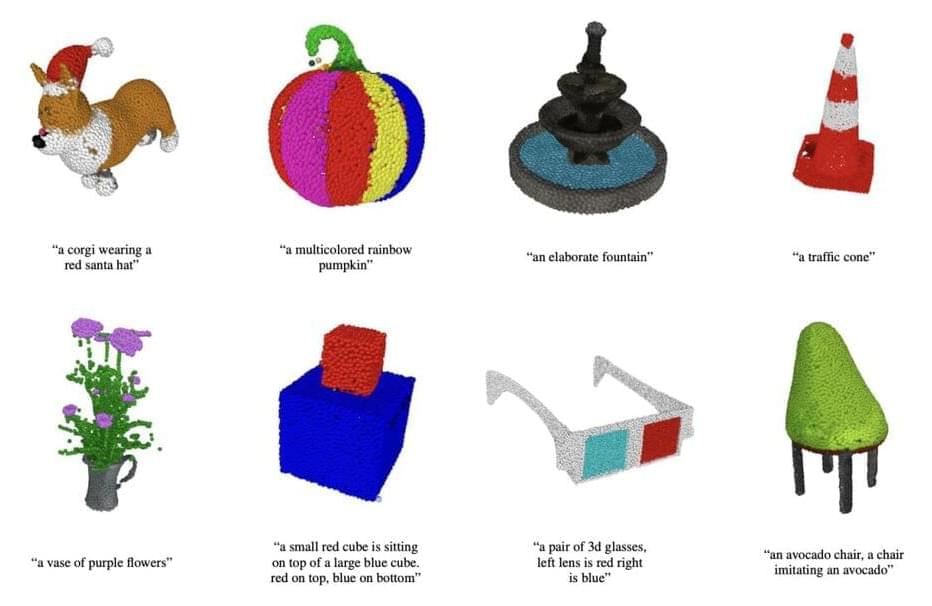
The next breakthrough to take the AI world by storm might be 3D model generators. This week, OpenAI open sourced Point-E, a machine learning system that creates a 3D object given a text prompt. According to a paper published alongside the code base, Point-E can produce 3D models in one to two minutes on a single Nvidia V100 GPU.

Point-E doesn’t create 3D objects in the traditional sense. Rather, it generates point clouds, or discrete sets of data points in space that represent a 3D shape — hence the cheeky abbreviation. (The “E” in Point-E is short for “efficiency,” because it’s ostensibly faster than previous 3D object generation approaches.) Point clouds are easier to synthesize from a computational standpoint, but they don’t capture an object’s fine-grained shape or texture — a key limitation of Point-E currently.

To get around this limitation, the Point-E team trained an additional AI system to convert Point-E’s point clouds to meshes. (Meshes — the collections of vertices, edges and faces that define an object — are commonly used in 3D modeling and design.) But they note in the paper that the model can sometimes miss certain parts of objects, resulting in blocky or distorted shapes.
/* */